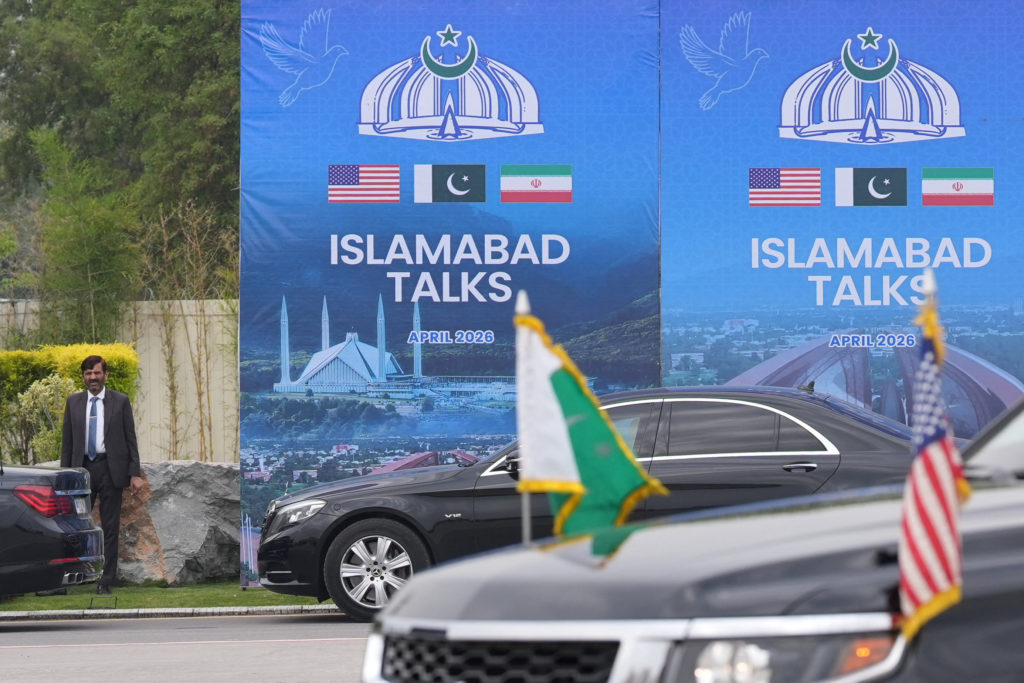
Forty days into the U.S.-Israeli war on Iran, the closest thing to a diplomatic breakthrough arrived over the weekend in the form of a Pakistani-brokered proposal for a 45-day ceasefire, paired with a commitment to reopen the Strait of Hormuz and begin broader peace negotiations. Pakistan’s army chief spent the night in direct contact with U.S. Vice President JD Vance, special envoy Steve Witkoff, and Iranian Foreign Minister Abbas Araghchi, working to close the gap between the two sides.
Tehran rejected the proposal outright. Through state media and its foreign ministry, Iran made clear it will not accept a temporary ceasefire that it believes would simply give the U.S. and Israel time to regroup and resume the war at a more favorable moment. Instead, Iran put forward a ten-point counter-proposal demanding a permanent end to hostilities, full sanctions relief, compensation for war damages, guarantees against future attacks, a protocol for Hormuz transit fees, and a broader regional settlement that includes Lebanon. The Strait, Iran’s negotiators signaled, will reopen only when the damage caused by the war is compensated through a new legal regime.
The White House, for its part, confirmed the 45-day proposal was one of several ideas under discussion but that Trump had not signed off on it and that Operation Epic Fury was continuing.
Trump’s Deadline and the Threat of Mass Infrastructure Strikes
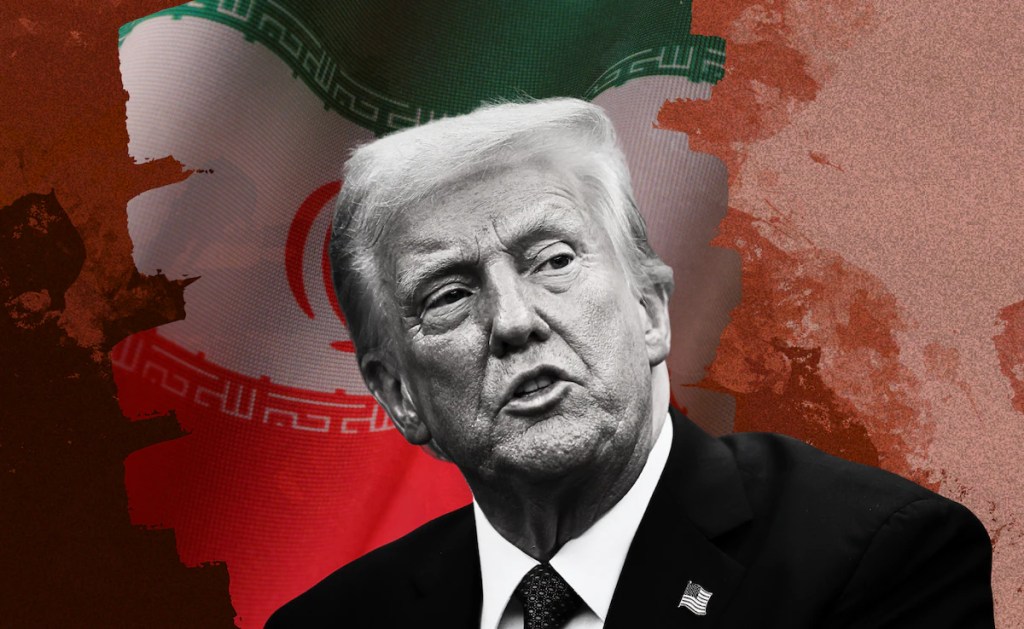
Trump set a hard deadline of 8 p.m. Tuesday Eastern time for Iran to agree to a deal and begin reopening the Strait, failing which he threatened strikes on every bridge and every power plant in Iran, describing the latter as burning and exploding, never to be used again. At a White House press conference on Monday, he added that the entire country could be taken out in one night, and that night might be tomorrow night. When asked whether targeting civilian infrastructure constituted a war crime, he dismissed the concern, calling Iran’s leaders animals and arguing that the real war crime would be allowing Iran to have nuclear weapons.
Trump simultaneously described Iran’s response to the ceasefire framework as a significant step, even if not good enough. The contradictions were, by now, familiar: maximum rhetorical pressure paired with signals that a deal remains possible. He said he was highly unlikely to postpone the deadline, while also noting that discussions were ongoing and that Iran appeared to be negotiating in good faith in some respects. Iran’s presidential spokesman called the ultimatum language a sign of sheer desperation.
As of Monday, 373 U.S. service members have been wounded in the operation. An Iranian drone strike on Ali Al Salem Air Base in Kuwait overnight injured 15 Americans. Iran’s central military command warned that any further attacks on civilian targets would trigger much more devastating and widespread retaliation.
The Diplomatic Triangle
The three-way mediation effort involving Pakistan, Egypt, and Turkey represents the most serious diplomatic track since the war began. Each party brings different leverage: Pakistan has a direct line to both Washington and Tehran and has been the most active interlocutor throughout. Egypt has longstanding ties with the Gulf states bearing the brunt of Iranian retaliation. Turkey sits at the intersection of NATO membership and genuine relationships with Iran. The fact that all three are now working in concert, and that Pakistan’s army chief is conducting overnight calls at the highest level, suggests the ceasefire push is being treated with real urgency.
The gap between the two sides is narrower than the public rhetoric suggests, but it is still substantive. The U.S. wants a temporary pause that creates space for negotiations, with Hormuz reopened quickly to relieve energy market pressure before the November midterms. Iran wants a permanent commitment before it gives up its most effective lever. The 45-day framework was designed to split that difference, but Iran’s insistence on guarantees against future attack makes the temporary framing unworkable unless Washington provides something more binding than a pause.
The UAE, which has been absorbing Iranian strikes while hosting U.S. forces, publicly stated that any settlement must guarantee ongoing access through Hormuz. Gulf states are watching the deadline closely, aware that a U.S. strike on Iranian power plants could trigger a wave of Iranian retaliation against their own energy infrastructure far worse than what they have already endured.
Analysis:
The next 24 hours are the most consequential of the war so far. Three outcomes are plausible. First, Iran makes a last-minute concession on Hormuz in exchange for a U.S. commitment to permanent negotiations, the deadline passes without a mass infrastructure strike, and both sides declare a fragile win. Second, the deadline passes with no deal and Trump follows through, triggering an Iranian retaliation that escalates the conflict into its most destructive phase yet. Third, the deadline passes, Trump extends it again, and the cycle of ultimatums and deferral continues for another week.
The third outcome has been the pattern so far. But the political cost of another extension is rising. Trump’s approval rating is at a second-term low, gas prices are above $4 nationally, and even some Republicans are beginning to publicly question the trajectory. Another empty deadline would further erode whatever credibility the threats carry, and Iran’s negotiators know it.
Iran’s counter-proposal is not entirely unreasonable as an opening position. Demanding permanent security guarantees before opening a chokehold that is your only real leverage is rational statecraft, not irrationality. The problem is that what Iran is asking for, a permanent end to the war, full sanctions relief, and regional settlements covering Lebanon, is far more than Washington is prepared to offer in the next 24 hours and accept what would be viewed as a strategic defeat for the world’s top military. This is all not even to mention Israel’s position in all this and likely completely opposition to any sort of ceasefire proposal being discussed with a much more maximalist position on collapsing the current Iranian regime. That gap is what makes the coming hours genuinely dangerous.
If strikes on Iranian power plants do happen tonight, the economic fallout globally will intensify sharply. Analysts have already warned that even a ceasefire would take months to translate into lower energy prices, given the physical damage to Gulf refining and shipping infrastructure. Strikes that knock out Iranian electricity grids would extend that timeline considerably and risk a humanitarian crisis inside Iran that further complicates any eventual peace as the war closes in on another critical pivot point.
On February 28, 2026, the United States and Israel launched coordinated strikes against Iran in what the Trump administration named “Operation Epic Fury,” igniting the most significant American military engagement in more than two decades. The seemingly stated objectives (although often unclear) were to dismantle Iran’s nuclear weapons infrastructure, destroy its ballistic missile and drone programs, degrade its naval capacity, and sever its network of regional proxies. The administration initially projected the campaign would be concluded within four to six weeks.
Over one month in, the results are both significant and complicated. Iran’s air defenses have been severely degraded. Supreme Leader Ayatollah Ali Khamenei was killed and has since been succeeded by his son. Several senior Revolutionary Guard commanders and military scientists have been eliminated. Iran’s proxy network, already weakened by Israel’s earlier campaigns against Hezbollah and Hamas, has struggled to mount a coordinated response. By nearly every military measure, the U.S.-Israeli coalition has achieved air superiority and delivered devastating blows to Iranian infrastructure.
Yet Iran’s most effective weapon has not been on the battlefield. It has been the Strait of Hormuz. Within days of the opening strikes, Tehran effectively closed the narrow waterway between Iran and Oman through which roughly 20 million barrels of oil and a major share of global liquefied natural gas flowed daily before the war. That closure has become the central focus of the conflict, and everything else has rotated around it since.
The Strait and the Chokehold
The closure of the Strait of Hormuz has turned what was always understood as a theoretical vulnerability in the global energy system into a concrete, ongoing crisis. Since early March, commercial tanker traffic has collapsed and ordinary commercial shipping has effectively stopped.
The International Energy Agency has characterized the disruption as the largest supply shock in the history of the global oil market, surpassing even the 1973 Arab oil embargo. Gulf producers, unable to export and rapidly running out of storage capacity, have been forced to cut production. Kuwait, which relies on Qatari LNG for a large share of its power generation, faces the prospect of running its electricity infrastructure on liquid fuels through the summer. Iraq, which derives roughly 88 percent of its government budget from oil revenues, faces a growing fiscal crisis for every month that exports remain near zero. The Gulf Cooperation Council’s economic model, built on the assumption of reliable export access, is under severe pressure.
Brent crude, trading around $65 per barrel before hostilities began, surged above $100 and has touched levels close to $120, nearing to the all-time record set in July 2008. U.S. benchmark crude crossed $99 per barrel. At the pump, the national average gasoline price in the United States has risen sharply past $4 per gallon, with prices in Los Angeles County reaching nearly $6 by the end of March. Jet fuel and diesel prices have spiked by $200 and $160 per barrel respectively, according to TotalEnergies. Urea prices are up roughly 50 percent since the start of the war and ammonia around 20 percent, with severe downstream consequences for global fertilizer supply. Brazil, which imports roughly 85 percent of its fertilizer, is particularly exposed. Egypt, itself a fertilizer producer dependent on natural gas, is in a state of near-emergency.
The disruption extends well beyond energy. The strait is also a transit point for sulfur, helium, and a range of industrial inputs. The Houthis’ formal entry into the war on March 28 has added pressure on the Bab-el-Mandeb and Suez Canal route, pushing commercial vessels onto the longer Cape of Good Hope alternative and adding delays throughout global shipping. A concurrent conflict between Afghanistan and Pakistan has closed airspace and trade corridors across Central Asia. The Philippines, which imports 98 percent of its oil from the Middle East, declared a national energy emergency on March 24. Multiple developing economies are rationing fuel or subsidizing energy costs at enormous fiscal expense.
The global economic picture has darkened quickly. Economists have drawn comparisons to the 1973 crisis and warned of stagflation. The eurozone is now projected to grow at just 0.5 percent year-on-year in the second half of 2026 if the conflict continues. European gas storage, which entered the winter at historically low levels of around 30 percent capacity following a harsh 2025-2026 season, has been further squeezed by the suspension of Qatari LNG shipments, pushing Dutch TTF gas benchmarks to nearly double. Europe faces a second energy crisis in four years, but one that is structurally harder to manage than the post-Ukraine shock, because a physical blockade cannot be worked around through rerouting or supplier substitution in the way a sanctions-driven disruption can.
The Ground War Question
As the air campaign rolled into its second month, the prospect of a ground operation began hovering over the conflict in a way that alarmed both allies and domestic critics. Pentagon deployments of additional troops to the region fueled speculation about escalation. Former Defense Secretary James Mattis, speaking at the CERAWeek energy conference in Houston, offered a sobering assessment: Washington did not consult its Gulf Arab allies before going to war, and Trump would be unable to simply declare victory and walk away. The Iranians, Mattis said, have a vote on when this ends.
The case against a ground campaign is straightforward. Air power alone has not forced Iran to reopen the strait, and a land invasion of a country of 90 million people would be a fundamentally different undertaking from anything the U.S. has attempted in recent history. The risk of a prolonged conflict or occupation would far outweigh what the air campaign has cost. Yet without ground forces, the administration has no obvious military lever left to force Hormuz open on its own terms.
Trump’s Escalating Rhetoric and the April 6 Deadline
Throughout March, the president’s posture shifted constantly. He threatened to destroy Iran’s civilian power plants, oil wells, and desalination infrastructure, then announced a five-day pause on strikes against Iranian energy facilities, citing good faith gestures from Tehran, including the passage of several oil tankers through the strait. He then extended that pause by a further ten days, to April 6, citing negotiations he described as going very well. Iranian officials publicly disputed that any formal talks were even underway.
Trump made statements in the same period threatening to bomb Iran back to the Stone Age while simultaneously telling reporters that the U.S. could end the war in two or three weeks, with or without a deal. The gap between these positions, often expressed within hours of each other, created persistent uncertainty about American intentions and gave Iranian officials grounds to question the reliability of any agreement that might emerge.
On April 1, Trump posted on Truth Social that Iran’s president had requested a ceasefire and that the U.S. would only consider it once the Strait of Hormuz was open, free, and clear. Tehran immediately denied that any ceasefire request had been made. That same evening, Trump delivered his first primetime national address on the war.
The April 1 Address
The speech, delivered in under 20 minutes from the White House Cross Hall, was closely watched by markets, allies, and the public as a potential turning point. What it delivered was a contradictory mix of victory claims and escalation warnings that satisfied almost no one outside the president’s core political base.
Trump declared Iran “essentially really no longer a threat,” citing the destruction of its navy, air force, and key command structures. He claimed that B-2 bomber strikes had hit Iran’s nuclear sites so hard that it would take months before anyone could get near the nuclear dust, though significant questions remain about the fate of Iran’s stockpile of near-weapons-grade enriched uranium. He framed the war as a necessary reckoning 47 years in the making, invoking the 1983 Marine barracks bombing and the 2000 USS Cole attack. He also drew comparisons to World War II and Vietnam to argue that at one month, the conflict has been short by historical standards.
Yet in the same speech, Trump promised to hit Iran extremely hard over the next two to three weeks. He maintained that discussions with Tehran were ongoing, though notably absent from the address was any mention of the ceasefire he had claimed Iran requested earlier that day. He did not mention NATO by name, softening his recent threats to consider withdrawing U.S. membership, though he told countries struggling with fuel shortages to either buy oil from the United States or go to the Strait and just take it themselves, arguing the hard part was done. On gas prices, he blamed Iranian attacks on commercial shipping for the spike and insisted the U.S. did not need the strait, a claim that sits uneasily with the administration’s own acknowledgment that prices will not fall meaningfully until traffic resumes.
Bond yields rose across the board in the U.S., UK, Germany, France, Japan, and Canada, signaling a broad sell-off in global debt markets. Analysts noted that markets had priced in a binary outcome from the speech, either a clear path toward winding down or a frank escalation, and instead received something in between, which resolved nothing.
Iran’s foreign ministry responded on April 2, stating that the Iranian people were absolutely determined to continue their defense against what it called ongoing aggression and that they had no choice but to fight back fiercely. Iranian missile attacks on Israeli territory were reported within hours of Trump finishing his address.
The Hormuz Dilemma and the Limits of “Mission Accomplished”
At the core of the administration’s exit pressure is a problem with no clean answer. White House Press Secretary Karoline Leavitt stated publicly that reopening the Strait of Hormuz was not a core objective of Operation Epic Fury, framing the campaign’s goals as destroying Iran’s navy, dismantling its missile and drone programs, and preventing nuclear weapons acquisition. Secretary of State Marco Rubio acknowledged that building a coalition to police the strait was a longer-term goal.
But walking away while the blockade remains in place creates its own serious problems. Oil prices would not fall meaningfully until traffic resumed, undermining the administration’s central promise that pump prices would drop once the U.S. withdrew. CNN reported that senior administration officials privately acknowledged they could not both achieve military objectives quickly and vow to reopen the strait within the same timeline. Defense Secretary Pete Hegseth framed Hormuz as not just a U.S. problem and called on other nations to do their share, signaling a potential handoff of maritime security responsibility to an international coalition. Trump’s own speech reinforced that framing, essentially telling the rest of the world it was their problem now.
The coalition Trump has been calling for has been slow to form. Most NATO allies refused to join the war, and several actively distanced themselves from it. Spain closed its airspace to U.S. aircraft conducting operations against Iran, drawing a sharp response from Rubio. Germany indicated it would not participate in the fighting but could help secure the waterway after a ceasefire. France’s junior army minister stated publicly that NATO operations in the Strait of Hormuz would constitute a breach of international law. The UAE has expressed support for international efforts to restore maritime security within the bounds of international law. UK Prime Minister Keir Starmer announced on April 1 that Britain would host a diplomatic conference on restoring Hormuz access and had secured commitments from 35 nations to work toward a plan.
Russia has stated that any mechanism for managing the strait must include Iran’s direct consent, effectively blocking an outside-imposed settlement. China and Pakistan, with Islamabad serving as a key backchannel between Washington and Tehran, have jointly proposed a five-point plan for restoring regional stability, including provisions on maritime security. That track remains the most credible path to a negotiated outcome, though what a deal acceptable to both sides actually looks like remains unclear.
Public Opinion and the Political Clock
The domestic political picture has become a serious constraint on the administration’s room to maneuver. Polling across Pew Research, Reuters/Ipsos, the Associated Press, Quinnipiac, and Fox News all show roughly 60 percent of Americans disapproving of Trump’s handling of the conflict. Trump’s overall approval rating has fallen to around 36 percent, the lowest of his second term. A Reuters/Ipsos poll found that roughly two-thirds of Americans want the war to end quickly even if U.S. objectives are not fully achieved.
The partisan split is sharp but not monolithic. Around 77 percent of Republicans support the war, with 90 percent of self-identified MAGA voters backing it and only 52 percent of non-MAGA Republicans doing so. Democratic opposition runs at 90 percent. Independents have moved significantly against the conflict over the last month. Rising gas prices are the most direct connection between the battlefield and everyday life, and Republican strategists are privately worried about their impact on November’s midterm elections, where the party is defending a thin Congressional majority. Senate Republicans have so far voted along party lines to block War Powers resolutions that would limit Trump’s ability to continue the campaign, with only Rand Paul crossing the aisle. But several centrist Republicans have begun expressing concern about the cost trajectory, particularly after Hegseth requested $200 billion in additional war funding.
Allied Fractures and the NATO Question
The diplomatic fallout has accelerated fractures within the Western alliance that were already visible before the war began. Most NATO members declined to join the military campaign or allow the use of their bases and airspace for operations against Iran. Several European governments expressed opposition outright. That refusal has prompted Rubio to state publicly that the U.S. will need to reexamine its relationship with NATO once the conflict is over, and Trump himself signaled he was weighing reconsidering U.S. membership in the alliance.
For Europe, the costs of a war it did not endorse, did not join, and cannot easily escape have landed hard. The energy shock has hit European economies at a moment of fragile growth and depleted gas reserves. European policymakers are again confronting the same structural weakness and supply-side shock exposed by Russia’s invasion of Ukraine in 2022
Iran’s Strategy
Iran’s approach throughout has been consistent with its historical playbook: impose costs broadly rather than fight symmetrically. Unable to match U.S.-Israeli air power, Tehran has spread the economic pain of the war through the Hormuz closure, strikes on Gulf Arab energy infrastructure, and missile and drone campaigns against Israel and U.S. regional bases. Iranian strikes have targeted facilities in Bahrain, Kuwait, Israel, and the UAE. The logic is straightforward: make the war expensive enough for enough people that pressure for de-escalation eventually forces Washington to negotiate.
Iran has also selectively allowed ships from friendly nations, including China, India, and Russia, to pass through the strait while blocking vessels with adversarial ties. That selective enforcement shows Tehran retains real control over the waterway even as its broader military has been degraded. Iran’s parliament has moved to formalize tolls on strait transit, a step that, if implemented, would codify Iranian leverage over the waterway as something more permanent than a wartime measure.
Iran’s leadership succession following Khamenei’s death remains a key unknown. How consolidated the new leadership is, what its negotiating limits are, and whether it has both the authority and the appetite to make the concessions required for a deal are questions Washington appears to lack clear answers to. Iranian officials have rejected ceasefire claims and denied formal talks are underway, while simultaneously keeping backchannels through Pakistan open.
Analysis: The Shape of an Unfinished War
Trump’s April 1 address was the most revealing moment of the conflict so far, not for what it announced, but for what it could not resolve. The president declared victory and promised more bombing in the same breath. He claimed the hard part was done while deploying a third aircraft carrier and additional troops to the region. He said discussions were ongoing while making no concrete mention of the ceasefire he had claimed Iran requested hours earlier. The speech was less a strategic update than a reflection of how genuinely difficult and contradictory the administration’s position has become.
The core escalation trap remains unchanged. The U.S. launched a war with a timeline it cannot keep, against a country that found its most effective leverage not in a fight it could win but in a chokehold it can sustain. Declaring victory while Iran retains functional control of the world’s most critical oil shipping lane is a significant strategic problem for the White House, no matter how they present it. But escalating further to force the strait open by military means carries risks that senior defense officials appear privately reluctant to endorse, and the market reaction to the speech confirms that the world does not believe the hard part is, in fact, done.
The most plausible near-term outcome remains a negotiated de-escalation brokered through the Pakistan channel, with Chinese involvement, that allows both sides to claim partial wins. Iran opens the strait to commercial traffic in exchange for a halt to strikes and some form of security guarantees against a future attack. The U.S. declares its core military objectives achieved, pointing to the degradation of Iran’s nuclear program and proxy network. A maritime coalition takes nominal responsibility for monitoring strait access going forward. None of that resolves the underlying tensions, but it creates an exit for parties.
The energy dimension is the most urgent and the most underappreciated in the public debate. Every week the strait remains effectively closed is another week of damage to global supply chains, developing-world sovereign budgets, and the Gulf’s credibility as a reliable energy exporter. Infrastructure destroyed during the conflict, including Iranian oil facilities, Gulf refineries struck in retaliatory attacks, and tanker terminals damaged across the region, will not come back online the day a ceasefire is signed. Markets will rally when hostilities formally end. But oil analysts expect a slow and painful return to pre-war prices. Structural supply damage, elevated shipping insurance premiums, lingering risk perception, and reduced Gulf credibility as a supplier will keep energy costs higher for months, possibly years.
For the United States, the political clock is the sharpest immediate constraint. A war sold as a weeks-long campaign to secure American interests is entering its fifth week with gas prices at multi-year highs, majority public opposition firm, NATO relations visibly strained, and no defined end state. Trump’s attempt in his address to downplay the Hormuz closure by telling Americans the U.S. does not need the strait may be factually defensible in narrow energy-security terms, but it does nothing for the voters paying $5 or $6 per gallon, or for the allies and trading partners whose economies are being squeezed. The gap between what the speech claimed and what markets immediately priced in was itself a measure of American credibility lost.
What the war has already demonstrated, regardless of how it ends, is that the assumptions underpinning Middle Eastern stability were far more fragile than they appeared. The proxy deterrence system, the expectation of guaranteed Gulf energy flows, the belief that a short decisive air campaign could bend a large regional power to American terms, and the reliability of NATO as a backstop for American military decisions have all been tested and proved feeble. The world is now paying for those assumptions in higher fuel prices, fractured alliances, a destabilized Gulf, and a global economy absorbing a supply shock it was not prepared for.
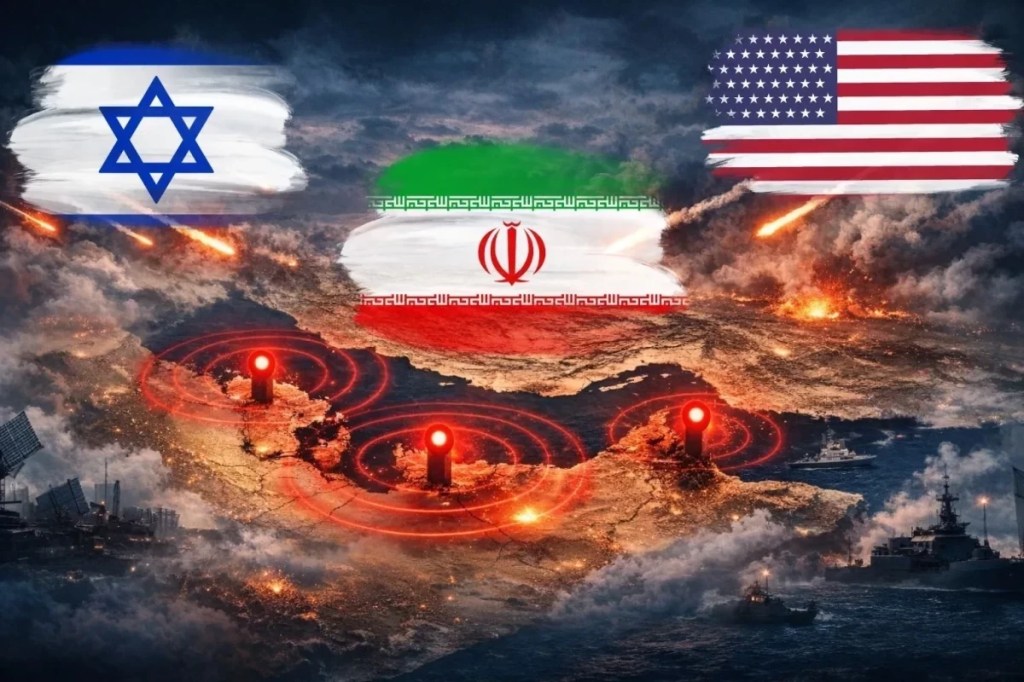
The war between the United States, Israel, and Iran has entered a more volatile stage, with the military balance shifting in some areas even as the wider political and economic fallout continues to deepen. What began on February 28 as a large-scale U.S.-Israeli assault on Iranian military infrastructure and senior leadership has now developed into a multi-front regional conflict stretching from Iran and Israel to the Gulf, Iraq, and Lebanon. The war has already caused heavy casualties, disrupted maritime trade through the Strait of Hormuz, and widened tensions between Washington and several of its traditional allies.
The initial strikes were among the most consequential attacks ever carried out against the Iranian state. According to the Council on Foreign Relations’ conflict tracker, the opening phase targeted senior leadership, major military assets, and strategic facilities, killing Supreme Leader Ali Khamenei and triggering a succession process that elevated his son Mojtaba Khamenei to the top of the political system. The conflict quickly expanded beyond a bilateral exchange. Iran responded with missile and drone attacks on U.S. positions and on energy and civilian infrastructure in Gulf states, while Israel broadened its military campaign against Hezbollah in Lebanon after the group entered the war in support of Tehran.
Context and Leadup to All-Out War
The roots of the conflict lie in a longer nuclear and regional rivalry. Iran’s nuclear program dates back to the 1950s, but the most consequential modern phase began after evidence of undeclared facilities emerged in 2002. Diplomatic efforts led to the 2015 nuclear agreement, which sharply constrained Iran’s stockpile of enriched uranium and centrifuge capacity in exchange for sanctions relief. That framework never resolved wider disputes over ballistic missiles, regional militias, and Iran’s projection of power across the Middle East. The first Trump administration withdrew from the deal in 2018 and restored a maximum-pressure strategy, after which Iran gradually moved beyond the agreement’s limits. Over time, the confrontation widened through tanker incidents, militia attacks, the killing of Qassem Soleimani, and repeated rounds of Israeli and Iranian escalation. (Council on Foreign Relations)
That path accelerated after the October 2023 Hamas attack on Israel and the regional crisis that followed. Iran-backed groups in Iraq, Syria, Lebanon, and Yemen increased attacks on U.S. and Israeli targets, while Israel’s direct exchanges with Iran in 2024 moved the two states from shadow war to overt confrontation. By 2025, Israel had significantly weakened parts of Iran’s regional network, including Hamas and Hezbollah leadership, while the Trump administration returned to office combining a renewed pressure campaign with intermittent attempts at nuclear diplomacy. The turning point came in June 2025, when the International Atomic Energy Agency found Iran in violation of its non-proliferation obligations, Israel launched direct strikes on Iranian nuclear and military sites, and the United States later joined by attacking key locations at Fordow, Isfahan, and Natanz. That earlier round ended in a fragile ceasefire, but it did not settle the core dispute.
The present war is not an isolated eruption but rather the culmination of years of failed deterrence, broken diplomacy, and repeated military signaling. Since February 28, the Trump administration has issued shifting and at times contradictory explanations for what it seeks to achieve. At various points, the White House has described the campaign as an effort to cripple Iran’s military capacity, destroy the infrastructure supporting missile and drone warfare, suppress maritime threats in the Gulf, and prevent any future nuclear breakout. Trump has also suggested the conflict could end soon, even as administration officials and Israeli planners indicate operations may continue for weeks. The president has delayed a planned trip to China in order to focus on the war, highlighting how central the conflict has become to his presidency.
On the battlefield, the U.S.-Israeli coalition appears to have made significant progress against one of Iran’s missile and drone arsenal. Reporting drawn from battlefield assessments indicates that a large share of Iranian launchers have been destroyed or rendered unusable, and that Iranian attack volumes have declined significantly since the opening days of the war. The logic behind their campaign is straightforward. Iranian strategy has long relied on imposing pain rather than winning conventional dominance. By striking U.S. facilities, Gulf energy infrastructure, shipping lanes, and Israeli population centers, Tehran appears to be trying to generate enough economic and political pressure to force Washington and Jerusalem to stop short of their goals. Current assessments suggest that effort has been degraded but not eliminated. Iran is still launching attacks, and even a much smaller number of successful strikes can continue to produce outsized political and global market effects. (New York Post)
Recent reporting also points to the war widening within Iran itself. Combined U.S. and Israeli strikes are now reaching deep into Iranian territory, including eastern sites associated with drone operations and the broader defense industrial base. Targets in and around Tehran have included intelligence and internal security infrastructure, while air defense systems and air bases across the country have also come under sustained attack. Analysts assessing recent strike patterns argue that these operations indicate growing coalition freedom of action inside Iranian airspace and an attempt not only to blunt immediate attacks but also to weaken Iran’s capacity to regenerate them over time. At the same time, information from inside Iran has become harder to verify as the authorities tighten internet restrictions, restrict VPN access, and reportedly target Starlink users while expanding checkpoints and internal surveillance. (New York Post)
The succession inside Iran has added another layer of uncertainty. Mojtaba Khamenei’s rise appears to have been backed by senior figures in the Islamic Revolutionary Guard Corps, suggesting continuity in the regime’s hardline orientation rather than a move toward pragmatic stabilization. Reuters reported on March 17 that Iran’s new supreme leader had rejected proposals aimed at reducing tensions with the United States, demanding instead that Iran’s adversaries first be weakened decisively (Reuters). Separate battlefield and analytical reporting indicates that his political base is closely tied to long-serving IRGC commanders who have historically favored securitization, internal repression, and confrontation with the West.
There is lots of current ambiguity coming out of Iran’s current diplomatic messaging. On the one hand, Iranian officials have signaled they are willing to discuss safe access to the Strait of Hormuz with countries that want maritime transit restored. On the other hand, Tehran has made clear that it does not consider itself close to a ceasefire and is prepared to continue the war. At the same time, Iranian officials have publicly rejected claims by Trump that meaningful negotiations are imminent. Taken together, those positions suggest that Iran is open to transactional arrangements around shipping and third-country access while refusing to frame those discussions as a strategic retreat against the U.S. and Israel. (AP News)
Expanding War, Economic Shock, and Strategic Strain
The Strait of Hormuz has become the conflict’s most consequential global pressure point. Roughly one-fifth of the world’s oil supply normally passes through the waterway, and although the strait is not fully sealed in a legal or physical sense, commercial traffic has sharply contracted under the weight of attacks, mining threats, insurance costs, and continued uncertainty. Reuters reported that Middle Eastern oil exports had fallen by at least 60%, while the UK maritime authorities have recorded more than 20 incidents in and around the strait and nearby waters since the war began (Reuters). Even where no attacks occur for several days, the risk environment remains severe enough to suppress normal shipping patterns. The International Energy Agency has already responded by releasing hundreds of millions of barrels from strategic reserves to soften the shock.
The pattern of maritime disruption has also become more selective. Recent reporting suggests Iran has permitted some tankers linked to countries such as China, India, and Pakistan to transit more safely while continuing to threaten or deter shipping associated with the United States and its partners. That approach fits Tehran’s broader attempt to weaponize access rather than simply close the waterway indiscriminately. It also allows Iran to maximize political leverage by driving wedges between energy importers, Gulf producers, and the America-led coalition. Even if the U.S. Navy ultimately reopens the route operationally, the commercial recovery may lag because markets, insurers, and shipping firms will respond to perceived risk rather than purely military assurances. (Reuters)
The wider regional picture remains volatile. In the Gulf, Iran continues to fire missiles and drones toward energy sites, airports, and other infrastructure. Recent attacks have struck or damaged facilities near Dubai and Fujairah and caused casualties in Abu Dhabi, while Gulf air defense systems in Bahrain, Kuwait, Qatar, Saudi Arabia, and the United Arab Emirates have intercepted many incoming projectiles. In Iraq, militia attacks have continued against sites linked to the United States, including areas near Baghdad International Airport and other infrastructure associated with U.S. interests. Israeli and coalition strikes have in turn hit Iraqi militia targets. These exchanges underline the fact that the war is no longer confined to three states but is now radiating through the full geography of Iran’s regional network. (Reuters)
Lebanon has emerged as another major theater in recent days. Hezbollah resumed attacks across the Israel-Lebanon front in support of Iran, prompting a significant Israeli escalation. Israeli operations now include continued airstrikes and what officials describe as limited and targeted ground action in southern Lebanon aimed at Hezbollah infrastructure and forward positions. Western governments have called for de-escalation as the humanitarian toll rises. Reports indicate that hundreds of thousands have been evacuated from southern Lebanon, while other reporting places the death toll there nearing 1000 and the displacement burden at over a million. What began as a support front has increasingly taken on the characteristics of a separate war layered on top of the Iran conflict.
Humanitarian costs are mounting across the region. Fatalities now number well into the thousands, with Iran suffering the heaviest losses but Lebanon, Israel, Iraq, and Gulf states also affected. U.S. military casualties have risen beyond the earliest reported totals, with CNN reporting approximately 200 U.S. troops injured across seven countries and 13 service members killed in action (AP News). Civilian harm has become a major point of contention, including scrutiny surrounding the strike on an Iranian school that reportedly killed around 150 schoolchildren. Civilian infrastructure, energy systems, airports, and urban neighborhoods have all been drawn into the conflict’s widening footprint.
For Washington, the military campaign is now colliding with harder political questions. Trump has argued that the United States can break Iran’s pressure on Hormuz with or without allies, yet his administration has openly lobbied NATO states and major Asian economies to contribute naval support to the mission. The response has been hesitant at best. Japan and Australia have indicated they are not planning deployments, while several European governments have made clear they do not want to be drawn into a wider war that began without their backing or consultation. France has gone further, explicitly ruling out participation in military operations to reopen the strait during active hostilities. Britain has supported efforts to restore navigation but stopped short of committing to U.S.-led combat operations. The result is that Washington faces the conflict’s biggest energy chokepoint with limited visible allied participation. (Reuters)
The war’s economic impact is increasingly visible. Oil and gas prices have remained elevated, and the rise in U.S. gasoline prices has become a domestic political vulnerability for a president who campaigned heavily on affordability. The current average U.S. gasoline price has risen sharply over the course of the conflict, and analysts say the political danger is less the existence of war itself than the way prolonged disruption could affect daily living costs. A short aerial campaign can be defended politically more easily than a drawn-out conflict that keeps energy expensive, distracts from domestic priorities, and raises the possibility of direct American entanglement with boots on the ground.
This is the central strategic dilemma now facing Trump. If the United States limits itself to air and naval operations and declares success once Iranian launch capacity is sufficiently reduced, Tehran may still retain enough capability to harass shipping, unsettle markets, and claim it outlasted its opponents. If Washington escalates further by using more naval assets or even ground forces to secure chokepoints, terminals, or sensitive infrastructure, it risks entering the kind of long regional military commitment that much of the American public has grown weary of after two decades of Middle East wars. The White House insists the operation is moving in the right direction while military reporting supports the view that Iranian missile and drone capabilities are being steadily degraded. But that does not automatically answer the harder question of whether battlefield success will translate into a stable political end state.
Analysis
The emerging picture is one of tactical progress paired with strategic uncertainty. From a strictly military perspective, the U.S.-Israeli campaign is degrading Iran’s capacity to conduct the mass missile and drone attacks that underpin its coercive doctrine. Launch rates have declined, key infrastructure has been struck, and coalition air operations are extending deeper into Iranian territory with increasing freedom of action. Maritime pressure also suggests that Tehran is under sustained strain, even if its capabilities have not been fully neutralized. On these narrow operational terms, it is premature to characterize the campaign as a failure.
However, the war cannot be evaluated solely through battlefield metrics. Iran does not require conventional parity to impose meaningful costs. Its strategy is asymmetric and political in nature. Even a reduced but persistent capacity to disrupt shipping, target energy infrastructure, and unsettle global markets may be sufficient to sustain leverage. If oil prices remain elevated and maritime risk continues to deter normal trade flows, Tehran can still shape outcomes indirectly by increasing the perceived cost of prolonging the conflict. In that sense, limited but sustained disruption may allow Iran to retain strategic relevance despite clear military setbacks. This dynamic is reinforced by the internal political shift following the rise of Mojtaba Khamenei. The consolidation of power among entrenched IRGC hardliners points toward a more securitized and rigid regime that is less inclined toward rapid de-escalation and more likely to interpret the conflict in existential terms.
A second layer of analysis is geopolitical rather than military. The United States has demonstrated that it can project force decisively, but it has struggled to translate that dominance into broad diplomatic alignment. While many allies share Washington’s concerns regarding Iran’s regional conduct and nuclear ambitions, far fewer are willing to endorse the methods employed in this campaign or participate in securing the Strait of Hormuz. This divergence matters. It suggests that even if the United States and Israel prevail militarily, they may face difficulty shaping the regional order that follows. The conflict therefore becomes a test not only of coercive capability, but of whether overwhelming force can yield an outcome that is economically sustainable, diplomatically supported, and politically durable. At present, none of those conditions appears guaranteed.
An additional layer of risk lies in second-order strategic consequences, particularly for U.S. relationships in the Gulf. While Gulf Cooperation Council states broadly support the weakening of Iran, they are also bearing the brunt of retaliatory strikes against energy infrastructure, logistics hubs, and civilian areas. This creates an imbalance in which the benefits of Iranian degradation are paired with immediate and tangible costs for regional partners. Over time, this could prompt Gulf states to reassess the meaning of U.S. security guarantees if alignment with Washington and Israel consistently translates into exposure rather than insulation. The economic implications extend further. Sustained damage to Gulf infrastructure or prolonged disruption to energy flows could begin to affect global investment patterns, including capital flows from Gulf sovereign wealth funds into key U.S. sectors such as advanced technology and artificial intelligence. While such a shift remains contingent, it represents a non-trivial vulnerability if the conflict escalates or endures.
The most significant strategic inflection point concerns the trajectory of U.S. war aims. If the objective remains limited to degrading Iran’s military capabilities, the current air and naval campaign may prove sufficient over the next few weeks. If, however, the implicit or explicit goal shifts toward absolute regime change, the logic of the conflict changes fundamentally. Airpower alone is unlikely to achieve that outcome, raising the possibility of ground operations. Such a scenario would carry far greater risks. Iran’s geography, population size, and entrenched security apparatus make it a significantly more complex operational environment than previous U.S. interventions in the Middle East. A ground campaign could evolve into a prolonged conflict characterized by insurgency, high casualties, and regional destabilization, including potential refugee flows that would disproportionately affect Europe.
There is also a credible argument that previous diplomatic efforts failed to constrain Iran’s nuclear trajectory or its regional proxy network, leaving military action as the remaining option. From this perspective, decisive intervention may reinforce U.S. credibility in the Gulf, limit Chinese strategic expansion by stabilizing key energy corridors, and signal that Washington remains willing to act where others hesitate. Some analysts further argue that the campaign reflects a broader recalibration of U.S. global posture, one that places less emphasis on European alignment and more on direct strategic outcomes.
Even under this slightly more favorable interpretation, structural risks persist. Iran’s leadership, now more ideologically consolidated and shaped by personal and institutional loss, may be more inclined to pursue escalation through indirect means. The IRGC could prioritize sustained economic disruption, particularly in and around the Strait of Hormuz, not because it can indefinitely close the waterway, but because even intermittent disruption can generate disproportionate global effects. The objective in such a scenario would be to erode international tolerance for the conflict and pressure external actors to push for de-escalation.
Finally, the domestic dimension in the United States introduces an additional constraint. The current trajectory sits uneasily alongside the political narrative that accompanied Trump’s return to office, which emphasized avoiding prolonged foreign entanglements. A conflict that extends in duration, drives up energy prices, and shifts public attention away from domestic economic concerns risks becoming politically costly, particularly as midterm elections approach. Rising fuel prices and broader cost-of-living pressures remain highly salient for voters, and sustained disruption in global energy markets could amplify those concerns.
Taken together, the central issue is no longer whether the campaign is achieving tactical military success. It is whether that success can be translated into a stable and acceptable political outcome before escalation dynamics, economic consequences, and shifting alliance perceptions begin to outweigh the desired military gains.
President Donald Trump used his appearance at the World Economic Forum in Davos to defend his increasingly assertive foreign policy, centering on Greenland, trade, and global security, amid mounting criticism from European and other Western leaders. His speech and accompanying meetings unfolded against a backdrop of market volatility, diplomatic unease, and warnings that the dispute risks reshaping the transatlantic relationship.
Trump’s remarks came one day after sharp declines in major U.S. stock indexes, which followed his threat to escalate tariffs against several European countries if they do not support U.S. control over Greenland. While equities later staged a partial recovery, Trump himself linked the earlier selloff to investor reactions to his Greenland comments, underscoring how closely markets are tracking the dispute.
Rather than focusing primarily on economic themes previewed by his advisers, Trump delivered a wide-ranging address lasting more than an hour that mixed foreign policy demands, trade threats, and criticism of allied governments. He reiterated that Greenland is central to U.S. and global security interests, particularly in the context of missile defense and Arctic surveillance, while insisting he would not resort to military force to secure control of the territory.
For the first time, Trump explicitly ruled out armed intervention, stating that negotiations should begin immediately and that force would not be used. At the same time, he warned that refusal by Denmark and its European partners would carry consequences, framing the issue as a strategic necessity rather than a discretionary geopolitical ambition.
European Responses and Rising Friction
European officials listening closely to the speech said that, despite the pledge to avoid force, Trump’s broader message offered little reassurance. Diplomats in Brussels and Davos described confusion over his ultimate objectives, noting that the tone suggested his determination to acquire Greenland remained unchanged.
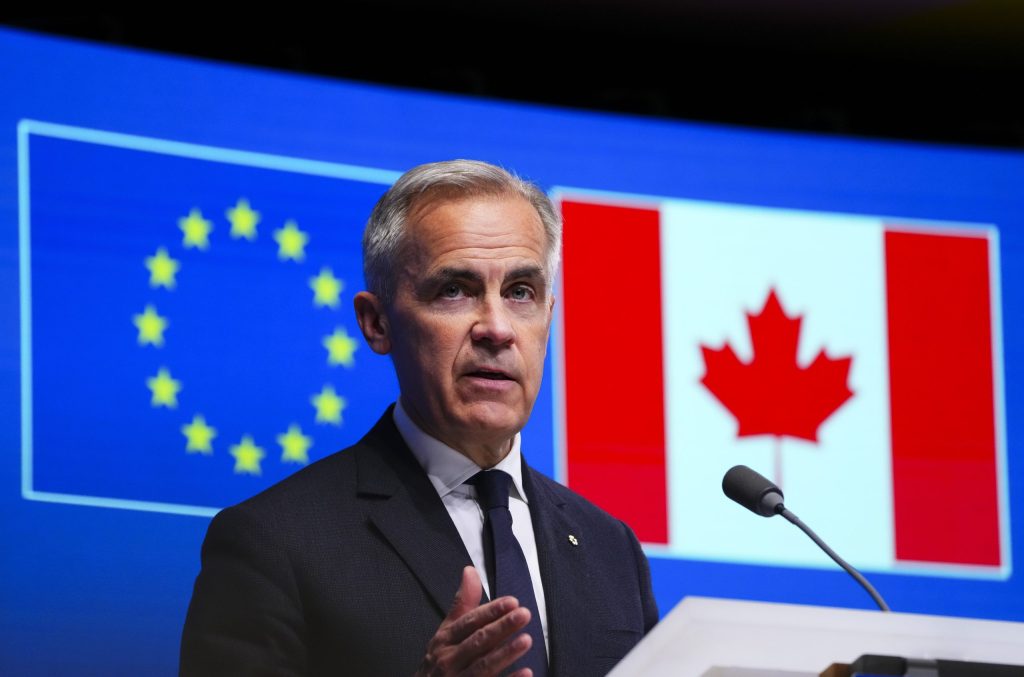
Canadian Prime Minister Mark Carney delivered one of the sharpest rebukes of Trump’s approach during the forum, warning that the world is entering a period of rupture in the global order. He argued that economic integration loses legitimacy when it results in subordination rather than shared benefit, and called for closer cooperation among middle powers to avoid being marginalized by larger states. His remarks drew a standing ovation from attendees.
French President Emmanuel Macron echoed calls for greater European autonomy, criticizing what he described as coercive behavior by powerful states. In contrast, NATO Secretary General NATO Mark Rutte adopted a more measured tone, acknowledging that Trump is correct to emphasize Arctic defense while stopping short of endorsing the U.S. position on Greenland.
Germany’s former foreign minister Annalena Baerbock warned publicly that questioning borders through pressure or coercion risks returning the international system to darker historical precedents. Meanwhile, several European policymakers declined to comment directly, reflecting both caution and uncertainty over how to respond.
Tariffs, Trade, and Institutional Pushback
The dispute intensified after Trump reiterated threats to impose escalating tariffs on a group of European countries, including Denmark, Germany, France, and several Nordic states, unless they back his Greenland proposal. Under the plan outlined earlier in the week, a baseline tariff would take effect in February and rise substantially by mid-year.
European leaders warned that such measures could trigger a trade war and strain NATO cohesion. The European Union’s trade chief met with U.S. Trade Representative Jamieson Greer on the sidelines of Davos, emphasizing that Brussels prefers dialogue and negotiated solutions. Nonetheless, the European Parliament moved to suspend work on the EU U.S. trade agreement in protest at Washington’s demands.
Greenland at the Center of Strategic Competition
Greenland, an autonomous territory within the Kingdom of Denmark, has become a focal point of great power competition due to its geography, resources, and role in Arctic security. The world’s largest island sits largely within the Arctic Circle between the Atlantic and Arctic oceans and is covered by ice across most of its interior. Its population of roughly 56,000 people is concentrated along the coast, with the capital Nuuk home to about one third of residents.
The island already hosts a major U.S. military installation, the Pituffik Space Base, which plays a key role in missile warning and space surveillance. Denmark oversees Greenland’s defense through the Joint Arctic Command, responsible for sovereignty enforcement, monitoring, and search and rescue operations.
Trump argued that only the United States is capable of fully securing Greenland, linking the territory to the planned Golden Dome missile defense system. Danish Foreign Minister Lars Lokke Rasmussen responded that while it is positive Trump ruled out military action, his underlying ambition remains intact and the dispute itself is unresolved.
The Arctic’s Expanding Strategic Role
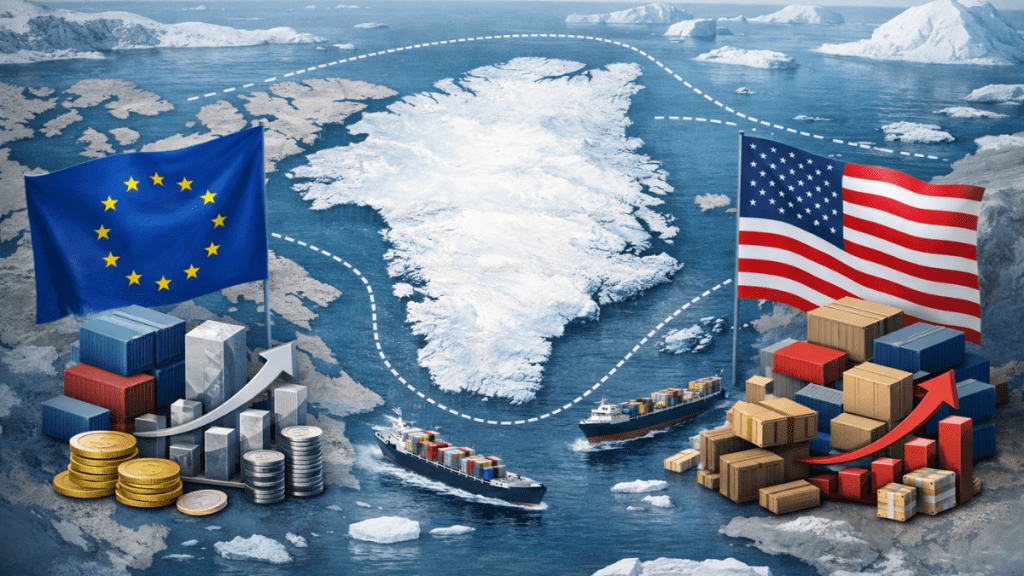
The Greenland controversy is unfolding as the Arctic rapidly gains importance due to climate change and increased maritime activity. Melting ice has contributed to a sharp rise in Arctic shipping over the past decade, opening new routes that could significantly shorten travel times between Asia, Europe, and North America.
Three major corridors are drawing attention. The Northern Sea Route along Russia’s coast could reduce transit times between East Asia and Western Europe by up to two weeks compared with the Suez Canal. The Northwest Passage through Canada’s Arctic could cut journeys via the Panama Canal by about ten days. A future Transpolar Sea Route across the central Arctic may eventually become viable by mid-century as ice conditions continue to change.
According to the Center for Strategic and International Studies, Russia views control of Arctic routes as central to its security posture. The Northern Sea Route is overseen by Rosatom, giving Moscow leverage over access. Russia has expanded radar coverage, airfields, and missile systems across the Arctic, reinforcing its military footprint from the Barents Sea to the Bering Strait.
China has also emerged as a major Arctic stakeholder, promoting a Polar Silk Road linked to its Belt and Road Initiative. Chinese state owned firms hold stakes in Russian LNG projects, including those operated by Novatek, and have supplied key equipment following Western sanctions. Chinese companies are also involved in mining projects in Greenland, targeting iron ore, rare earth elements, and uranium.
Beyond its strategic location, Greenland possesses significant natural resources. The island hosts large deposits of rare earth elements critical to high tech manufacturing, renewable energy, and defense industries. It also contains zinc, lead, gold, iron ore, copper, nickel, graphite, tungsten, titanium, vanadium, and potential hydrocarbon reserves.
Many of these resources remain underexplored, particularly in Greenland’s eastern and northeastern regions. Their potential has drawn international interest, reinforcing perceptions in Washington that Greenland is both a security asset and a long term economic prize.
Reactions from Davos
Trump’s speech produced a subdued and at times uncomfortable atmosphere in the Davos hall. While some remarks drew scattered laughter, much of the audience remained silent. Many delegates eventually drifted away to follow the address on screens in nearby halls or resumed private conversations.
The president also used the platform to criticize allies on a range of unrelated issues, from European environmental policies to immigration and energy production, and to revisit grievances with the United Kingdom, Switzerland, France, Canada, and NATO. Domestic economic concerns, including cost of living pressures, featured only briefly and late in the speech.
Recent Frameworks Reached
Momentum around Greenland shifted again as President Donald Trump announced that he had secured what he described as total and open-ended U.S. access to Greenland through a new framework arrangement with NATO. The announcement marked a clear tactical retreat from earlier threats of tariffs and force, and immediately eased financial market pressure in Europe and the United States. Equity markets rebounded sharply after days of volatility that had been driven by fears of a deep transatlantic rupture.
NATO Secretary General Mark Rutte confirmed that allied military planners would now begin working through the operational implications of enhanced Arctic security, with the aim of moving quickly toward implementation, potentially as early as 2026. The emerging understanding centers on expanded access, coordination, and presence rather than a formal transfer of sovereignty. Denmark stressed that no negotiations had taken place regarding ownership or territorial control, reiterating that Greenland’s constitutional status within the Danish kingdom is not subject to discussion.
Greenland’s Prime Minister Jens Frederik Nielsen cautiously welcomed the easing of rhetoric but underscored that significant uncertainty remains. Greenlandic authorities indicated openness to deeper cooperation and an upgraded partnership with the United States and NATO, particularly on security and infrastructure, while drawing a firm line at any arrangement that would infringe on sovereignty or violate international law. Reports that Washington had sought control over areas surrounding U.S. military facilities were met with clear resistance from Nuuk.
Denmark, Europe, and the Question of Trust
In Copenhagen, Prime Minister Mette Frederiksen described the situation as stabilizing but still serious. She framed recent developments as progress toward structured discussions on collective Arctic security rather than a resolution of political tensions. Frederiksen and several European leaders emphasized the need for a more permanent NATO presence in the Arctic, including around Greenland, as a way to address Russian and Chinese activity without redrawing borders or undermining alliance norms.
European Union officials took a more sober view. EU foreign policy chief Kaja Kallas said the episode had inflicted lasting damage on trust between Washington and Brussels, even if immediate economic and military risks had receded. Diplomats across Europe signaled concern that the abrupt policy shifts and intense pressure tactics had exposed vulnerabilities in the transatlantic relationship that could not be repaired solely through technical agreements.
While Trump’s reversal triggered relief in markets and among some allies, it also reinforced a growing perception in Europe that U.S. commitments have become unpredictable. Officials privately questioned how durable the new framework would be, given how rapidly the administration’s position had evolved over the previous two weeks.
Existing Legal Foundations and Strategic Reality
Analysts noted that much of what Washington is now seeking is already permissible under long standing agreements. A 1951 defense accord between the United States and Denmark grants U.S. forces wide latitude to build facilities and operate freely in Greenland, provided Danish and Greenlandic authorities are informed. During the Cold War, the United States maintained a far larger footprint on the island than it does today, with multiple bases and extensive activity.
From this perspective, the current negotiations appear less about legal access and more about formalizing an expanded NATO role in response to intensifying Arctic competition. Russia’s military buildup along northern sea routes and China’s growing economic and scientific presence have sharpened allied concerns. The Greenland framework is increasingly being interpreted as part of a broader effort to lock in Western strategic advantage in the Arctic rather than a genuine bid for territorial acquisition.
Analysis: A Test for the Transatlantic Order
Trump’s renewed push for Greenland marks one of the most direct challenges to postwar transatlantic norms in decades. While he has now ruled out military force, the combination of territorial demands, trade threats, and public pressure on allies has unsettled European capitals and raised questions about the durability of existing alliances.
Supporters of Trump’s approach argue that Arctic security realities have changed and that U.S. leadership is necessary to counter Russian and Chinese expansion. From this perspective, Greenland is framed as a strategic necessity rather than an act of territorial revisionism.
Critics counter that leveraging tariffs and coercive diplomacy against allies risks undermining NATO cohesion and accelerating a fragmentation of the global order. They warn that normalizing pressure over sovereignty, even without force, could set precedents with far reaching consequences.
In the narrow sense, Trump’s decision to rule out military force and step back from tariff escalation can be read as a successful application of pressure followed by negotiation, producing a framework that advances U.S. security objectives while avoiding outright confrontation.
Yet the broader political consequences are harder to contain. Even as tensions cooled, the episode reinforced the belief among European leaders that the postwar assumptions underpinning the alliance are eroding. The willingness of a U.S. president to openly challenge the sovereignty of a fellow NATO member, even temporarily, crossed a psychological threshold that cannot be easily reversed by technical agreements or market recoveries.
For Europe, the Greenland dispute has accelerated an already ongoing reassessment of strategic dependence on the United States. Calls for greater European autonomy, stronger internal defense capacity, diversified trade relationships, and a more reciprocal posture toward Washington have gained momentum. Recent moves to deepen trade ties beyond the transatlantic space and to strengthen independent defense planning reflect this shift.
For the United States, the episode illustrates the limits of coercive diplomacy among allies. While pressure tactics may yield short term concessions or frameworks, they risk weakening the very alliance structures that have historically amplified American power. A NATO centered solution on Arctic security may ultimately stabilize the immediate situation, but it does not fully repair the erosion of trust exposed over the past weeks.
The Greenland affair is therefore less a resolved dispute than a turning point. It underscores a transition toward a more transactional, power centered Western order in which even close allies hedge against uncertainty. Whether the new framework becomes a foundation for renewed cooperation or merely a pause before future confrontations will depend on whether Washington can translate strategic urgency in the Arctic into alliance management grounded in predictability rather than pressure.
Iran is currently in the midst of the most lethal wave of domestic unrest the country has seen in decades, following protests that began on December 28 and culminated in a sweeping crackdown, mass arrests, and a severe information blackout. As the internal crisis has intensified, Iran’s confrontation with the United States has also sharpened, with senior Iranian officials warning of a forceful response to any renewed attack and Washington repositioning military assets closer to the region.
What has emerged, through a mixture of government statements, activist reporting, and limited material that has escaped Iran despite communications restrictions, is an undeniable crisis with both domestic and regional consequences. It is also a moment that has revived long running questions about the durability of Iran’s political system, the credibility of any opposition alternative, and the risks of foreign intervention.
The Protest Wave That Began on December 28
The latest unrest was triggered on December 28, initially linked to economic and social grievances that had been building for months. Shopkeepers in central Tehran were among those reported to have played a catalytic role, with strikes and demonstrations spreading in a way that surprised both supporters and skeptics of the protest movement. For nearly two weeks, demonstrations persisted in multiple areas, at times smaller than previous waves such as those in 2022, but sustained enough to pressure the authorities.
Iran has a record of weathering such episodes, including major unrest after the disputed 2009 election and the women led protests of 2022. In those cases, predictions of imminent collapse did not materialize. This time, however, the context was described as significantly more fragile. The country had already experienced a year marked by economic instability, severe inflationary pressure, and the aftereffects of a 12 day war with Israel in June 2025 that underscored Iran’s vulnerability to external strikes and the limits of its deterrence.
Mass Mobilization and Internet Cuts
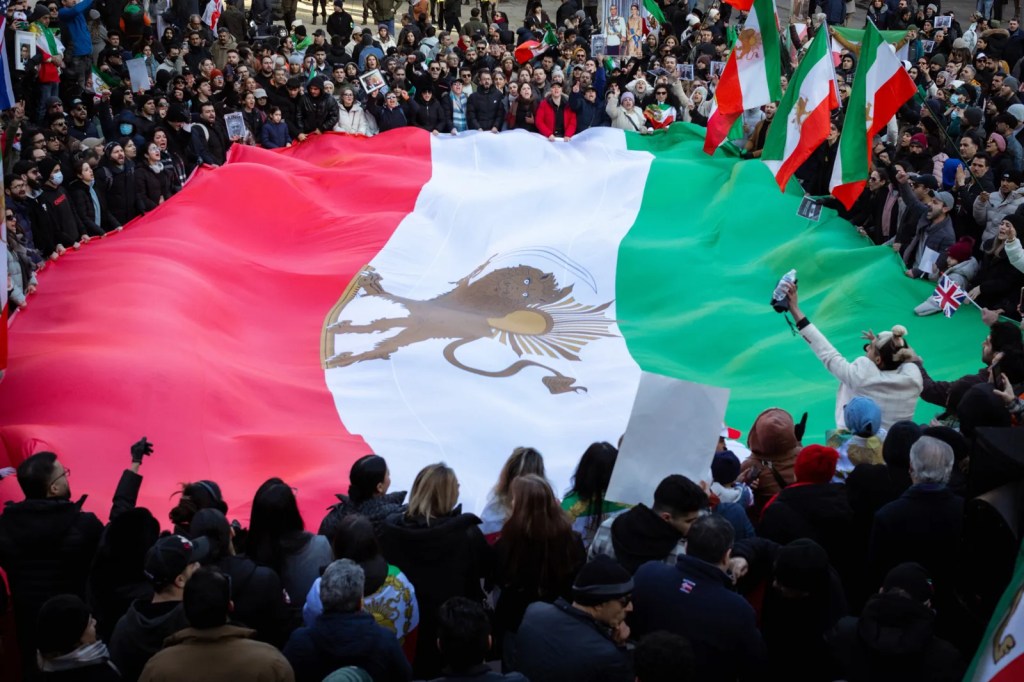
A pivotal moment came around January 8, when an exiled opposition figure, Reza Pahlavi, publicly urged Iranians to mobilize on a larger scale. The appeal appeared to resonate more widely than many observers expected, contributing to a surge in protests that followed. Around the same time, Iranian authorities imposed what was described as an unprecedented communications shutdown.
International monitors and observers characterized the internet restrictions as deeper and more sustained than those seen during prior unrest in 2019 or 2022. Connectivity was reported to have dropped to a minimal fraction of normal levels, leaving families struggling to contact relatives and making it difficult to verify events on the ground. Even in this environment, some videos and images reportedly made it out of the country early in the blackout, though the flow later slowed to a trickle, suggesting either tighter controls or more effective disruption.
Reporting described Iran using a blend of techniques to control information. These included rerouting or manipulating internet connectivity at the national level, blocking or degrading VPN traffic, and relying on a domestic state controlled network that could keep limited services functioning even while cutting broader access. Satellite based workarounds, including the use of smuggled Starlink terminals that are illegal in Iran, were discussed as a partial lifeline, though with reports that access was uneven and increasingly disrupted. Several possible interference methods were raised, including jamming or spoofing signals that satellite systems rely on to function.
Alongside the communications crackdown, the security response reportedly intensified sharply. Accounts described the deployment of multiple security forces, including units linked to the Revolutionary Guards and affiliated militia elements, as well as the use of snipers and live ammunition in some locations. The state has consistently maintained that violence was driven by hostile elements, including armed participants and foreign backed actors, while activist networks and leaked footage have suggested that security forces fired on people who appeared unarmed. With limited independent access, the full scope and sequence of events remains difficult to confirm.
Competing Death Tolls
In recent days, Iranian state television carried what it presented as the first official death toll. The figure was attributed to a statement by the Martyrs Foundation, which said 3,117 people were killed. The statement added that 2,427 of those killed were civilians and members of the security forces, without clarifying how the remaining casualties were categorized.
Activist reporting produced a higher estimate. A US based monitoring group, the Human Rights Activists News Agency, placed the death toll at 4,560, citing a network inside Iran that it says verifies fatalities. Independent verification has been constrained by the ongoing blackout and the absence of open access for international media and outside investigators.
Even with these discrepancies, multiple accounts converged on the conclusion that the death toll is extraordinarily high by modern Iranian standards, exceeding the casualties reported in previous rounds of unrest in recent decades. Comparisons were also drawn to the turmoil surrounding the 1979 revolution, largely due to the combination of scale, severity, and uncertainty about what comes next.
Iran’s Supreme Leader Ayatollah Ali Khamenei, in remarks reported over the weekend, acknowledged that the protests left several thousand dead and blamed the United States, marking one of the clearest signals from the top of the system about the magnitude of casualties.
Mass Arrests, Punishment Threats, and Asset Seizures
The crackdown was not limited to lethal force. By activist estimates, nearly 26,500 people were arrested. Iranian authorities continued to announce arrests in multiple provinces and cities, often describing detainees as organizers or instigators of unrest, or as participants in violent acts against public institutions and religious sites.
Iranian officials also signaled that punishments could be harsh. Statements carried by state media described a two track approach, with severe treatment promised for those labeled as violent “rioters” and potential leniency for individuals portrayed as having been misled by foreign actors. Senior security officials reportedly urged people to turn themselves in within a short time window, promising reduced sentences in exchange.
State television aired confessions from detainees with faces blurred, continuing a long criticized practice that rights groups and foreign observers have described as coercive. At the same time, officials emphasized that they aimed to recoup economic damage from unrest through confiscations. Reports described the seizure of assets from prominent figures alleged to have backed protests, including businesses and cafes, framing these actions as compensation for property damage.
In the background was widespread concern that some detainees could face execution. Iran is already among the world’s most prolific users of capital punishment, and comments from officials contributed to fears that legal proceedings could be accelerated.
Iran’s Foreign Minister Warns the US Against Renewed Military Action
As reporting on casualties and arrests intensified, Iran’s foreign minister, Abbas Araghchi, issued his most explicit warning yet about potential conflict with the United States. In a published opinion article, he argued that the most violent period of unrest was limited in duration and again placed blame on armed demonstrators. He also framed Iran as having exercised restraint during the June 2025 Israel-Iran war, while emphasizing that future restraint should not be assumed.
The core message was that Iran would respond decisively if attacked again, and that a major confrontation would not be short, contained, or limited to Iran. The warning implicitly drew on Iran’s missile capabilities, particularly its short and medium range arsenal that could threaten US bases and interests across the Gulf region.
In practical terms, there were already indications of increased caution. Restrictions were reported on certain movements by US diplomats to bases in Kuwait and Qatar, reflecting concern about retaliation if tensions escalated.
Araghchi’s position came with diplomatic consequences. His invitation to the World Economic Forum in Davos was rescinded in connection with the protest killings, underscoring the reputational impact of the crackdown and the degree to which Iran’s domestic crisis is spilling into international forums.
US Military Movements Add to the Sense of Imminent Risk
Against this backdrop, the United States began repositioning military assets. Ship tracking data showed the USS Abraham Lincoln, which had been operating in the South China Sea, transiting through the Strait of Malacca into the Indian Ocean and heading west. A US Navy official, speaking anonymously, said the carrier and accompanying destroyers were moving in that direction. While US officials did not explicitly state that the group was bound for the Middle East, its location and direction indicated it could enter the region within days.
The context here matters, as the the US recently carried out a major deployment in the Caribbean that culminated in troops seizing Venezuela’s Nicolás Maduro, and that operation was referenced as a benchmark by commentators weighing whether Washington might contemplate a similarly decisive move against a leader it considers hostile.
President Donald Trump’s stance was portrayed as volatile and consequential. He publicly warned Iran against killing protesters and hinted at strong action, while also signaling at points that an attack might not be necessary if violence subsided. One step announced by the US was a tariff policy targeting countries that trade with Iran, alongside a pullback from engagements with Iranian officials after Araghchi floated a revival of nuclear related talks.
At the operational level, the US reportedly began withdrawing some personnel from major regional facilities in Qatar and Bahrain, a move often interpreted as a precaution when strikes are being considered or when retaliation is feared.
Regional governments, especially in Gulf Arab states, were reported to have urged Washington not to attack, reflecting fears that escalation would place their territory and critical infrastructure within the range of Iranian missiles and other retaliatory tools. Iran, for its part, reportedly shut its airspace last week, interpreted as a sign it anticipated potential strikes.
Drivers of Unrest
Beyond the immediate violence, the unrest was repeatedly linked to economic collapse and public hardship. Descriptions emphasized the rapid weakening of the rial, high inflation, rising import costs, and widespread poverty. Employment levels were portrayed as depressed, with hardship affecting both working class households and professionals.
Multiple accounts argued that sanctions have compounded these pressures, particularly those tied to oil exports, while also highlighting internal corruption and the economic influence of the Revolutionary Guards, which are described as controlling major commercial networks spanning key sectors. This combination, in the narrative presented, left the state with limited tools to calm the streets besides force.
Officials reportedly proposed small scale payments or stipends to ease anger, but this was portrayed as inadequate relative to the depth of economic distress.
The Uncertainty of What Comes Next
Although there had been no major protests for several days at the time of the reporting, the lull was not treated as a resolution. Iran’s own history suggests protest cycles can recede and then return with greater intensity. The ongoing communications shutdown has made it difficult to gauge the true level of organizing, morale, and fear across the country.
Iranian authorities signaled that internet restrictions might be eased gradually, while also replacing a top executive at a major telecom provider amid reports that some operators hesitated to enforce shutdown orders. State media also reported actions against domestic outlets that published protest related reporting, and described episodes of satellite broadcast disruption, hinting at a broader contest over information control.
A recurring element in the coverage was the role of Reza Pahlavi as a possible rallying figure, especially given the absence of organized opposition inside Iran after decades of repression. He has presented himself as a transitional leader who would oversee a move toward democratic governance and put major constitutional questions, including the potential restoration of the monarchy, to a referendum.
At the same time, accounts underscored doubts about his ability to unify Iran’s fragmented opposition, particularly among ethnic minorities and non monarchist movements that distrust the legacy of the pre 1979 era or favor decentralization. His practical reach inside Iran was described as uncertain, with skepticism about whether online resonance translates into organizational capacity on the ground.
Several narratives framed the crisis as having consequences far beyond Iran’s borders. Iran’s internal instability raises concerns about refugee flows, regional proxy dynamics, and control over missile and drone stockpiles. The existence of enriched uranium, nuclear expertise, and hardline factions adds another layer of risk, especially if the state fragments or loses cohesion.
For the United States and its partners, the dilemma is acute. Military intervention could trigger Iranian retaliation across the region and produce unpredictable escalation. Doing little could be seen as abandoning red lines tied to mass killings or executions. Taking steps to restore communications, such as facilitating satellite connectivity, was presented as an option with lower immediate military risk, but not necessarily one that would change outcomes quickly given Iran’s control over domestic telecom infrastructure and its capacity to disrupt workarounds.
Analysis:
Based on the events we’ve seen play out over the last few weeks, Iran’s leadership appears determined to treat the protests as an existential threat and to use maximal force to deter future uprisings. Yet the scale of casualties, the breadth of arrests, and the intensity of the blackout suggest not confidence but insecurity. A state that believes it can manage dissent through limited repression typically does not need to sever communications nationwide for weeks or acknowledge thousands of deaths.
At the same time, the opposition landscape remains structurally weak inside the country. Iran’s system has spent decades preventing the emergence of credible, legal, and organized alternatives. That leaves space for symbolic figures abroad and sudden surges of mobilization, but it also increases the danger that if the center weakens, the vacuum is filled by fragmentation rather than a coherent transition.
Foreign intervention, which some voices in Washington have implied and which Tehran is clearly preparing for rhetorically, looks like a high risk accelerator rather than a solution. A limited strike might satisfy demands for punishment or deterrence, but it is unlikely on its own to stop domestic repression and could unify hardliners. A larger strike or an attempt at leadership decapitation could produce regional escalation and leave Iran’s internal succession dynamics unpredictable, particularly in a system where power is distributed across multiple security and clerical figures.
The prospective scenarios moving forward from here could all be costly. One is that the regime survives, hardened by bloodshed, and Iran enters a longer period of stagnation, repression, and isolation. Another is that the state fractures, producing internal conflict in a country with significant ethnic diversity, armed factions, and sensitive military capabilities. A third is a transition driven by insiders, such as factions within the Revolutionary Guards sidelining clerical leadership, which could reduce some forms of ideological rigidity but might deepen militarization unless paired with a viable economic opening and credible political reform.
What stands out most is that the protest movement’s bravery and the state’s severity are now colliding with a regional security environment already primed for escalation. With US forces repositioning and Iranian officials publicly warning of prolonged retaliation, the risk is not only that Iran’s domestic crisis worsens, but that it becomes the trigger for a wider confrontation that neither side can easily contain.
1/3 – International Breaking News & Geopolitical Updates
In the early hours of January 3, the United States carried out a dramatic and unprecedented military operation in Venezuela that culminated in the capture and removal of President Nicolás Maduro and his wife, Cilia Flores. By sunrise, the Venezuelan leader had been flown out of the country aboard a U.S. Navy vessel, marking one of the most sweeping acts of forced regime change in modern American history.
President Donald Trump announced the operation publicly just hours after explosions were reported across Caracas and surrounding strategic locations. The announcement confirmed weeks of speculation that Washington’s escalating pressure campaign against Venezuela had moved beyond maritime interdictions and covert pressure into direct military action on Venezuelan soil.
Months of Escalation Lead to Direct Intervention
The operation capped a five-month buildup of U.S. military assets across the Caribbean, the largest such naval concentration in the region since the Cuban missile crisis of 1962. Beginning in September, the Trump administration authorized dozens of strikes against vessels accused of transporting narcotics toward the United States. By December, those actions expanded to include a blockade of tankers carrying Venezuelan oil and a CIA-directed drone strike on a coastal port facility.
Although administration officials repeatedly insisted during the fall that regime change was not the objective, President Trump publicly escalated his rhetoric in late December, warning that the campaign would soon move “on land.” Days later, Maduro attempted to reopen negotiations, offering concessions related to drug trafficking and security cooperation. Those efforts were rejected.
Behind the scenes, U.S. intelligence agencies had already been preparing for a far more ambitious operation.
The Night of the Operation
Shortly after midnight on January 3, explosions rocked multiple military and infrastructure sites in and around Caracas. Targets included the Tiuna military base, headquarters of Venezuela’s defense ministry and a residential compound for senior officers, the port of La Guaira, the La Carlota airfield, and the communications hub at El Volcán, a heavily fortified antenna site overlooking the capital. Additional strikes were reported in Higuerote, a port and airfield east of Caracas, where secondary explosions lit up the night sky.
American aerial refueling tankers were observed taking off from Puerto Rico as part of the operation, while more than 150 aircraft launched from 20 bases across the Western Hemisphere. These included advanced fighter jets and strategic bombers designed to overwhelm air defenses and disable command and control systems. Large portions of Caracas experienced power outages during the raid, which U.S. officials later attributed to cyber and electronic warfare tactics.
The strikes themselves were brief, lasting less than half an hour, and notably left several major military installations untouched. U.S. officials later suggested that the bombardment served as cover for a more focused objective.
The Capture of Maduro
As air defenses were suppressed, U.S. special operations forces moved in. Helicopters from an elite night operations unit flew low over Caracas, firing on ground targets and landing near a fortified residence on a military base where Maduro was believed to be staying. Intelligence officials had spent months tracking his movements, eating habits, and sleeping locations. A small CIA team had been operating inside the country since August, supported by at least one human source close to Maduro who was able to relay his precise location in real time.
Elite troops, including Delta Force operators, had rehearsed the mission using a full-scale replica of the residence. With those preparations complete and weather conditions deemed optimal, the operation proceeded. Maduro and his wife were seized without prolonged resistance and transported to the USS Iwo Jima before being flown toward New York.
Whether elements within Maduro’s inner circle assisted the operation remains unclear.
Venezuelan state television condemned what it called a grave act of military aggression and urged citizens to prepare for armed resistance. However, initial official statements conspicuously avoided confirming Maduro’s fate. Vice President Delcy Rodríguez later demanded proof that Maduro was alive and is now widely regarded as the acting authority, though the command structure of the Venezuelan state remains intact.
Despite the operation, U.S. forces do not control Venezuelan territory, and domestic security forces, militias, and armed groups remain active across the country.
Legal Justification and Criminal Charges
Within hours of Trump’s announcement, U.S. federal prosecutors unsealed a revised indictment charging Maduro, his wife, and their adult son with narco-terrorism conspiracy, cocaine importation conspiracy, and weapons offenses. The indictment alleges that Maduro presided over a criminal network that used state power to facilitate drug trafficking, enriching his family and collaborating with armed groups operating across the region.
Administration officials cited these indictments as legal justification for the operation. Vice President JD Vance argued that Maduro’s criminal status eliminated any protection associated with his position. Secretary of State Marco Rubio reiterated that the U.S. does not recognize Maduro as Venezuela’s legitimate president.
Maduro and Flores are expected to stand trial in New York. It remains unclear whether their son has also been captured.
Trump Declares Temporary U.S. Control
Speaking from Mar-a-Lago later that day, President Trump declared that the United States would effectively run Venezuela until a leadership transition could be arranged. He suggested that a small group of senior U.S. officials would oversee the process and did not rule out deploying American troops on the ground if necessary.
Trump also announced plans to open Venezuela’s oil sector to major U.S. energy companies, promising large-scale investment to restore production and infrastructure. While American firms expressed interest, analysts warned that years of neglect and sanctions would require tens of billions of dollars and at least a decade of sustained investment to reverse the industry’s decline. A full U.S. embargo on Venezuelan oil remains in place.
Congressional Backlash and Domestic Criticism
The operation triggered immediate outrage among Democratic lawmakers, who accused the president of bypassing Congress and launching an unauthorized war. Several lawmakers warned that Venezuela posed no imminent threat to the United States and likened the operation to the early stages of the Iraq war.
Veterans of previous conflicts questioned the lack of planning for the aftermath and asked who now governs Venezuela. Polling shows that a strong majority of Americans oppose military intervention in Venezuela, including opposition among Venezuelan diaspora communities in Florida.
While some Democrats welcomed Maduro’s removal in principle, they criticized the unilateral nature of the decision. Republicans were more divided, with several hawks praising the operation and others warning against deeper entanglement. Even some long-time opponents of U.S. intervention described the raid as tactically impressive while remaining skeptical of its long-term wisdom.
The administration defended its secrecy by arguing that congressional notification could have compromised operational security.
Governments across Latin America largely condemned the intervention, warning of violations of sovereignty and regional instability. Other global leaders expressed alarm, while a handful of U.S. allies praised the decisiveness of the operation.
Trump framed the action as part of a revived Western Hemisphere doctrine, warning that foreign powers such as China and Russia would no longer be tolerated in what he described as America’s strategic backyard. He singled out Cuba and Colombia as future areas of concern, further raising fears of regional escalation.
Analysis:
Even if the removal of Maduro is initially successful, history suggests that the most dangerous phase of regime change begins after the leader is gone. Venezuela is not a small, centralized state like Grenada or Panama during past U.S. interventions. It is a vast country with rugged terrain, porous borders, and a dense ecosystem of armed actors, including pro-regime militias, criminal organizations, and transnational guerrilla groups. Many of these actors have little incentive to disarm and every incentive to exploit chaos.
Research on foreign-imposed regime change consistently shows a heightened risk of civil war, insurgency, and prolonged instability. Armed forces that do not formally surrender often reemerge as insurgent networks, as seen in Iraq. Venezuela’s security apparatus, which still controls weapons and territory, may fragment rather than dissolve.
Any successor government installed with U.S. backing would face acute legitimacy problems. Leaders elevated by external force are significantly more likely to be removed violently, especially when they are perceived as dependent on foreign power. While Venezuela’s democratic opposition commands genuine popular support, aligning that movement with a foreign military risks undermining its credibility and provoking nationalist backlash.
The operation also exposes deep contradictions in President Trump’s foreign policy narrative. For years, he criticized the Bush administration for launching open-ended wars and campaigned as a leader opposed to foreign entanglements. A unilateral regime change operation, conducted without congressional authorization and with unclear exit plans, directly conflicts with those commitments.
Strategically, the benefits are uncertain. Venezuela is not a major source of narcotics entering the United States, and intelligence assessments have downplayed the threat posed by Venezuelan-based criminal groups to U.S. homeland security. Further destabilization may accelerate refugee flows rather than reduce them.
Perhaps most striking is that diplomacy was not exhausted. Maduro had reportedly offered sweeping economic and geopolitical concessions, including preferential access for U.S. companies and a realignment away from rival powers. Walking away from those talks in favor of military action raises questions about whether force was necessary to secure U.S. interests.
By focusing intensely on how to remove Maduro while leaving the aftermath largely undefined, the administration risks repeating a familiar pattern. History offers repeated warnings that toppling a regime is often far easier than building a stable order in its place. Without a credible plan for governance, security, and legitimacy, the United States may find itself drawn into exactly the kind of prolonged conflict it once vowed to avoid.
As of today, January 1, 2026, Bulgaria is scheduled to adopt the euro, marking one of the most significant economic transitions since the country joined the European Union in 2007. The move will make Bulgaria the 21st member of the eurozone and extend the single currency to the Black Sea region for the first time. While the decision has been years in the making and follows formal approval from EU institutions in 2025, the final approach to accession has exposed sharp divisions within Bulgarian society, shaped by economic anxiety, political instability, and questions of national identity.
Path to Eurozone Entry
Bulgaria’s ambition to adopt the euro dates back to its EU accession, but progress was repeatedly delayed by political turbulence and concerns over corruption, governance, and macroeconomic readiness. Under the Maastricht Treaty, candidate countries must meet strict criteria on inflation, budget deficits, debt levels, exchange rate stability, and long-term interest rates. Bulgaria formally met these benchmarks in early 2025, prompting a sequence of approvals by the European Commission, the European Council, the EU’s finance ministers, and the European Parliament.
The transition builds on decades of monetary alignment with Europe. Since 1997, Bulgaria has operated under a currency board regime, initially pegging the lev to the German mark and later to the euro. The fixed conversion rate of 1 euro to 1.95583 lev has been in place since Bulgaria entered the Exchange Rate Mechanism in 2020, and in practice even earlier. As a result, analysts note that monetary policy has already been heavily influenced by the eurozone, even without formal membership.
From January, Bulgaria will gain a seat on the Governing Council of the European Central Bank, giving it a voice in setting interest rates and monetary policy across the currency union.
In practical terms, the transition is designed to be gradual. Prices will continue to be displayed in both leva and euros until August 2026, and the lev will remain legal tender until the end of January. For six months, citizens will be able to exchange cash freely at banks, post offices, and the Bulgarian National Bank.
Many businesses, particularly those engaged in cross-border trade, have already adapted. Dual pricing has become widespread, and companies that regularly deal in euros expect fewer administrative burdens once conversion costs and invoice adjustments are eliminated. More than 80 percent of Bulgarian imports have long been denominated in euros, limiting direct exposure to currency volatility.
For consumers, especially those who travel or work elsewhere in the EU, the euro promises convenience. Supporters argue that everyday transactions abroad will become simpler, banking fees lower, and financial integration deeper.
A Society Split on the Eve of Change
Despite these technical preparations, public sentiment remains divided. Polling conducted in mid-2025 showed Bulgarians almost evenly split between support and opposition. Opposition is more prevalent among older citizens and residents of smaller towns and rural areas, while support is stronger among younger, urban, and business-oriented groups.
The most common fear is inflation. Many Bulgarians point to recent price increases in food, housing, and utilities and worry that the currency switch will accelerate the erosion of purchasing power. Memories of the economic turmoil of the 1990s remain vivid, particularly among pensioners who fear that fixed incomes will not keep pace with rising costs.
Concerns also extend beyond economics. For some, the lev represents sovereignty and continuity. Bulgarian banknotes feature prominent cultural figures, and the disappearance of the national currency is seen by critics as a symbolic loss of identity. Others worry that euro adoption will further centralize decision-making in Brussels, reducing national control over fiscal policy.
Political distrust amplifies these anxieties. Bulgaria has held seven parliamentary elections in four years, and the most recent governing coalition collapsed in December following protests over proposed tax increases. The instability has fueled skepticism about the state’s ability to manage the transition fairly and transparently.
President Rumen Radev called for a referendum on euro adoption earlier this year, arguing that the country was not ready. Parliament rejected the proposal, deepening political polarization. Opposition parties, including nationalist and pro-Russian groups, frame the euro as a threat to financial sovereignty and portray the move as imposed rather than chosen.
Competing Narratives
Supporters counter that Bulgaria effectively committed to the euro when it joined the EU and that postponing accession would only prolong uncertainty. They argue that the lev has long been tied to the euro in any case, limiting the risks often cited by critics. Economists point to studies suggesting that inflation linked directly to euro adoption is typically modest and short-lived.
During a visit to Sofia, ECB President Christine Lagarde described the expected inflation impact as limited and emphasized benefits such as smoother trade, lower borrowing costs, and greater financial stability. Analysts at the Brussels-based think tank Bruegel estimate that price effects in similar transitions have generally remained below 1 percent.
Yet opposition narratives resonate strongly amid broader European trends. Euroscepticism has risen across the continent, alongside the growth of far-right parties. In Bulgaria, these currents intersect with long-standing concerns about inequality, regional disparities, and elite accountability.
Analysis:
Bulgaria’s euro adoption illustrates a widening gap between institutional readiness and public confidence. From a macroeconomic and legal perspective, the transition is the culmination of a process that began decades ago. The currency board, euro-denominated trade, and ECB oversight have already constrained Bulgaria’s monetary autonomy.
Socially and politically, however, the change arrives at a fragile moment. Inflation fears are not abstract in a country where wages remain the lowest in the EU and recent price shocks are still being felt. Nostalgia for the lev reflects not only cultural attachment but also a desire for stability in uncertain times. Distrust of political elites further undermines confidence that safeguards against price manipulation or speculative behavior will be enforced.
The prevailing sentiment, while mixed, tilts toward caution rather than celebration. Even among those who accept euro adoption as inevitable, unease remains about its short-term impact on living standards and social cohesion. Supporters tend to frame the euro as a long-term structural benefit, while opponents focus on immediate costs and perceived losses of control.
As Bulgaria enters the eurozone, the success of the transition will depend less on meeting formal criteria, which it already has, and more on whether institutions can maintain price stability, communicate clearly, and rebuild public trust. The euro’s arrival is not only a monetary change but a test of whether economic integration can proceed without deepening social divides in one of Europe’s most politically sensitive moments.
12/22 – International Relations News & Diplomacy Analysis
As 2025 draws to a close, the European Union finds itself confronting simultaneous pressures from a more transactional United States, an increasingly assertive China, and a war in Ukraine that has entered a more precarious financial and military phase. With American funding sharply reduced following Donald Trump’s return to the White House, Ukraine has been forced to rely more heavily on Europe to sustain its war effort against Russia. That shift has exposed unresolved questions about Europe’s willingness, unified cohesion, and capacity to act as a strategic power.
Those tensions came to a head at a pivotal European Union summit in Brussels earlier this week, where leaders debated how to secure long-term financing for Ukraine. In recent months, the European Commission, led by Ursula von der Leyen, had advanced an ambitious proposal to use frozen Russian sovereign assets held in the EU as collateral for a large-scale loan to Kyiv. The plan envisioned mobilizing up to €210 billion in frozen Russian funds to underpin a €90 billion financing package that would keep Ukraine solvent and militarily supplied for more than a year. Beyond its financial utility, the proposal was designed to send a strategic signal to Moscow that Europe could sustain Ukraine’s resistance well into the future while imposing direct costs on the aggressor.
The initiative quickly gained backing from several of Europe’s most powerful political figures, most notably Friedrich Merz, who argued that using Russian assets would strengthen Ukraine while sparing European taxpayers. However, despite weeks of negotiations, the proposal collapsed during the summit after overnight talks failed to resolve legal and political obstacles. The most significant resistance came from Belgium, where roughly €185 billion of the frozen Russian assets are held. Belgian Prime Minister Bart De Wever warned that repurposing those assets could expose his country to international legal challenges and targeted retaliation from Moscow.
European leaders attempted to offer Belgium guarantees against potential financial and political consequences, but these assurances raised further legal questions that proved impossible to resolve under EU rules requiring unanimity. As discussions dragged into the early morning hours, it became clear that the reparations-based loan could not command the consensus needed to proceed.
Faced with the risk that Ukraine could run out of money as early as April of next year, EU leaders pivoted to a fallback option. At approximately 3 a.m. in Brussels, the bloc agreed to jointly borrow €90 billion on international markets and lend it to Ukraine over the next two years. The borrowing will be backed by the EU budget, meaning that member states will ultimately bear the financial responsibility. Hungary, Slovakia, and the Czech Republic will not participate in the scheme, effectively turning the effort into a coalition of 24 willing countries rather than a fully unified bloc.
For Ukraine, the immediate effect is largely the same. The funds are expected to prevent a fiscal collapse in Kyiv and to sustain basic state functions and defense spending through 2026. Ukraine’s leadership publicly welcomed the decision, emphasizing that the agreement significantly bolsters the country’s resilience at a moment of utmost need. International observers also noted that failure to reach any deal would have sent a damaging signal to both Kyiv and Moscow.
Nevertheless, the compromise carries important consequences. By abandoning the use of Russian assets, Europe has placed the financial burden squarely on its own taxpayers while forgoing an opportunity to directly weaken Russia’s financial position. Russian President Vladimir Putin responded by asserting that the EU stepped back because using the assets would have undermined trust in the euro zone and triggered serious repercussions, particularly among countries that store reserves in Europe.
The funding debate unfolded against a broader backdrop of strategic anxiety. The EU has long depended on American military power for its security and relied heavily on U.S. financial support for Ukraine since Russia’s full-scale invasion in 2022. With that support now reduced, Europe has increased its contributions but not enough to fully fill the gap. According to the International Monetary Fund, Ukraine faces a projected financing shortfall of roughly €72 billion next year without sustained external aid.
Data from the Kiel Institute highlight the uneven nature of Europe’s support. While countries such as Germany, France, and the United Kingdom have increased absolute contributions, Nordic states continue to lead when measured as a share of GDP. By contrast, Italy and Spain have contributed relatively little. Public opinion trends also raise concerns as polling in major European economies suggests growing fatigue among voters, with significant portions of the electorate in Germany and France favoring cuts to financial assistance for Ukraine.
The divisions visible in the Ukraine funding debate were mirrored elsewhere at the summit. EU leaders also failed to finalize a long-delayed free trade agreement with Mercosur, the South American bloc that includes Brazil and Argentina. Supporters of the deal argue that it would help diversify Europe’s trade relationships away from China and the United States. Negotiations have stretched on for 25 years now, and Commission officials had hoped to finalize the agreement before the end of the year.
Opposition from European farming interests and political hesitation once again derailed progress. French President Emmanuel Macron pressed for additional protections for European farmers, while Italian Prime Minister Giorgia Meloni withheld support at a critical moment. As a result, von der Leyen canceled a planned trip to Brazil to sign the agreement. Brazilian President Luiz Inácio Lula da Silva had previously warned that continued delays could cause his government to abandon the deal altogether, though last-minute assurances from Rome appear to have temporarily eased tensions.
By the summit’s conclusion, European Council President António Costa declared that the EU had delivered on its commitments to Ukraine. German Chancellor Merz echoed that sentiment, arguing that Europe had demonstrated its sovereignty and resolve. Ukrainian President Volodymyr Zelensky, who traveled to Brussels to advocate for the reparations loan, returned home with substantial financial support but without the stronger political message he had hoped Europe would send to Russia.
Analysis:
The EU’s decision to jointly borrow €90 billion for Ukraine averts an immediate financial crisis in Kyiv and prevents a potentially catastrophic failure of European credibility. In practical terms, the outcome may be close to the best Ukraine could reasonably expect heading into 2026, especially given declining American involvement and growing political fatigue within Europe itself.
Yet the manner in which the decision was reached underscores deeper structural weaknesses. Months of public disagreement, followed by a last-minute retreat from an ambitious plan endorsed by the bloc’s most powerful leaders, reinforces perceptions of European indecision and dividedness. The inability to leverage frozen Russian assets, despite their clear strategic value, reflects legal caution, political fragmentation, and an enduring reluctance to fully confront the consequences of great-power conflict.
Europe can plausibly claim that it has stepped into a void left by the United States. It cannot yet claim that it has seized the geopolitical moment. By choosing the path of least resistance, the EU secured short-term stability over a large reshape of the strategic balance. As the war drags on and financial needs resurface within a year, the same questions about burden-sharing, political will, and strategic purpose are likely to return with even greater urgency.
China has reached a historic milestone in global commerce, recording an annual goods trade surplus that has exceeded 1 trillion dollars for the first time ever. Data released by China’s General Administration of Customs shows that in the first eleven months of the year, exports climbed to 3.4 trillion dollars, representing a rise of 5.4 percent from the same period a year earlier. Imports over that interval fell by 0.6 percent to 2.3 trillion dollars. The resulting surplus of 1.08 trillion dollars places China at an unprecedented level of export dominance and highlights how deeply embedded the country has become within global supply chains.
This latest figure reflects more than forty years of economic transformation. China began its ascent in the late 1970s by shifting away from a primarily agrarian structure and adopting policies that encouraged industrial production. Through the 1980s and 1990s, the country became known for low-cost goods such as wigs, sneakers and holiday decorations, attracting foreign buyers with low prices and dependable manufacturing. What initially appeared to be a comparative advantage in low-value items soon evolved into a broad manufacturing ecosystem capable of climbing into high-value sectors.
By the early 2000s, China had already become a central manufacturing hub, but recent years have seen the country achieve significant breakthroughs in advanced industries. Chinese companies have taken leading positions in solar technology, electric vehicles and key segments of the semiconductor supply chain. These developments have deepened China’s influence over global production networks while heightening concerns in capitals around the world.
Last year, China posted what was then a record trade surplus of 993 billion dollars. Surpassing the 1 trillion dollar mark now casts the ongoing imbalances into sharper relief. Analysts note that the size of this gap means it is not only the United States or Europe that must account for the imbalance, but the entire global trading system.
Rerouted Trade Amid U.S. Tariffs
The milestone comes despite the policy actions of the United States, which remains the world’s largest economy and China’s largest individual trading partner. After returning to office in January, President Trump sharply increased tariffs on a wide range of Chinese goods. At one stage the tariffs briefly exceeded one hundred percent. Even after reductions, average tariffs remain elevated at approximately thirty seven percent.
Rather than significantly reducing Chinese export volumes, the tariffs have primarily altered their destination. Chinese shipments to the United States dropped notably, with November exports to the U.S. falling twenty nine percent from a year earlier. Yet overall Chinese exports rose by nearly six percent over the same month, supported by strong growth to other regions. Exports to the European Union increased fifteen percent, shipments to Southeast Asia rose 8.2 percent and exports to Africa and Latin America grew by 26 percent and 7.1 percent respectively. Economists point out that this adjustment reveals a global reallocation of trade routes, which has helped offset the pressures created by U.S. tariffs.
Despite geopolitical tensions and the stated intentions of many governments to reduce reliance on Chinese supply chains, forecasts indicate that China’s export performance is unlikely to weaken significantly. Analysts at Morgan Stanley expect the country’s share of global goods exports to rise from roughly 15 percent today to 16.5 percent by 2030. They attribute this trajectory to China’s strength in advanced manufacturing and its ability to scale production rapidly in sectors experiencing rising global demand.
Europe Signals Growing Unease
This momentum has sparked concern in various regions, particularly in Europe. Long-standing European strengths in automobiles, technology and high-end consumer goods face competitive pressure from Chinese producers who combine cost advantages with increasingly sophisticated engineering.
These anxieties were highlighted during French President Emmanuel Macron’s recent comments following his visit to Beijing. While the trip had otherwise cordial elements, Macron cautioned that Europe could be compelled to act if China did not take steps to reduce its overwhelming export position. He indicated that Europe might consider measures similar to those adopted by the United States, including potential tariffs on Chinese goods.
French officials have voiced particular frustration regarding the depreciation of the yuan, which has weakened by about ten percent against the euro this year, making Chinese goods more competitive in European markets. Concerns over currency dynamics have added to broader apprehensions about the long-term vitality of Europe’s industrial base.
The unease is not limited to France. Across the European Union, and increasingly in parts of Southeast Asia, Latin America and the Middle East, governments are initiating more investigations and trade defense actions targeting Chinese products.
Some analysts argue that the trade imbalance is even more striking when measured in physical terms rather than monetary value. While China accounts for roughly 15 percent of global export value, the country’s share of global containerized exports is estimated to reach nearly 37 percent. For every container that Europe sends to China, approximately four return filled with Chinese goods. This imbalance in volume points to the structural depth of China’s manufacturing reach.
Observers warn that if current trends continue, global economic pressures could rise significantly. There is growing speculation that trade relationships may reach a breaking point if adjustments are not made, particularly as more countries reassess the risks associated with concentrated supply chains.
Analysis:
China’s unprecedented 1 trillion dollar trade surplus reflects both the remarkable success of its long-term economic strategy and the mounting strain that this success places on global commercial relationships. The surplus demonstrates China’s unmatched ability to produce and export at scale, yet it also exposes the limits of a world economy that must absorb ever-growing volumes of Chinese goods.
The international response is hardening. The United States has already taken aggressive action through tariffs. Europe, typically more hesitant to confront China directly, is now increasingly vocal about the need to defend its own industrial model. Emerging economies, once primarily focused on the benefits of inexpensive Chinese imports, are also beginning to question the sustainability of the current arrangement.
Although China’s export strength is likely to continue, it now faces a global environment less willing to tolerate large and persistent trade imbalances. The country’s ability to adapt, along with the willingness of other nations to recalibrate industrial and trade policies, will shape the next decade of global economic competition.
For now, the world is watching a powerful manufacturing nation press further ahead. The milestone of a 1 trillion dollar surplus may be a symbol not only of China’s capacity to dominate global trade, but also of the geopolitical frictions that such dominance inevitably creates.
12/9 – International Relations News & Geopolitical Analysis
Since early September, the United States has pursued a rapidly intensifying campaign of air strikes against vessels it claims are involved in maritime drug trafficking across the Caribbean Sea and eastern Pacific Ocean. What began as targeted interdictions has evolved into a sprawling military effort that has already destroyed more than 20 boats and killed at least 87 people, prompting growing concerns across Latin America and beyond. Officials in Washington insist the strikes are part of a larger strategy to dismantle drug-smuggling networks. Yet the scale of the military deployment, the geographic reach of operations, and the administration’s increasingly direct threats against Venezuela’s government have fueled speculation that the campaign is intended to pave the way for coercive regime change in the South American nation.
Military Build-Up & Escalations at Sea
The first major signs of escalation emerged in late August, when the United States began quietly shifting personnel and assets to the Caribbean. Air force teams arrived in Puerto Rico to refurbish a long-abandoned naval base and restore its airstrip. By mid autumn, warships, bombers, fighters, and surveillance aircraft were circulating throughout waters overseen by the Pentagon’s Southern Command. On November 11th, the navy announced that the USS Gerald R. Ford, the world’s largest aircraft carrier, had arrived in the region accompanied by three destroyers. Observers immediately noted that this represented the largest American maritime concentration in the Caribbean since the Cuban missile crisis.
The operational tempo heightened further as aircraft executed a steady rhythm of reconnaissance flights, dry-run strike simulations, and maritime interdictions. The White House framed these actions as part of a broadened mandate to confront “narco-terrorist” groups.
The first lethal strike occurred on September 2nd when American forces hit a Venezuelan boat in the Caribbean, killing 11 people believed by Washington to be members of the Venezuelan gang Tren de Aragua. From that point forward, the tempo accelerated. Four separate vessels were destroyed in the eastern Pacific on October 27th, taking 14 lives and marking the deadliest day of the campaign.
In total, 22 confirmed strikes have been carried out across both bodies of water. The most recent attack, on December 4th, killed four men aboard a vessel in the eastern Pacific that the administration said was carrying narcotics to the United States. The government has described the broader mission as “Operation Southern Spear” and has entrusted many of the strikes to Joint Special Operations Command, which controls elite units including Delta Force and the Navy SEALs.
The administration argues that these operations qualify as lawful armed conflict. President Trump has officially designated the targeted cartels as foreign terrorist organizations and treats boat crews as enemy combatants. Legal scholars across the political spectrum dispute this characterization, warning that the administration’s approach bypasses domestic and international law.
Controversies surrounding the issue have escalated further after the Washington Post reported that commanders overseeing the September 2nd strike observed two survivors clinging to wreckage. According to the report, Admiral Frank Bradley ordered a second missile strike that killed the unarmed men. International law prohibits the killing of individuals who are out of combat and pose no threat. The allegation has triggered accusations of war crimes and strained cooperation with allies.
A Broader Strategic Objective
Although the administration continues to insist that the primary target is drug trafficking, the scope of American deployments suggests a more expansive objective. Over 15% of the United States Navy is now positioned in the region, including more than 10k sailors and the world’s most advanced carrier group. Pilots have been conducting simulated strike missions on Venezuelan targets. The arrival of an American destroyer in Trinidad and Tobago in late October, only 11 km from Venezuelan shores, further underscored the proximity of military assets to Caracas.
President Trump has even warned international airlines to treat Venezuelan airspace as fully closed. He has also stated that the United States will conduct strikes on Venezuelan territory “very soon” and confirmed that he has authorized covert action activities inside the country. On October 15th he publicly acknowledged these covert missions. Several senior officials have hinted that the introduction of land strikes is under review.
The design appears reminiscent of the war on terror approach. The administration’s language closely resembles the rhetoric once used against jihadist organizations. Hegseth has argued that drug trafficking groups have killed more Americans than al-Qaeda and should be treated accordingly.
The Venezuela Question
Analysts suggest that the acceleration of operations coincides with renewed interest in removing Venezuelan President Nicolás Maduro from power. While the administration is unlikely to launch a traditional ground invasion, it appears committed to coercive pressure backed by targeted strikes. Officials believe that sustained military action may persuade Maduro’s inner circle or the armed forces to negotiate terms of exit. To reinforce this message, American envoys have quietly circulated offers of amnesty and assurances aimed at Venezuelan military leaders, promising support for modernization if a new government takes power and avoiding any wholesale purge of the officer corps.
The administration’s strategy also aligns with a revived interpretation of the Monroe Doctrine. The second Trump Administration’s National Security Strategy, released last week, declares that the United States will enforce a “Trump Corollary” aimed at preventing adversarial influence in the Western Hemisphere. Officials highlight Venezuela, Cuba, and Nicaragua as the last hostile governments in the region and justify a more forceful posture to remove openings for Russian and Chinese involvement.
A Shift in Global Priorities
The prioritization of the Western Hemisphere raises broader strategic questions. Resources channeled into the Caribbean and Pacific must come from somewhere, and the United States is already stretched across Europe, the Indo Pacific, and the Middle East. A more assertive hemispheric stance risks pulling attention away from longstanding security architectures in Europe and the Indo Pacific that have anchored American influence since the end of WWII.
Despite these concerns, the administration believes the domestic political costs are low. The president’s calculus appears guided by the belief that the public will tolerate foreign operations as long as American casualties remain minimal. The success of a previous lightning strike operation, known as Operation Midnight Hammer in Iran, has reinforced confidence in high intensity but low footprint military action.
Analysis:
The unfolding campaign represents a profound shift in American foreign and security policy. For decades, maritime drug interdiction was treated primarily as a matter for law enforcement and international policing partnerships. The current approach reframes narcotics trafficking as a theater of armed conflict, with implications that stretch well beyond counternarcotics efforts.
Several elements signal a long term change. The deployment of an aircraft carrier strike group, the renovation of military infrastructure in Puerto Rico, and the integration of special operations units suggest an operational presence that is more than temporary. The decision to apply counterterrorism tactics to criminal groups risks blurring the distinction between combatants and civilians, creating significant humanitarian and legal challenges. The conduct and legality of the strikes have already provoked controversy that could intensify if land targets in Venezuela are hit.
A conventional ground invasion of Venezuela remains highly unlikely, as it would seem contradictory and optically inconsistent with the president’s “America First” messaging, which emphasizes avoiding prolonged foreign entanglements and maintaining an image of restraint and a broker of peace across the world. Instead, the administration seems to recognize and believe that, as long as American casualties are avoided, the public is willing to tolerate assertive displays of military power abroad.
At the geopolitical level, the administration’s embrace of a resurrected Monroe Doctrine marks a decisive return to sphere-of-influence thinking. This orientation prioritizes dominance in the Western Hemisphere as essential to American security and strategic identity. The intention appears to be the restoration of a regional order in which no adversarial powers can gain footholds. Whether such a doctrine is sustainable in a multipolar world is uncertain. It could also undermine existing alliances and create new vulnerabilities as attention shifts away from Europe and Asia.
Most significantly, the administration seems convinced that decisive action against Venezuela will demonstrate American resolve and deter rivals. Yet historical precedent suggests caution. Efforts to force political regime change from abroad often produce unpredictable outcomes, and the humanitarian and political cost to Venezuelans could be severe. While the administration argues that the present circumstances differ from past interventions, the long term consequences of covert operations and targeted strikes remain difficult to forecast.
America now stands at a moment where tactical military success risks evolving into a far broader regional confrontation. Whether this strategy will reshape regional dynamics or unleash a cycle of escalation will depend on choices made in the coming weeks.