December 11, 2024 – Top Geopolitical Events & Security Developments
U.S. Transfers $20 Billion Loan to Ukraine Backed by Russian Assets
The Biden administration has transferred a $20 billion loan to Ukraine, backed by interest earned from Russia’s frozen central bank assets. This move is a crucial step to sustain Ukraine’s economy amid ongoing conflict and uncertainty about future U.S. support with Donald J. Trump set to assume office. As part of a larger $50 billion package devised by the G7 nations, the loan ensures economic relief without imposing additional burdens on taxpayers, effectively making Russia financially accountable for the damage caused by its invasion of Ukraine. Treasury Secretary Janet Yellen described the transfer as a landmark policy achievement during her tenure.
The funds, handled through the World Bank, were carefully structured to maintain aid flow despite dwindling U.S. enthusiasm for further financial assistance to Ukraine. The innovative use of Russian assets as collateral reflects a broader strategy to keep the pressure on Moscow while ensuring Ukraine’s stability. Yellen emphasized the loan as a testament to Western resolve, signaling to Vladimir Putin that the coalition remains committed to Ukraine’s cause.
The initiative is also designed to withstand potential political shifts, as Trump and Congressional Republicans may be less inclined to extend similar levels of support. However, reversing the sanctions underlying the loan would be challenging, particularly given Europe’s unwavering commitment. This creative policymaking underscores a unified G7 effort to make Russia bear the economic weight of its actions, reaffirming international solidarity with Ukraine amidst a prolonged and costly conflict.
Ukrainian Intelligence Plays Role in Assad’s Fall
Ukraine played a key role in aiding Syrian rebels, particularly the Hayat Tahrir al-Sham (HTS) group, in their surprising capture of Damascus. Ukrainian intelligence reportedly provided about 150 drones and 20 experienced operators to the rebels a month prior to the offensive, as part of Kyiv’s broader strategy to weaken Russian influence worldwide. While this support played only a minor role in toppling Syrian President Bashar al-Assad, it is emblematic of Ukraine’s covert efforts to strike at Russian interests in the Middle East, Africa, and even within Russia itself.
This effort aligns with Ukraine’s larger strategy to expand the battlefield against Russia. Ukrainian intelligence has conducted operations targeting Russian operatives elsewhere, such as aiding Malian rebels in a deadly ambush against Wagner Group mercenaries. These actions have occasionally drawn criticism from the U.S., reflecting concerns over the reach and aggressiveness of Ukraine’s intelligence tactics. Nevertheless, Russia appeared unprepared for the HTS offensive, a miscalculation that led to the downfall of its key Middle Eastern ally. Ukrainian support, while not decisive, contributed to the rebels’ success, marking another point in Ukraine’s ongoing campaign to undermine Russia on multiple fronts.
Russia has acknowledged Ukraine’s involvement in Idlib and accused Kyiv of conducting “dirty operations,” though it has downplayed the extent of Ukrainian assistance. Ukraine’s willingness to assist Syrian rebels, despite limited acknowledgment from Western allies, underscores its commitment to counter Russian influence wherever possible, even in unexpected theaters like Syria.
Israeli Airstrikes in Syria Aim at Chemical Weapons and Advanced Missile Stockpiles
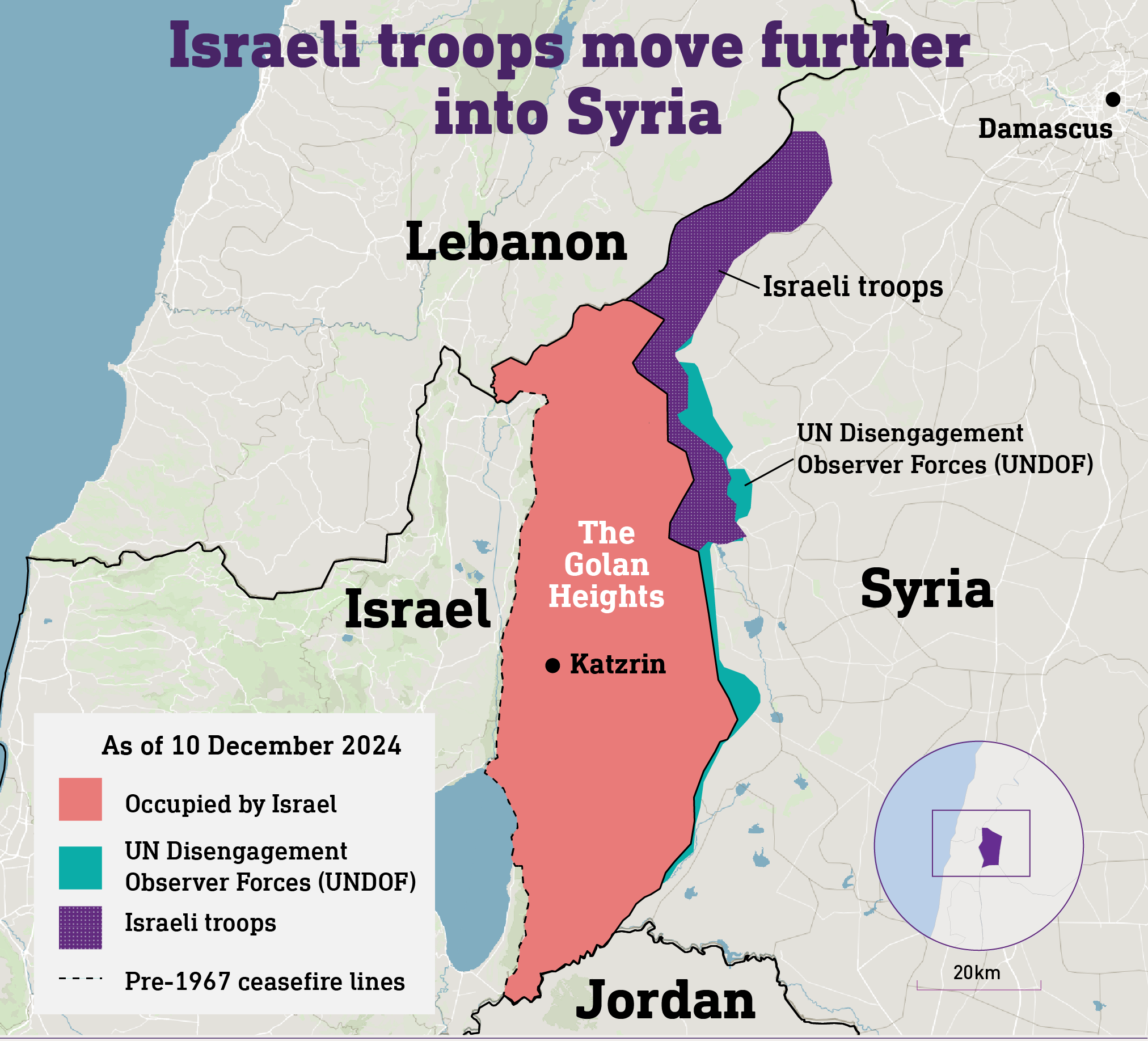
Israel has launched significant military actions in Syria, claiming to target chemical weapons caches and advanced armaments to prevent them from falling into the hands of Sunni Islamist rebels. These moves included seizing a demilitarized buffer zone along the Israeli-Syrian border, intensifying airstrikes, and bolstering defenses. Israeli leaders argue the actions are necessary for national security, especially following the October 7, 2023, Hamas attacks. Critics, including Arab nations, have condemned the incursions as violations of Syria’s territorial integrity and international law, sparking fears that temporary actions could lead to territorial entrenchment.
The collapse of Bashar al-Assad’s regime has left a power vacuum in Syria, with Turkish-backed Islamist group Hayat Tahrir al-Sham (HTS) emerging as a key player. Israel views HTS, despite its attempts to moderate its image, with suspicion due to its al Qaeda-linked origins and support for Hamas. This has added urgency to Israel’s efforts to neutralize threats along the border and across Syria. The Israeli government is particularly concerned about chemical weapons, as Syria has a history of using sarin gas and other agents, and remnants of its stockpiles remain unverified by international authorities.
These operations are part of Israel’s broader strategy to counter regional threats, including Iran’s influence in Syria and the potential formation of a Sunni Islamist corridor from Turkey to Egypt. However, the situation remains volatile and unpredictable, with uncertainty about Syria’s future leadership and the possibility of prolonged civil conflict that could destabilize the region further.
Syria’s Post-Assad Void Serves as Battleground for Global Powers
The unexpected fall of Bashar al-Assad’s regime in Syria has left a volatile power vacuum, with foreign powers scrambling to assert control. The U.S. has launched airstrikes against ISIS in central Syria while also supporting the Kurdish-led Syrian Democratic Forces (SDF) against Turkish-backed rebel offensives. Turkey has seized on the situation to expand its influence, capturing territory and targeting Kurdish groups it deems terrorists. The U.S. now faces the challenge of balancing its alliance with the SDF against its strategic partnership with Turkey, even as it works to prevent ISIS resurgence.
Turkey’s actions, including capturing key cities and preparing for broader offensives, reflect its broader goal of preventing the creation of an autonomous Kurdish enclave in Syria. Meanwhile, Israel has launched extensive military strikes against Syrian targets, seeking to dismantle potential threats and weaken Iran’s presence in the region. These developments underscore the fragility of Syria’s post-Assad landscape, where rebel factions like Hayat Tahrir al-Sham, which spearheaded the regime’s downfall, struggle to consolidate control amid the ambitions of foreign powers.
This geopolitical upheaval risks plunging Syria back into perennial internal conflict. While Assad’s collapse weakens Russia and Iran’s influence, it emboldens Turkey and creates tension between NATO allies and regional actors. The competing agendas of the U.S., Turkey, Israel, and other countries highlight the challenges of navigating a post-authoritarian Syria where foreign interests and local dynamics collide, threatening renewed instability.
Pentagon Announces Successful Ballistic Missile Intercept Test in Guam
The U.S. Missile Defense Agency achieved a significant milestone by successfully intercepting an air-launched intermediate-range ballistic missile target during a test off Guam, highlighting progress in defending the strategically vital U.S. territory. This test, known as Flight Experiment Mission-02 (FEM-02), utilized the advanced Aegis Guam System, equipped with the AN/TPY-6 radar and Standard Missile-3 Block IIA, to intercept a missile target near Andersen Air Force Base. The achievement underscores the Pentagon’s commitment to strengthening Guam’s defenses against evolving missile threats, especially given its proximity to China and its critical role in U.S. military strategy in the Pacific.
The success marks a step forward in the development of the Guam Defense System (GDS), an initiative to create an integrated air and missile defense network for the island. Lt. Gen. Heath Collins, director of the Missile Defense Agency, highlighted the importance of this test in validating joint tracking systems and integrated defense capabilities. The data from the experiment will inform further refinement of the GDS, which aims to enhance Guam’s resilience against potential adversaries.
This achievement reflects the broader U.S. strategy to maintain its presence and deter threats in the region. By advancing missile defense systems like the GDS, the Pentagon demonstrates its focus on adapting to emerging threats and ensuring the security of key strategic assets like Guam, a linchpin in the Indo-Pacific defense architecture.
China Launches Largest Military Display in Decades Following U.S. Visit by Taiwan’s President Lai
China recently conducted one of its largest military exercises near Taiwan and the Western Pacific since 1996, signaling an increasingly assertive stance in the region. Taiwanese officials reported the involvement of nearly 100 Chinese warships and vessels, spanning the South China Sea, the waters around Japan and South Korea, and near Taiwan itself. This large-scale operation combined efforts from China’s navy, coast guard, and multiple theater commands, showcasing Beijing’s ambitions to dominate the region’s key waterways and assert its claim over Taiwan. The maneuvers, criticized as coercive and provocative, align with China’s response to President Lai Ching-te’s international tour, which Beijing opposes as it staunchly rejects any official interactions between Taiwan and the U.S.
The exercises also appear to test strategies for a potential blockade of Taiwan, including intercepting international shipping and preventing foreign militaries from aiding the island in the event of conflict. Observers noted that China’s military activities signal broader regional intimidation, targeting not just Taiwan but other nations like Japan and the Philippines. The drills coincided with sightings of Russian naval forces near Taiwan, underscoring the growing partnership between Beijing and Moscow to challenge Western influence. Analysts suggest the coordinated maneuvers serve as a reciprocal effort, with Russia supporting China’s regional goals as China backs Russia in its war in Ukraine.
Taiwan responded with military readiness drills and emphasized the threat to regional stability posed by China’s actions. President Lai urged China to adopt a more cooperative approach, warning that intimidation tactics would not earn respect. Meanwhile, the U.S. continues to navigate its strategic ambiguity regarding Taiwan’s defense, with President Biden affirming support for Taiwan but maintaining official policy unchanged. As tensions escalate, China’s drills reinforce the potential for a conflict involving Taiwan, with implications for regional and global security.
The Global Apparatus Fueling the Deployment of Colombian Mercenaries in Sudan’s War
The ongoing civil war in Sudan between the country’s military and the Rapid Support Forces (RSF) has drawn foreign powers and mercenaries into the fray, deepening the crisis for Sudan’s 48 million people. Among the most notable foreign players is the United Arab Emirates (U.A.E.), which has supported the RSF through arms shipments and the deployment of Colombian mercenaries. These fighters, recruited under misleading contracts by UAE-linked private security firms, were routed through Libya to Sudan’s Darfur region, where videos surfaced of their capture by forces aligned with the Sudanese military. The U.A.E., motivated by strategic interests such as Red Sea trade routes and Sudan’s gold reserves, denies supporting the RSF, but evidence suggests otherwise, including links to weapons shipments and mercenary recruitment efforts.
On the opposing side, Egypt has provided air support to the Sudanese military, driven by its concerns over Ethiopian control of the Nile. This proxy conflict has transformed Sudan into a battleground for regional powers vying for influence. The escalating violence has created a catastrophic humanitarian crisis, with an estimated 150,000 deaths, millions displaced, and widespread famine, particularly in Darfur.
The involvement of Colombian mercenaries underscores the global reach of the conflict. Many were reportedly deceived into joining, unaware they would be fighting in an active war zone. The Colombian government is now working to repatriate its citizens. Meanwhile, Sudan continues to suffer as external powers exploit its internal strife, amplifying the devastation for its people.
– F.J.
 IRinFive