Britain and Germany signed a joint defense declaration on Wednesday July 24.
The two countries committed to closer collaboration in order to strengthen their defense industries, bolster European security, and support Ukraine against Russian aggression. [Reuters]
British Defense Minister John Healey and German counterpart Boris Pistorius signed a cooperation deal in Berlin on, pledging enhanced industrial coordination and joint operations. [Politico]
Healey emphasized that European security is a top priority for the UK’s new government, while Pistorius highlighted the importance of strengthening the arms industry and standardizing weapons systems.
“These visits send a clear message that European security will be this government’s first foreign and defense priority,” Healey said in a statement.
“We want to strengthen our arms industry,” Pistorius said, standing next to Healey. “We want to work more closely together in the development, production and procurement of weapons and ammunition.” [Politico]
Healey’s visit to Berlin is part of a two-day trip that includes stops in France, Poland, and Estonia, demonstrating the new Labour government’s dedication to deepening defense ties with European allies.
This push for stronger relations aligns with NATO’s efforts to address the significant costs and challenges of enhancing Europe’s defenses in response to Russia’s invasion of Ukraine.
The declaration outlines plans for Britain and Germany to support the European defense industrial base, initiate joint procurement projects, and collaborate on research and development to boost production and innovation.
Prime Minister Keir Starmer has emphasized the importance of improved cooperation with European allies to better support Ukraine and has even proposed a UK-EU security pact covering various areas, including energy, supply chains, pandemics, and migration. [Reuters]
Opinion:
Germany and Britain, Europe’s top military aid donors to Ukraine, have solidified their defense alliance amidst growing fears that a potential Donald Trump victory in the U.S. election could jeopardize European security.
Concerns have heightened with Trump selecting J.D. Vance as his running mate, a critic of U.S. financial aid to Ukraine, as his running mate.
The agreement marks the beginning of a new, robust defense relationship between the UK and Germany, and one that both nations will attempt to fortify moving forward.
With Europe rattled at the uncertainty of a highly possible Trump-Vance victory in November, the continent’s political leaders have heard their wake up call to start organizing and cooperating amongst themselves when it comes to defense.
European nations must prepare for a potential shift in American foreign policy. Trump and Vance have both expressed sentiments of reluctance towards providing what both have echoed as “blank checks” to Ukraine in their attempts to fight Russia. [Politico]
The agreement between Britain and Germany is a proactive step towards addressing critical deficiencies within NATO, and by fostering joint procurement initiatives and collaborative research and development, these European heavyweight nations are attempting to set a precedent for other European countries to follow.
President Joe Biden addressed the nation in a live speech from the Oval Office in Washington D.C. on Wednesday evening.
Biden announced directly to voters on Wednesday his decision to abandon his reelection campaign and endorse Vice President Kamala Harris as the Democratic candidate, citing the need to unite the country and safeguard democracy.
In his Oval Office address, Biden, 81, emphasized that the defense of democracy outweighs personal ambition, reflecting on his 50 years in public office.
“But nothing, nothing can come in the way of saving our democracy. That includes personal ambition,” he said. “So I decided the best way forward is to pass the torch to a new generation. That is the best way to unite our nation.”, said the President. [Reuters]
Biden praised his Vice President Kamala Harris as a strong leader, capable of guiding the nation forward, and expressed confidence in her ability to win the presidency.
“She’s experienced, she’s tough, she’s capable. She’s been an incredible partner to me and a leader for our country. Now the choice is up to you, the American people,” he said. [Reuters]
In his address, President Biden aimed to highlight the election’s significance, portraying it as a pivotal choice between freedom and chaos, a narrative both he and Vice President Harris have emphasized. Despite this, Biden avoided overtly campaigning from his official capacity.
“The beauty of America is that it is not ruled by kings or dictators,” Biden stated. “The power belongs to the people. History is shaped by your hands. The essence of America is in your hands.” [AP News]
Harris, the first Black woman and Asian American vice president, has since gained substantial support and financial donations within the Democratic Party and invigorated its election campaign.
Biden asserted that as he transitions out of his presidential bid, he remains focused on his current term’s agenda, including lowering costs for families, defending civil rights, and addressing climate change.
He outlined an extensive agenda for his remaining six months in office, committing to stay dedicated to his presidential duties until his term concludes on January 20, 2025. Biden vowed to work on ending the conflict between Israel and Hamas in Gaza, increasing government support for cancer research, tackling climate change, and advocating for Supreme Court reform. [AP News]
The Democratic National Committee plans to formally nominate Harris by early August, with a significant fundraising surge already bolstering her campaign.
This is undoubtedly a historic moment. A sitting U.S. president explaining to the nation his rare decision to voluntarily relinquish power and step away from the nomination. Such a step hasn’t been taken since 1968, when Lyndon Johnson declared he would not seek reelection amidst the Vietnam War.
“I have decided the best way forward is to pass the torch to a new generation,” Biden said, saying he wanted to make room for “fresh voices, yes, younger voices.” – “That is the best way to unite our nation.”
Opinion:
The announcement finally came three days after the President revealed his decision to withdraw from the race via a letter posted on the social media platformX.
Until earlier today, Biden had not been seen publicly for almost a week, following reports of his COVID diagnosis. The absence of any public appearances or trustworthy communications from the President in the days surrounding his monumental decision led to growing suspicion and mounting theories among citizens.
His choice to withdraw followed a challenging June debate with Donald Trump, which raised doubts about his ability to secure another term. This was compounded by several public political blunders and resulted in overwhelming pressure from within his own party to step down.
The Democrats are now focusing on the ‘passing the torch’ and ‘new generation’ narrative as their key strategy to win the election. This can be seen through what is being carved out to be Kamala Harris’ emerging campaign slogan, “We’re not going back.”
They aim to turn around the age argument, Biden’s biggest detriment, to their advantage by positioning 59-year-old Kamala Harris against 78-year-old Donald Trump.
Donald Tusk, the Polish prime minister, currently faces significant political blowback in the fallout of his recent failure to fulfill his major campaign promise of increasing access to abortion.
Despite a strong election victory in October, bolstered by pledges to restore the rule of law and introduce liberal reforms, including same-sex partnerships and easing anti-abortion laws, Tusk encountered a major political defeat on July 12 when he brought the matter to parliament.
This recent attempt by lawmakers to draft a law aimed at removing this punishment for abortion assistance was shot down by members of parliament by 218 votes against the 215 that were in favor. [Barron’s]
The right-wing Law and Justice (PiS) party, which governed Poland for eight years until October’s election, implemented a near-total abortion ban in 2020. The current law holds that abortion is only permitted in cases of rape, incest, or when the woman’s life is at risk.
Poland has one of Europe’s strictest laws surrounding abortion, with a penalty of up to three years in jail for even aiding an abortion.
Protests have erupted throughout Poland as several thousand voters take to the streets to challenge the parliament’s decision to reject a bill decriminalizing assisting abortion. [Barron’s]
These protests were mostly lead by Women’s rights groups, but were also met with counter-demonstration from anti-abortion activists
Polish Prime Minister Donald Tusk, stated on Tuesday that he felt “very bad that I haven’t found arguments that would convince” those who voted against the bill.” [Politico]
Tusk removed an MP from the position of deputy minister and suspended two MPs from his Civic Coalition party who did not vote for the proposal following the vote. [Politico]
Opinion:
Poland is a country with a strong Catholic presence and heritage, exemplifying the modern tug-of-war between conservative religious values and access to modern reproductive rights. Women’s rights to their bodies and decisions surrounding childbirth should be increasingly considered a fundamental human right as we move further into the 21st century, yet there seems to be consistent resistance among government’s of the world’s advanced nations.
Instances of women dying after being denied abortions and facing complications have significantly eroded the popularity of the ruling Law and Justice (PiS) party.
Ahead of the most recent vote, Donald Tusk emphasized that decriminalizing abortion is central to his reform agenda for the country. Many voters supported Tusk’s centrist coalition in October, driven by his promise to expand abortion rights and address the strict punishments surrounding the procedure. His party secured a sizable portion of the female vote, highlighting the importance of this issue for women.
Some members of conservative parties argue that abortion is not as high a priority for Polish citizens as other issues like national security, border defense, the economy, and healthcare. T
his argument is partly supported by Poland’s defense spending, which is 4% of its GDP—the highest of any European state and double the 2% spending target for NATO members. Foreign Minister Radoslaw Sikorski stated that the Polish government plans to increase defense spending to 5% of GDP by 2025. [Reuters]
Despite this, for a country with around 40 million people, the issue of looser access to abortion remains a central concern for young female voters. It will be interesting to see if Tusk’s ruling coalition can withstand a potential backlash in public opinion if they fail to deliver on this key campaign promise.
The Left aims to resubmit its decriminalization proposal, hoping to pass it narrowly with support from its backers and potential absenteeism among opposing MPs.
The Left aims to resubmit its decriminalization proposal, banking on potential absenteeism among opposing MPs and strong support from its backers to narrowly pass the bill. However, President Andrzej Duda, a conservative Catholic ally representing the right-wing opposition PiS party, is expected to veto any bill increasing abortion access.
This veto could be pivotal in mobilizing liberal voters to support an anti-PiS candidate in the next presidential election, provided the coalition manages to advance the bill to Duda’s desk.
Many Polish citizens feel that they propelled the ruling coalition to victory based on the promises of progressive reform and increased reproductive rights, however, disillusionment and betrayal now stain the judgment of Tusk and his party following this recent defeat.
This past Sunday, July 21, President Joe Biden publicly announced his decision to step down as the Democratic nominee for President and not seek reelection in November.
Following his announcement on X, Biden offered his full support and endorsement to Vice President Kamala Harris to be the Democratic nominee for president at this year’s election. [X]
Biden pledged to finish his tenure and remain in office as president until the end of his term in January 2025. [Reuters]
Immediately following the announcement, Harris and her campaign began garnering support from Democrats throughout the party. Recent surveys show that Harris already has well over enough delegates’ support to win the official delegate vote for nominee at the upcoming Democratic National Convention in Chicago on August 19. [Reuters]
Recent reports claim that the Harris campaign has raised over $81 million dollars in 24 hours.
Since Biden’s resignation from the presidential race and public endorsement of Harris, virtually all of the current Vice President’s possible challengers for the nomination have come out supporting Harris’ campaign. This includes top governor choices such as Gretchen Whitmer of Michigan, Gavin Newsom of California, Andy Beshear of Kentucky, Josh Shapiro of Pennsylvania, and J.B. Pritzker of Illinois.
The path to the nomination is all but clear for Harris at this point in the race.
The AFL-CIO labor union federation, which represented more than 12.5 million labor workers, also declared its institutional support for Harris. [Reuters]
Harris also received the support of former Speaker Nancy Pelosi, and both Bill and Hillary Clinton. She did not, however, receive an endorsement from former President Barack Obama, who praised Biden for his decision to step down from the race and stated that an “outstanding nominee” would be selected in an open process at the upcoming convention. [New York Post]
Recent polls show that Harris typically falls on average about two percentage points behind Donald Trump. The 46% to 48% difference is slightly better for Harris compared to how Biden polled on average – three percentage points behind the Republican presidential nominee, 47% to 44%. [Fox News]
BACKGROUND
Kamala Harris’ political ascent began as a prosecutor and later as California’s attorney-general, where she strategically navigated the state’s fluid and future-focused political landscape. Harris has often adjusted her positions to align with the political climate, leading critics to label her as opportunistic and ambitious, a reputation that seems to stick with her aside a lack of charisma. [Economist]
Harris’ ethnic background offers an advantageous political persona as the daughter of civil-rights activists and immigrants from India and Jamaica. She seems to have struggled to have leveraged this identity towards garnering effective national support from minority and immigrant demographics throughout her career in high politics.
When it comes to policy issues, Harris would be tied to the Biden administration’s record, which has seen legislative achievements but also faced unpopularity on various fronts. Her role in addressing southern border issues has already drawn attacks from Trump’s allies and will surely be the target of increased criticism throughout this race. [Economist]
On the topic of foreign policy, Harris maintains a relatively centrist stance, in support of maintaining strong aid to Ukraine and aligning with traditional Democratic views. Her campaign would contrast sharply with Trump and his America-first agenda, emphasizing global leadership.
Opinion:
Many people saw this outcome of Biden’s nominee resignation following his disastrous debate performance in late June.
The Democratic Party shamelessly misled its supporters and the American public, insisting for months that Biden was the best candidate and fit to run, effectively eliminating potential challengers during the primary. Now, as Biden’s chances of victory appeared more dismal than ever, the Democratic elites have abandoned him, and he has finally succumbed to the pressure to step down.
During his 2020 presidential campaign, Joe Biden promised to choose a woman of color as his vice-presidential running mate, leading to the selection of Kamala Harris. Despite her poor performance in the 2020 nomination race, she has now inherited the nomination due to Biden’s apparent cognitive decline and his adherence to a self-imposed diversity quota.
Senior Democrats and left-wing media, after urging Biden to abandon his reelection bid, are now portraying him as a phenomenal and selfless leader who had one of the most successful presidencies. These same individuals, who previously begged him to step down in light of recent polls and public opinion, are now depicting his resignation as an act of patriotism and service. Is this truly the mark of an American hero, or simply the reality of an 81-year-old man finally buckling under pressure from powerful party elites and wealthy donors?
As the 2024 presidential election approaches, Democratic voters have been stripped of their agency in selecting their preferred nominee and participating in a democratic process. Biden was virtually pushed through every stage of the Democratic primary without contenders, leaving voters no opportunity to support other candidates despite clear public opposition to another Biden vs. Trump rematch.
The Biden-Harris ticket’s main campaign point is to protect and preserve democracy. However, by not allowing voters to choose their candidate, the Democrats have shown that the millionaire donor class, not the voters, selects the nominee.
At 59, Harris’s age is a notable improvement over Biden’s 81, addressing the primary concern of voters regarding his age and physical ability to lead.
Although Harris is not much more popular than Biden, her campaign will focus on positioning her as the last possible opponent to Trump. She will adopt a full anti-Trump stance in every advertisement, seeking the votes of those opposed to his return to the White House.
Harris and her campaign are likely to take the approach of framing this refreshed campaign as the prosecutor vs. the felon in their aims of discrediting and defeating Trump.
Harris will likely make her position in defense of abortion and instating Roe v. Wade as a central feature of her candidacy, as well as staunch support for clean energy and environmental justice.
The Republican Party and Trump campaign have expressed discontent with the Democrats’ decision to replace Biden with Harris so late in the race, citing millions of dollars spent on attacking Biden.
They also recognize that defeating Kamala Harris will be slightly more challenging than defeating Joe Biden, which was shaping up to be a possible landslide in November given recent political developments.
Nevertheless, given the current disarray surrounding the Democratic party, a Trump victory still seems more likely for now.However, it will undoubtedly be a tight election this November, and it will be interesting to see how the Harris vs. Trump race unfolds in the coming months.
As China’s economic slowdown continues, the governing Communist Party held its third plenum from July 15 to 18 to lay out future economic developments while Europe braces itself with uncertainty.
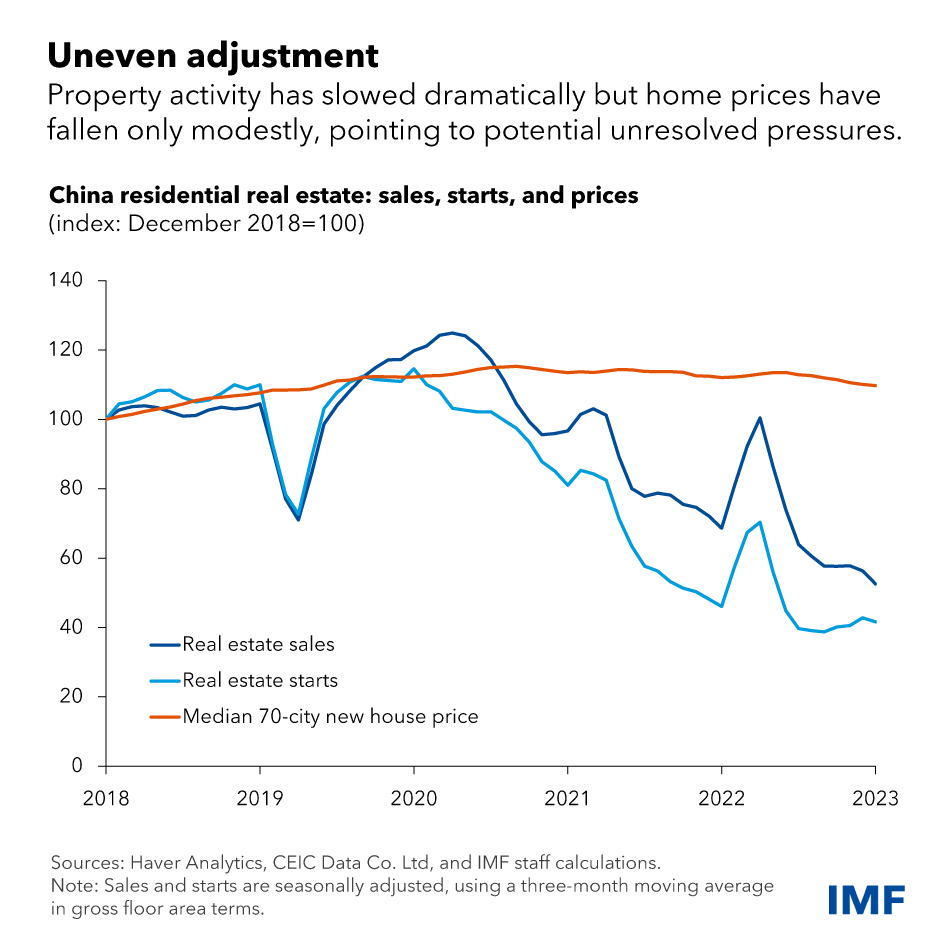
In the years following the COVID-19 pandemic, China’s economy has faltered with a shaky property market and decreased consumer spending, impacting European foreign investments.
At the height of the COVID-19 pandemic in 2020, the Chinese government attempted to crack down on indebted real estate developers to reduce risk to the financial system. This effort pushed housing prices down and weaker companies defaulted.
With a slowdown in the development of pre-paid homes, some homeowners stopped paying mortgages increasing the perceived uncertainty of property investments.
As of mid-2023, housing prices had fallen every month for more than a year and the declining value of homes seemed to negatively impact spending tendencies in China as people adopted a “save-over-spend” mentality.
In the first half of 2024, property investment fell 10.1% from a year earlier. Home sales by floor area declined by 19%. [Reuters]
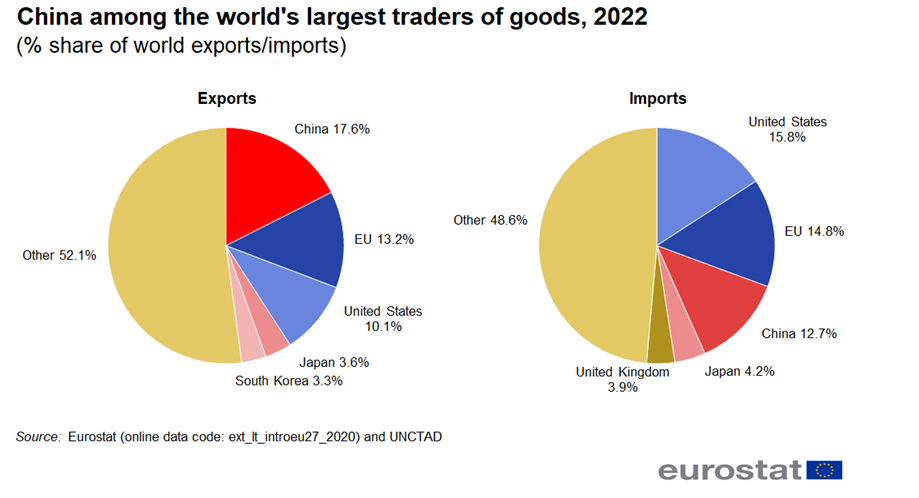
At the end of 2021, China’s exports peaked at a record $340 billion and the country took over as the world’s largest exporter of goods.
All of this led to optimism at the start of 2023 that China would see a rapid recovery in consumer spending after the loosening of both global COVID-19 restrictions and China’s strict Zero Covid policy.
China’s growing tensions with the United States has also played a role in negative economic impact with increasing doubts about future access to technology, markets, and capital. Concerns over the potential for reduced feasibility of regular travel and engagement with the West have also been raised.
The structural slowdown of China’s economy has also been linked to China’s Deleveraging Campaign from 2013 to 2021 which aimed to expand credit and investment to reduce debt within the Chinese economy, particularly in the corporate and local government sectors. [CSIS]
One such tactic under this campaign involved developers replacing one form of borrowing from shadow banks with revenues from sales of homes before their construction.
When housing sales began declining, developers cut back on new land purchases and construction
THIRD PLENUM
Amid these economic challenges, China held its third plenum meeting from July 15-18 presided over by Chinese President Xi Jinping, head of the party’s Central Committee.
In all, there are 7 plenums with the first, second, and seventh focusing on power transitions between Central Committees. The fourth and sixth generally center around party ideology leaving the fifth for five-year development plans and the third to focus on long-term economic reforms. [Reuters]
Following the closure of the third plenum meeting on July 18, the government reiterated China’s commitment to a “new development philosophy,” focused on “high-quality economic development” driven by “all-around innovation” as well as reaching its 5% annual growth target.
The CCP has also shown signs of shifting away from its previous emphasis on raw growth driven by infrastructure investments. [The Diplomat]
The official Chinese Xinhua News Agency reported after the meeting, “High-quality development is the top mission of building a modern socialist country.” [Bloomberg]
IMPACT ON EUROPE
In 2024 so far, China’s economy has continued its slowing trend which has only furthered uncertainty in Europe.
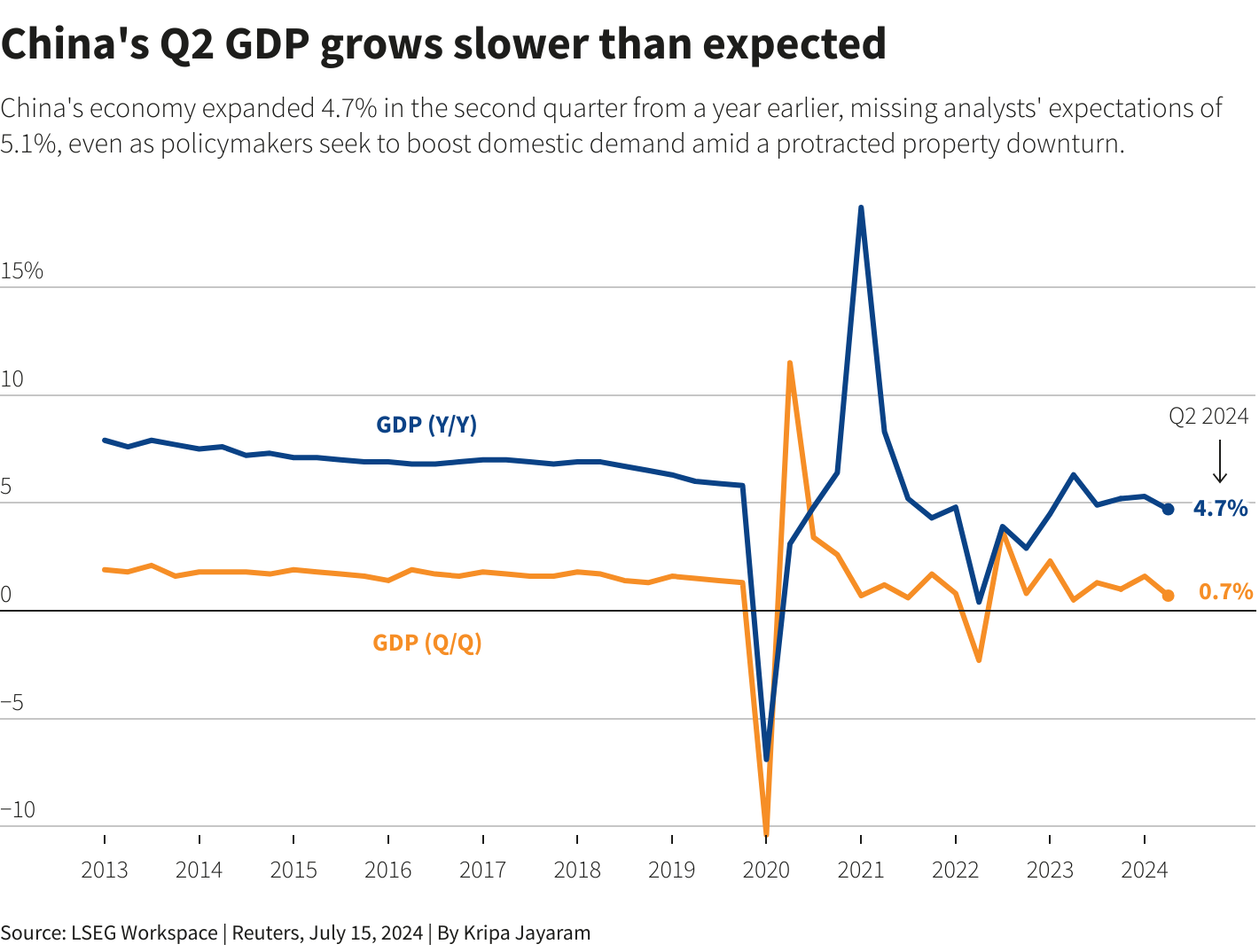
China’s economy, the second-largest in the world, grew much slower than expected in the second quarter of 2024, growing by 4.7% from April to June, its slowest since the first quarter of 2023. [Reuters]
By the end of 2024, the Chinese government is aiming for an economic growth target of around 5.0%, an ambitious target according to some analysts.
This second-quarter growth slowdown prompted investment banking company Goldman Sachs to lower its forecast for China’s 2024 growth to 4.9% from 5.0%.
The consumer sector has remained a major concern during the slowdown as retail sales hit an 18-month low, forcing businesses to cut prices on various products.
In particular, luxury markets in Europe have been hit by China’s slowing economy and decreasing consumer demand.
The Stoxx luxury index, a stock market index that tracks the performance of the top European luxury goods companies was down 1.5% on July 15. [Market Watch]
British fashion brand Burberry reported a quarterly sales decrease of 21% in China with Swiss watchmaker Swatch also reporting a decrease in sales due to weaker demand in China.
Lynn Song, chief economist for Greater China at ING said: “A negative wealth effect from falling property and stock prices, as well as low wage growth amid various industries’ cost cutting, is dragging consumption and causing a pivot from big-ticket purchases toward the basic ‘eat, drink and play’ theme consumption,”
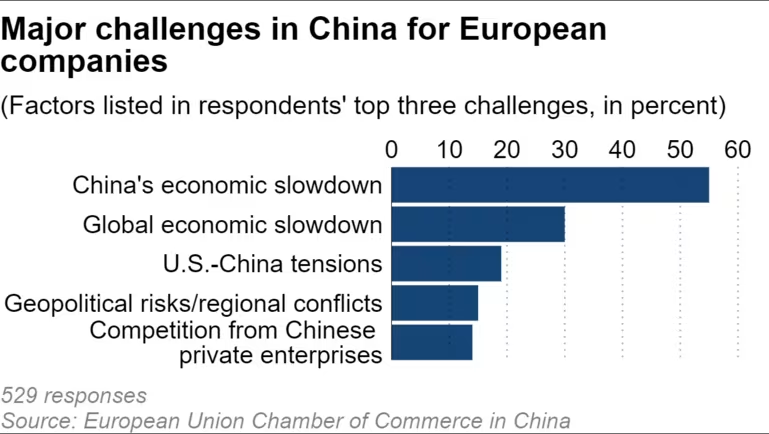
In May the European Union Chamber of Commerce in China said that European companies operating in China are concerned that the slowdown will hurt their profitability.
It also reported in its Business Confidence Survey that the outlook for doing business in China hit its lowest in the report’s 20-year history.
In recent months the US and EU have also accused China of flooding global markets with cheap products to cope with industrial overcapacity. [Nikkei]
Data on China’s inbound foreign direct investment showed a 26.1% decline for the January to March quarter, dampening prospects for a turnaround. [Nikkei 2]
EU Commission chief Ursula von der Leyen and French President Emmanuel Macron urged President Xi Jinping in May to ensure more balanced trade with Europe.
Von der Leyen said at the talks in Paris that the European Union “cannot absorb massive over-production of Chinese industrial goods flooding its market,” [Reuters]
Denis Depoux, global managing director of management consultancy Roland Berger said: “European companies are confronted by growing uncertainties in China, in large part due to economic volatility and less predictable policy direction,”
Opinion:
It is becoming clear that popular Western fears of China overtaking the United States as the world’s top economy have proven exaggerated, with the U.S. still firmly in the lead for the foreseeable future.
China’s decades of growth largely resulted from the historic opening of their socialist economy, which spurred modernization and financial boom. However, as with all nations that experience significant economic runs, a slowdown and structural issues eventually emerge.
The ruling Communist Party remains committed to its authoritarian model, and necessary reforms to reignite economic development may lead them to double down on national security, limiting free-market development and foreign investment.
This could heighten tensions with the West, setting the stage for another global power rivalry between democracy and autocracy, where historically, democracy has often emerged victorious on the economic front. [The Diplomat]
Despite its slowing economy, China’s dominant role in the global economy is undeniable. They lead economically in their region, and a declining Chinese economy will impact the development of its Asian neighbors.
The European Union faces its own challenges, particularly with China as its second-largest trading partner and the EU being China’s largest trading partner. [EEAS]
The European Union will have to deal with its own reliability issues amidst an economically stagnating Chinese— and not to mention the looming potential of an increasingly protectionist United States on the horizon.
This EU-China relationship is becoming more antagonist as of late, as a stagnating China has led to more economic malpractices from the Xi regime which has invited condemnation from the European commission. Top EU and NATO leaders have also recently publicly condemned China’s foreign policy actions and economic enabling of Putin’s war of aggression in Ukraine.
As China’s economy slows, European companies with operations or production bases in China are increasingly worried and may begin exiting the country. This stagnation, coupled with a potential trade war with the West, could create uncertainty in European economies heavily reliant on trade with China.
Germany will be particularly important to monitor, as the EU’s largest economy grapples with recent financial turmoil. For the past eight years, China was Germany’s largest trading partner, until being overtaken by the United States this year. [Reuters]
European governments, including Germany, will need to engage in serious discussions about their economic ties and dependence on the People’s Republic of China. As the economic prowess of the Chinese begins to show signs of decline, these discussions will be crucial in addressing the ripple effects on international trade.
Former President Donald Trump announced his choice of running mate on July 15, picking Ohio Senator J.D. Vance.
Trump made the announcement on his social media network Truth Social, saying: “After lengthy deliberation and thought, and considering the tremendous talents of many others, I have decided that the person best suited to assume the position of Vice President of the United States is Senator J.D. Vance of the Great State of Ohio.”
Soon after the announcement Vance received a formal nomination from the Republican party at the Republican National Convention in Milwaukee, Wisconsin.
The choice of vice presidential candidate is somewhat interesting given that Vance himself was once a strong critic of Trump during the beginning of his political career and during his presidential campaign against Hillary Clinton in 2016.
In the past Vance had dubbed Trump “a total fraud,” “a moral disaster” and “America’s Hitler.”
However, his tone has changed over the years to staunch support for the former president which Vance says was due to Trump’s performance in office.
In 2021, Vance apologized for his criticism of Trump in an interview with Fox News. Last month, he told Fox “Look, I was wrong about Donald Trump. I didn’t think he was going to be a good president,” Adding:”He was a great president, and it’s one of the reasons why I’m working so hard to make sure he gets a second term.”[Fox News]
In 2022, Vance landed a seat in the US Senate representing Ohio after being endorsed by Trump.
In the wake of an assassination attempt on Trump at a rally in Butler, Pennsylvania on July 13, Vance wrote on the social media platform X accusing President Joe Biden’s campaign of inciting the violence.
He wrote: “The central premise of the Biden campaign is that President Donald Trump is an authoritarian fascist who must be stopped at all costs.” He added: “That rhetoric led directly to President Trump’s attempted assassination.”
With the upcoming Presidential election in November, midwestern states are expected to play a critical role in swaying the turnout.
In Trump’s announcement of Vance as his VP pick, he wrote that Vance “will be strongly focused on the people he fought so brilliantly for, the American Workers and Farmers in Pennsylvania, Michigan, Wisconsin, Ohio, Minnesota, and far beyond,” in an appeal to midwestern voters.
In response to Trump’s announcement nominating Vance, Biden’s campaign chair Jen O’Malley Dillon said in a statement: “Donald Trump picked J.D. Vance as his running mate because Vance will do what Mike Pence wouldn’t on January 6: bend over backwards to enable Trump and his extreme MAGA agenda, even if it means breaking the law and no matter the harm to the American people,” [AP News]
The statement was made in reference to an insurrection made by a pro-Trump mob in the US Capitol Building on January 6 2021 following Trump’s loss in the 2020 presidential election.
Meanwhile, President Biden wrote on X: “Here’s the deal about J.D. Vance. He talks a big game about working people. But now, he and Trump want to raise taxes on middle-class families while pushing more tax cuts for the rich.”
If Trump wins in the November election, Vance will be the second youngest vice president, tied with Richard Nixon. Vance’s vacant Senate seat would be filled by Ohio Governor Mike DeWine, a moderate Republican. [Politico]
Opinion:
Leading up to this week’s Republican National Convention, speculation about who Donald Trump would select as his hopeful Vice President had been swirling for months.
Trump’s VP shortlist included names such as North Dakota Governor Doug Bergum, Florida Senator Marco Rubio, South Carolina Senator Tim Scott, New York Congresswoman Elise Stefanik, and Florida Congressman Byron Donalds. [AP News]
Ultimately, Trump chose 39-year-old Ohio Senator J.D. Vance, who the media had tipped as the most likely candidate.
Similar to his 2016 campaign, Trump’s VP choice is clearly made on tactical grounds concerning campaign strategy. His previous running mate, Indiana Governor Mike Pence, was chosen to court evangelical Christian voters. [BBC]
This time, in 2024, Trump selected the up-and-coming young senator J.D. Vance from Ohio, a crucial swing state in the November race. This selection demonstrates Trump’s perceived importance of securing votes from industrial Midwestern battleground states, which will likely decide the upcoming presidential election.
Vance’s background will help Trump focus on courting the demographic of working-class voters.
Vance’s initial rise to popularity came through his personal memoir, “Hillbilly Elegy,” published in 2016. The memoir explains his blue-collar upbringing and how it influenced his worldview and inspiring rise into national politics. [BBC]
Vance appeals to average, lower, and working-class Americans through his own lived experience of the “American Dream,” rising from nothing to become a successful and prominent national civil servant. He also holds an accredited Ivy League law degree and has served in the military.
Although initially an avid “anti-Trumper” during Trump’s first presidential bid in 2016, Vance has since become an outspoken defender of the former President, garnering the support of both Trump and his supporters. He holds similar views on notable policy issues as President Trump, including trade, immigration, foreign policy, and the war in Ukraine. [BBC]
At this point in the presidential campaign race, Trump’s choice for running mate makes sense when considering these factors and the possible choices leading up to the RNC.
Should Trump win in November and return to the White House, J.D. Vance’s role as Vice President, along with his age and political alignment, will likely make him the prospective heir to the MAGA throne and the Republican presidential nomination in 2028.
On Saturday, July 13, shots rang out at a Trump campaign rally in Butler, Pennsylvania, leaving former President Donald J. Trump injured.
Trump was shot at multiple times, with one bullet striking him in the right ear. [Reuters]
The bullet that struck Trump was only an inch from hitting his brain, and had the President not turned his head away from the crowd only a split second before, the former President would not be alive today.
In an exclusive interview given to the New York Post, Trump recounted the event, stating, “I’m not supposed to be here, I’m supposed to be dead.” [The Independent]
This incident marks the most serious attack on a former or current president since Ronald Reagan was shot and wounded in March 1981. [The Economist]
The shooter has been identified as 20-year-old Thomas Matthew Crooks from Pennsylvania. His political affiliations are unclear, as records show he is a registered Republican who has previously donated to Democratic groups and campaigns. [ABC News]
Crooks used an AR-15 from a rooftop about a football field-length away from the stage, firing multiple shots at the former President and grazing his ear. Crooks was shot and killed by a Secret Service counter-sniper within three seconds of opening fire on Trump.
The attack also claimed the life of 50-year-old former fire chief Corey Comperatore, who was shielding his family in the crowd, reports AP News. Two other bystanders were seriously injured in the incident. [AP News]
An investigation has been launched and is ongoing to uncover more details about the planned assassination. The direct motives of the shooter remain unknown.
International Reactions
The shooting of Donald Trump generated a wave of international response, with numerous world leaders condemning the attempted murder of the former President.
“I’m sickened by the shooting at former President Trump. “It cannot be overstated – political violence is never acceptable. My thoughts are with former President Trump, those at the event, and all Americans.” – Canadian Prime Minister, Justin Trudeau
“I am appalled by the shocking scenes at President Trump’s rally and we send him and his family our best wishes. Political violence in any form has no place in our societies and my thoughts are with all the victims of this attack.” – U.K. Prime Minister, Keir Starmer
“The attack on US presidential candidate Donald Trump is despicable. My thoughts are also with all of those who were affected by the attack. Such acts of violence threaten democracy.” – German Chancellor, Olaf Scholz
“The desperation of the international left, which today sees its nefarious ideology expiring, is not surprising. In panic of losing at the polls, they resort to terrorism to impose their backward and authoritarian agenda.” – Argentinian President, Javier Milei
“Violence has no place in politics and democracies. Our thoughts and prayers are with the family of the deceased, those injured and the American people.” – Indian Prime Minister, Narendra Modi
“This wasn’t just an attack on Donald Trump. This was an attack on a candidate for the presidency of the United States. This was an attack on America. It was an attack on democracy.” – Israeli Prime Minister, Benjamin Netanyahu
“An attempt on the life of Donald Trump, a heinous crime. One that can only be condemned, and which shows how serious the global challenges to democracy are right now. Violence in any form and anywhere must not prevail.” – Ukrainian President, Volodymyr Zelenskyy
The Chinese Ministry of Foreign Affairs issued a statement claiming they are “following the shooting incident” and that Xi Jinping has “expressed sympathies to former President Trump” [U.S. News]
A Kremlin spokesperson issued a statement saying ““We do not believe that the attempt to eliminate and assassinate Trump was organized by the current authorities. But the atmosphere around candidate Trump provoked what America is confronting today.” [U.S. News]
The spokesman also said there were no plans for Putin to call Trump in connection with the incident. [Reuters]
Opinion:
The immediate reaction to the assassination attempt displayed the prevalence of misinformation and conspiracy theories. The Left claims it to be a staged set-up to sway public opinion and garner support. Meanwhile, many on the Right believe it to be an inside job due to the security breach and Secret Service misjudgment, as well as the astonishing lack of vulnerability for a former President.
Overall, the entire country should feel extremely fortunate that Trump’s life was not taken on live television. Such an event would have undoubtedly plunged our nation into absolute chaos, with protests and riots likely to have ensued. The likelihood of counter-violence and a response from Trump supporters would have been dangerously high, throwing the highly contentious and consequential November election into utter plight.
Both parties and the entire country feel the urgent need to lower political tensions as polarization has reached a clear and evident boiling point. Political violence should never be a characteristic of American democracy, and it is extremely alarming to see this trend emerging more frequently over the last few years.
Former President Trump should make it clear in his first public speech about the attack, likely at this week’s Republican National Convention in Milwaukee, that no one should retaliate or seek vengeance in his name by any means. He must emphasize, as his presidential opponent should, that political violence has absolutely no place in any democracy, especially in the United States.
In light of the recent incident, the Biden campaign has temporarily taken down Democratic ads openly criticizing Trump. This reaction follows a public address to the nation on Sunday by President Joe Biden, who condemned the attack and emphasized the need for national unity and to “lower the temperature in our politics.” [The Guardian]
This shocking event has thrown the Democratic presidential campaign into short-term disarray. Both President Joe Biden and Vice President Kamala Harris canceled and postponed planned speeches for early this week.
It is clear that following the solemn mood surrounding Saturday’s attack, the Biden team is now forced to pivot away from outright criticism of former President Trump.
Both Biden and Vice President Kamala Harris have labeled Trump as an “existential threat” and the biggest possible danger to the future of American democracy. [Vox]
It is hard not to attach some blame to this aggressive rhetoric in light of the recent attempt on the former President’s life.
It will be interesting to see how the Biden campaign adapts after a terrible few weeks, including an abysmal debate performance and ongoing calls from senior Democrats for his resignation from the nomination.
With Donald Trump now surviving an assassination attempt, public opinion will likely shift in his favor as we approach November’s election. Meanwhile, Biden’s campaign and chances of reelection seem shakier and less likely than ever.
F-16 fighter jets will be deployed to Ukraine for first time and after over a year of pleads from Zelenskyy
Jens Stoltenberg wraps up his ten-year term as Secretary General of NATO; receives Presidential Medal of Freedom from Joe Biden
Bloc support for Ukraine and a collective commitment to ensuring their path to alliance membership
Joint Communique outlining at least 40 billion euros in aid for Ukraine
Leaders:
UK PM Keir Starmer dismisses doubts over Biden’s cognitive capabilities and their nascent relationship is characterized by friendly remarks.
Turkey’s President Recep Tayyip Erdogan accuses Biden and the US of being complicit in Israeli war crimes in Gaza, questioning international law if a nation like the US does nothing about what he deems inexcusable in Palestine.
NATO member Turkey has denounced Israel’s assault on Gaza, halted trade with it, and voiced support for Hamas. Erdogan has repeatedly criticized Western countries for backing Israel and called for Israel to be punished by international courts. Last month, he expressed his nation’s solidarity with Lebanon amidst rising tensions and the potential for a wider regional war between Israel and Iranian-backed militia Hezbollah.
“We are an unwavering NATO ally. However, we do not believe that this impedes our ability to establish positive relationships with nations such as China and Russia,” Erdogan told Newsweek. [Reuters]
U.S. President Joe Biden gave a solo speech towards the end of the summit, where he cordially handed off the stage to Ukrainian President Volodymyr Zelenskyy, mistakenly introducing him as “President Putin” before correcting himself.
European leaders defended him afterwards, with French President Emmanuel Macron and German Chancellor Olaf Scholz both reiterating that slips of the tongue are normal and “happen to everyone.” Ah yes, that certainly seems to be the case with good ‘ol Joe.
Following NATO’s announcement of a common stance supporting a path to Ukrainian accession, Slovakian PM Robert Fico publicly expressed his dismay over the decision.
Fico emphasized his concerns by stating, “I understand Ukraine’s wishes, it is a sovereign country, but Ukraine’s membership in NATO is just a guarantee of World War III.” [Politico]
Fico has remained one of Europe’s main leaders against providing military aid to Ukraine and has downplayed the severity of the conflict.
He also voiced support for Hungarian Prime Minister Viktor Orban’s recent attempts at acting as a rogue diplomatic peacemaker, stating that he “would have liked very much to have joined him” in his recent meeting with Russian President Vladimir Putin. [Politico]
Orban’s sporadic visits to Ukraine, Russia, China, and now the United States for this week’s NATO summit have generated significant criticism from most EU leaders, many of whom claim that Orban does not diplomatically represent the bloc despite his current role as rotating President of the EU Council. In contrast, Slovakia’s leader Robert Fico is notable for his open praise of the Hungarian PM’s efforts.
China:
A draft communique from the summit took notable shots at China, labeling the country as an enabler of Russia’s war effort in Ukraine due to their ongoing trade relations and third-party undermining of Western sanctions.
The resolution called on China to cease all support for Russia’s war effort against Ukraine. The alliance’s draft communique further claims that Beijing continues to pose systemic challenges to European security. [Reuters]
China’s foreign ministry responded to these accusations as mere smears and lies, claiming that the resolution was “biased and “sowing discord”. [AP News]
The PRC’s spokesperson, Lin Jin, stated that these claims are belligerent provocations and NATO’s way of shifting blame rather than taking concrete action to try and end the war in Ukraine. He asserted that “China’s core position on the Ukraine issue is to promote peace talks and a political settlement, which has been widely recognized and appreciated by the international community.” [Reuters]
Hungary’s representatives also openly opposed these condemnations of China, with Foreign Minister Peter Szijjarto emphasizing that Hungary does not want NATO to become an “anti-China bloc”.
He further highlighted that China is an important trade and investment partner for Hungary.
This contrasts with many other European member states that are trying to divest and shift economic dependence away from China. Hungary’s government has also doubled down on their opposition to the bloc’s dedication to Ukrainian NATO membership. With fears of direct confrontation and escalation with Russia, Hungary has maintained this divergent position throughout the conflict.
“Ukraine’s admission wouldn’t strengthen but weaken the alliance’s unity, as there are completely different viewpoints on their membership,” Szijjarto said. [Reuters]
NATO boss Jens Stoltenberg doubled down on his antagonization of China later in the summit when commenting on recent joint military exercises between China and Belarus.
Stoltenberg expressed concerns over China’s increasing levels of cooperation with Russia and Belarus, claiming that the East Asian power is moving closer and closer to NATO on basically every continent.
He even labeled the PRC as an authoritarian regime and openly criticized the nation’s treatment towards their neighbors and own population.
“We are speaking about authoritarian regimes. China is oppressing its own people, cracking down on democratic voices … in Hong Kong, more assertive behavior in the South China Sea, threatening neighbors, threatening Taiwan”, stated Stoltenberg. [Politico]
In the ongoing trade war between the West and China, a new battlefront has emerged over electric vehicles (EVs).
In May, the United States imposed a 100% duty on Chinese EVs as part of broader measures against Chinese tech. On July 2, Canada launched a consultation on “unfair Chinese trade practices” in the EV industry. Two days later, the European Union enacted a provisional tariff of 37.6% on Chinese EVs. On July 10, China’s Ministry of Commerce indicated it would investigate whether the EU’s tariffs create barriers to free trade, signaling its intention to retaliate. [The Economist]
Western car manufacturers with significant operations in China fear becoming collateral damage in this conflict. Chinese government agencies have already been directed to remove American-made software and hardware from firms like IBM, Microsoft, and Oracle, citing national security concerns. [The Economist]
Valdis Dombrovskis, the EU’s top trade official, dismissed concerns of retaliation from Beijing after the European Commission imposed tariffs on Chinese EVs ranging from 17.4% to 37.6%. These tariffs, lower than the US’s 100% duty, supplement the existing 10% duty on Chinese EV imports. [The Guardian]
After an eight-month investigation, the European Commission found that companies making electric cars in China benefit from substantial government support, allowing them to undercut EU rivals on price, gain significant market share, and threaten European jobs. [AP News]
European Commission President Ursula von der Leyen expressed concerns about job losses due to these imbalances during her meeting with Chinese President Xi Jinping. China has signaled potential tit-for-tat measures, investigating French cognac and pork imports over subsidies. [The Guardian]
The Chinese commerce ministry accused the West of escalating trade frictions.
The customs duties will be provisional, meaning they will be totaled up but won’t need to be paid until confirmed by a vote of EU governments before November 2. They were announced on June 12 and will go into effect this Friday. [AP News]
The EU will only collect the duties if it finds that the European auto industry would have suffered material harm without them. This timeline gives the EU and the Chinese government time to negotiate, with talks already held between Valdis Dombrovskis, the EU commissioner for the economy, and Chinese Trade Minister Wang Wentao.
China has rapidly gained a 25% share of the EU market for electric battery-powered cars, up from 3% in 2020. EU officials fear without action, Europe’s EV industry, which employs millions, could be severely harmed.
Importers of Chinese vehicles will now provide bank guarantees to cover the new duties, pending a final decision on permanent tariffs in the autumn. Provisional tariffs for BYD are set at 17.4%, Geely at 19.9%, and SAIC at 37.6%. Despite opposition from Germany, the tariffs will likely remain, requiring a weighted majority of 15 EU member states to overturn. [The Guardian]
The Biden administration is raising tariffs on Chinese EVs to 100% from the current 25%, effectively blocking nearly all Chinese EV imports. In contrast, Europe’s planned tariffs are aimed at leveling the playing field by approximating the size of the subsidies available to Chinese carmakers, rather than blocking imports entirely. [AP News]
EU officials argue that while affordable electric cars from abroad are necessary to achieve greenhouse gas reduction goals, they should not come at the cost of fair competition.
The trade war over EVs between the West and China continues to escalate, with significant implications for global trade and the automotive industry. As both sides maneuver for advantage, the impacts on international markets and geopolitical relations remain uncertain.
Opinion:
China is now in a peculiar position. On one hand, China must appear firm against accusations of flooding markets with subsidized products. On the other hand, with a slowing economy, China wants to signal openness to foreign investment. China might opt for a measured response, possibly imposing export restrictions on crucial minerals like gallium and germanium, essential for electronics in EVs.
The rapid growth of Chinese EV manufacturers has sparked fears that these Chinese cars will threaten the EU’s ability to produce its own green technology and jeopardize the jobs of 2.5 million workers in the auto industry and 10.3 million more people indirectly dependent on EV production. Flashbacks to the EU’s experience with subsidized Chinese solar panels wiping out European producers has heightened these concerns.
The impact of these duties on car prices remains uncertain. Chinese carmakers might absorb the duties through lower profits instead of raising prices. While consumers might benefit from cheaper Chinese cars in the short term, allowing unfair practices could eventually reduce competition and increase prices.
Currently, Chinese carmakers often sell their vehicles in Europe at higher prices than in China, focusing on profits over market share. However, there is a fear that Chinese competitors might lower their prices to increase their market share in Europe.
Beijing has sharply criticized the higher duties, calling them “a naked act of protectionism.” [AP News]
The Chinese Commerce Ministry has noted that several rounds of technical consultations have been held and hopes for a mutually acceptable solution. China could retaliate against European products and luxury imports.
Over the longer term, Chinese carmakers might try and avoid tariffs by manufacturing cars in Europe, with BYD building a plant in Hungary and Chery planning a joint venture to build cars in Spain’s Catalonia region. [AP News]
These developments could be intriguing as the commercial tit-for-tat will heavily depend on the outward stances of EU member states towards the PRC and the perceived instability it could cause.
Currently, it is evident that the bloc is not entirely unified in its suspicions and diplomatic relationship with China. The progression and diversity of opinions on the national and economic security threat posed by China will shape the potential future escalation of the developing trade war between the East Asian power and the broader Western world.
Washington, DC – At the NATO Summit celebrating the alliance’s 75th anniversary, President Joe Biden delivered a speech confidently declaring positive assertions for Ukraine’s victory in the ongoing war and the determination to halt Putin’s advances.
“Today NATO is stronger than it’s ever been in its history,” Biden asserted. [Reuters]
Ukraine aims to increase pressure on the Biden administration during this week’s summit, pushing for the removal of restrictions on using American-supplied weapons in Russian territory.
Andriy Yermak, a top adviser to President Volodymyr Zelenskyy, revealed in an interview with POLITICO that Ukraine seeks permission to deploy longer-range Army Tactical Missile Systems for strikes inside Russia. [Politico]
Currently, Ukraine uses these weapons in Crimea but wants U.S. approval to launch them from other areas.While the U.S. granted limited permission in May for strikes near Kharkiv, the White House has prohibited using long-range missiles against targets deep within Russia.
The U.S. remains cautious, fearing such strikes could provoke Russian President Vladimir Putin to escalate the conflict. However, Yermak argues that these concerns should not overshadow Ukraine’s need to retaliate effectively against Russian aggression.
NATO Secretary General Jens Stoltenberg stated that he expects NATO leaders to agree on a substantial new aid package for Ukraine. Results from the summit are likely to include advanced air-defense equipment, new military training centers, and more than sixty F-16 fighter jets. [The Economist]
A primary goal of the summit is to ensure Ukraine remains on an expected and “irreversible” path to NATO membership. Additionally, the U.S. decided to deploy long-range missiles to Germany by 2026, marking the first stationing of such weapons since the Cold War, sending a clear message to Putin.
This is also an open and confirmatory violation of the Intermediate-Range Nuclear Forces Treaty signed by the U.S. and Soviet Union in the late 80s, a mutual agreement to minimize and deplete their arsenals of intermediate and short range land missiles.
The treaty collapsed in 2019 due to U.S. claims of continued Russian violations.
The stationing of long range ICBMs in Germany displays a clear message to Putin, as this caliber of American weapons being stationed on the continent has not occurred since the Cold War [Reuters]
Opinion:
President Joe Biden appears to be focusing on foreign policy as his presidency progresses. He is likely to continue emphasizing his robust military support and funding for Ukraine, especially following his poor performance in a recent debate against presidential election opponent, Donald Trump.
Biden’s approval ratings have dropped, and concerns about his cognitive ability to serve another term are at an all-time high, with several Democratic members of Congress calling for him to step down from the nomination.
With the ongoing conflict between Russia and Ukraine, NATO’s role is under intense scrutiny, particularly given Donald Trump’s critiques and his questionable commitment to NATO. These concerns have already shaken alliance members, leading to an 18% increase in defense spending among allies this year. [Politico]
Part of this increase might be an effort to “Trump-proof” the alliance, though political and geographic factors also play a significant role in spending habits.
For countries bordering Russia, such as the Baltic states and Poland, fortifying defense systems and maintaining a strong commitment to NATO is crucial. Poland, for example, has allocated 4% of its annual GDP to defense spending, with President Andrzej Duda calling for allies to raise the target spending percentage to 3% of annual GDP. [Politico]
In contrast, smaller nations farther from Russia have less justification and incentive to meet the annual GDP percent requirement on defense.
Europe’s security is fragile, and the threat posed by Russian aggression will likely lead to increased focus and spending on national security and defense. The potential for a second Trump term adds to the unpredictability, prompting European NATO leaders to strive for unity and heightened attention on stopping Russia and defending Ukraine as the war escalates.
To promote stability and counter the unpredictability of a potential NATO future under Trump, Biden will likely assert that the United States will remain a leading protector of the alliance. He will contrast this with the image of Trump as an unpredictable wildcard who could destabilize Europe and appease Putin.
The Biden administration has repeatedly surpassed previous limits on military support for Ukraine, with President Volodymyr Zelensky urging the U.S. to allow deeper strikes into Russian territory.
They remain hesitant on this move as it will almost certainly provoke a sharp response and further escalation from Russian President Vladimir Putin. Many leaders even fear an expansion of the war that leads to direct confrontation between Russia and NATO.
Biden’s steadfast support for Ukraine and its resilience against Russian aggression remains one of his few avenues for garnering additional campaign support, as he continues to face calls for his resignation ahead of the upcoming November election.
 IRinFive