9/1- Geopolitical News & Diplomacy Analysis
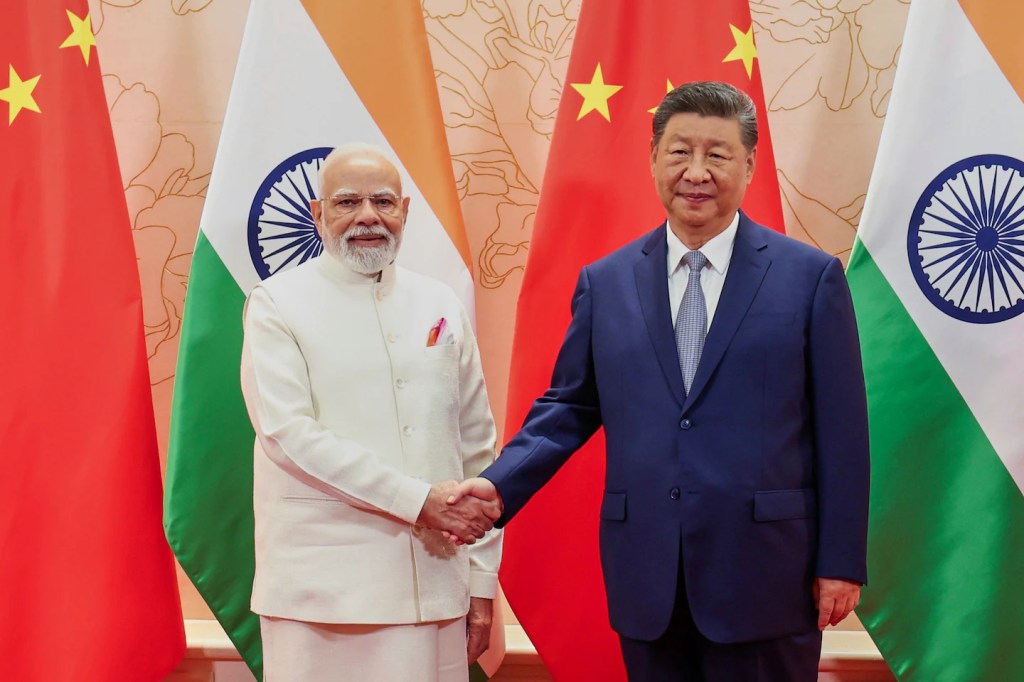
Chinese President Xi Jinping, Indian Prime Minister Narendra Modi, and Russian President Vladimir Putin came together in the port city of Tianjin for the 2025 Shanghai Cooperation Organization (SCO) summit. With over 20 world leaders in attendance, the summit marks a potential inflection point in the geopolitical landscape, reflecting growing solidarity among Eastern powers representing the Global South amid rising tensions with the West.
Multipolar Vision and Realigned Alliances
Launched in 2001 as a political and security bloc to counter Western hegemony, the SCO has grown from six founding members—China, Russia, Kazakhstan, Kyrgyzstan, Uzbekistan, and Tajikistan—to a 10-member coalition, now including India, Pakistan, and Iran, with 16 other nations acting as observers or dialogue partners.
This year’s summit, one of the most significant since the organization’s founding, took place amid a backdrop of escalating global instability. Washington’s imposition of steep tariffs—particularly a 50% levy on Indian goods in response to New Delhi’s continued purchase of Russian oil—has complicated U.S.-India ties, while Moscow remains heavily sanctioned over its war in Ukraine.
In this context, the Tianjin summit served as both a geopolitical statement and a diplomatic recalibration. It underscored Beijing’s ambition to lead a new “multipolar world order” and displayed a growing alignment between India and China— two historic rivals.
Prime Minister Modi’s presence in China, his first visit in seven years, was a headline event. His bilateral meeting with Xi on the sidelines of the summit conveyed a message of tentative rapprochement after years of tension and border clashes.
According to Indian officials, Modi emphasized the restoration of “peace and stability” along the Line of Actual Control (LAC), stating that both nations had reached an understanding on border management. Though specific details remain undisclosed, the agreement signals an effort to move beyond military standoffs that have frozen ties since 2020.
President Xi reiterated that the border issue should not dominate the bilateral agenda, encouraging both sides to view each other as “partners, not rivals.” He also expressed the view that the two nations, representing the world’s largest populations and fastest-growing economies, have a duty to shape what he called the “Asian Century.”
Resuming direct flights between India and China—a move suspended since 2020—was another symbol of warming ties. Modi further welcomed Chinese commitments to lift export restrictions on critical goods such as rare earth elements, fertilizers, and tunnel-boring machinery, while stressing the need to reduce India’s trade deficit with China, which reached a record $99.2 billion this year.
Modi’s Strategic Pivot
Modi’s posture at the summit reflected a nuanced shift in India’s global strategy. As the U.S.-India relationship shakens over sanctions and tariffs, New Delhi is reasserting its doctrine of “strategic autonomy”—engaging with Beijing not as a submissive junior partner but as a peer in the Global South.
In remarks shared by India’s foreign ministry, Modi clarified that the India-China relationship should not be framed through the lens of third-party influence, a veiled critique of Washington’s framing of India as a “bulwark” against China. Instead, Modi highlighted the importance of mutual respect, non-interference, and partnership on global challenges such as terrorism and fair trade.
This recalibration appears rooted in pragmatic calculations: With both Washington and Beijing exerting pressure in different forms—one through sanctions, the other through border tensions—New Delhi is hedging its bets. Analysts suggest that Modi’s participation in the SCO summit alongside autocrats like Putin and Xi is a strong signal that India refuses to be boxed into binary alliances.
President Putin’s appearance was equally symbolic. Arriving in Tianjin to a red carpet welcome, he stood firm in opposition to Western “discriminatory sanctions” on global trade. Russia’s presence, alongside other heavily sanctioned states such as Iran, North Korea, Belarus, and Myanmar, highlighted the SCO’s role as a safe diplomatic space for isolated regimes.
Putin will remain in China through Wednesday to attend a massive military parade commemorating the end of World War II. Other leaders, including North Korea’s Kim Jong Un, Serbia’s Aleksandar Vučić, and Slovakia’s Robert Fico, are also expected at the parade.
Putin’s rhetoric emphasized a joint Russian-Chinese front against Western economic coercion, with Beijing echoing similar sentiments through its ambassador to India, who promised that China would “firmly stand with India” against unjust tariffs.
New Era Symbolism
The summit itself, while largely ceremonial, carried significant symbolic weight. Hosted in a city blanketed with SCO banners and filled with light shows and public spectacles, the gathering underscored China’s desire to cement itself as a hub of an alternative world order.
At a formal reception, Xi told leaders that the SCO now bears greater responsibility for regional stability, economic development, and the defense of sovereign interests—particularly in contrast to Western-dominated forums like NATO or the G7.
Behind closed doors, the leaders discussed common challenges: the rise of protectionism, regional terrorism, and unequal development, with a focus on strengthening multilateral mechanisms to address these issues. Modi called for reforms in global trade norms and proposed deeper coordination in areas like border security and counterterrorism, while also calling out the need for greater economic fairness in international platforms.
India’s foreign secretary Vikram Misri summarized the Modi-Xi meeting as a milestone for re-establishing “deepening trust” and underscored that strong India-China relations are essential for realizing the vision of an “Asian Century.”
Despite the progress, deep-rooted tensions persist. India continues to express concern over China’s construction of a mega-dam in Tibet, which could severely disrupt water flows on the Brahmaputra River. Beijing’s long-standing support for Pakistan—India’s arch-rival—adds another layer of complexity to Sino-Indian relations.
Moreover, India’s hosting of the exiled Dalai Lama remains a sore point for Beijing, which regards him as a separatist threat. These issues, coupled with the unresolved border demarcations and the massive trade imbalance, represent structural challenges that will test the durability of this renewed diplomatic effort.
Analysis:
This SCO summit reflects a critical juncture in global geopolitics. For decades, the West—particularly the United States—banked on India as a democratic counterweight to China. But that strategy appears to be unraveling. Washington’s punitive tariffs have accelerated India’s pivot toward self-reliance and multipolar diplomacy.
What’s emerging is not a simple alliance between autocracies, but a more complex network of relationships based on national interest, regional autonomy, and strategic diversification. India’s rapprochement with China signals that it will not allow itself to be a pawn in a new Cold War between the U.S. and China.
Instead, nations like India are carving out space in the emerging “multipolar” world not by choosing sides, but by balancing them. The West may now need to revisit its assumptions about partnership, power, and influence in the 21st century that will not be characterized by the bipolar Cold War nature it operated in throughout the previous century.
The United States and its Western allies must prepare themselves for more of these summits and the proliferation of diplomatic ties between autocratic nations aiming to form a counterweight to the longstanding neoliberal world order.
 IRinFive
Leave a comment