7/13 – Geopolitical Analysis Piece – Part 1
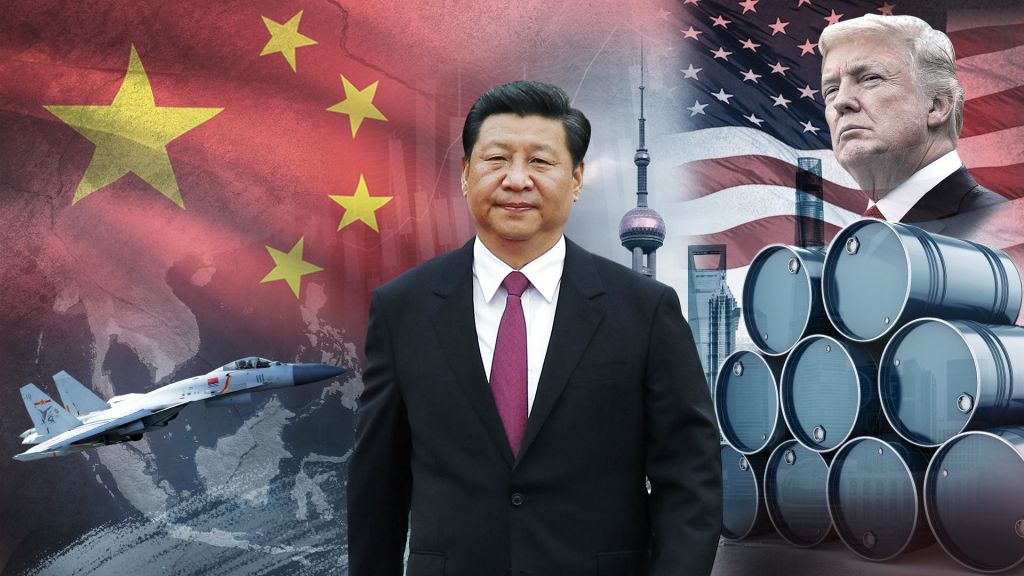
As President Donald Trump intensifies his economic offensive against China through tariffs, export controls, and diplomatic pressure, Chinese leader Xi Jinping seems to be playing a much longer and more calculated game. For Xi, this is not simply a trade war—it is a full-spectrum Cold War, informed by decades of internal study, historical caution, and strategic design.
Where Trump sees leverage in economic pain, Xi sees opportunity in endurance. His goal isn’t to win every battle. It is to survive long enough to outlast the United States and win the war by enduring past their decline.
According to advisers close to the Chinese leadership, Xi is pursuing what he calls a “strategic stalemate”—a scenario in which China doesn’t have to decisively defeat the U.S. but can neutralize American pressure and buy time to catch up economically, technologically, and militarily.
Learning from the Soviet Collapse
This doctrine of “strategic patience” has roots in both Chinese revolutionary history and Cold War studies. Xi and his top advisors have spent years studying the mistakes of the Soviet Union. From their perspective, Moscow lost the original Cold War because it exhausted its economy in an arms race, failed to diversify its industries, and allowed ideological disarray to fracture the state from within.
Xi’s solution: build resilience, avoid direct confrontation, and outlast American pressure. The Chinese leadership increasingly sees this not as a temporary spat, but as a generational conflict.
The lessons Xi has drawn from Soviet failure are deeply embedded in Beijing’s modern governance. The first is economic: whereas the Soviets focused narrowly on heavy industry and military production, Xi is determined to fortify China’s capacity to produce everything—from microchips to medicine—so that the country cannot be easily crippled by sanctions or technological decoupling.
The second is geopolitical: where the USSR ended up isolated in a rigid bloc, China is promoting “multialignment”—building diverse partnerships across Asia, Africa, and Latin America to weaken U.S. alliances and resist containment. This is central to the reimagined Belt and Road Initiative, which Xi has recalibrated to make Chinese lending more sustainable and appealing, particularly to Global South nations wary of Western finance.
Third, Xi is deliberately avoiding a costly arms race. Though China’s defense spending has risen steadily at around 7.2% annually, it remains modest relative to GDP—suggesting a desire to modernize, not overwhelm. Quietly, however, China is expanding its military influence in the Arctic, Pacific, and cyberspace.
And finally, Xi’s most enduring lesson from the Soviet Union’s fall is ideological control. In a 2013 speech to senior officials, Xi pointed to Gorbachev’s embrace of openness as a fatal mistake. “In the ideological domain, competition is fierce,” he warned, and made clear that no challenges to the Communist Party’s authority would be tolerated. Since then, the centralization of power has only intensified.
Trump’s Trade War
The 2018–2019 trade war under Trump’s first term served as the inflection point. Trump’s aggressive use of tariffs, national security justifications, and rhetoric about “making America great again” convinced Xi that the U.S. was not interested in partnership, but in preserving dominance at any cost.
China’s response came in the form of “dual circulation,” a major economic pivot announced in 2020. The idea: reduce dependency on foreign supply chains and insulate China’s economy while continuing to flood global markets with Chinese goods. It was Cold War logic cloaked in globalization.
Tensions further escalated under President Biden, whose policies largely continued Trump’s approach. In response, Xi doubled down—expanding ties with Russia, pushing multilateral diplomacy, and deepening China’s presence in emerging markets. Just before the Russian invasion of Ukraine in 2022, China and Russia declared a “no limits” partnership—another Cold War-era signal of alignment.
But unlike the USSR, China is resisting full isolation. Even as Xi prepares for economic decoupling from the West, he is careful to remain plugged into the global system. Beijing has ramped up charm offensives in Africa, the Middle East, and Southeast Asia while avoiding direct conflict with the EU or U.S.-aligned economies like Japan and South Korea.
While Trump dismantles institutions like the U.S. foreign aid agency and slashes international broadcasting, China is filling the vacuum. Beijing is now sponsoring trips for Western social media influencers and pushing curated images of Chinese modernity.
One of the most viral examples came earlier this year, when American content creator IShowSpeed spent 10 days in China. His videos, showcasing high-speed trains, electric cars, and vibrant urban life, garnered hundreds of millions of views and cast China in a positive light—an unexpected but undeniable soft-power win for Beijing.
Meanwhile, Xi is trying to restore regular “dialogues” with Washington, even as the Trump administration views them as pointless. For Beijing, these talks are not about immediate breakthroughs, but about delaying escalation and maintaining a controlled tempo.
The Risks of Protracted Struggle
Despite its methodical approach, China’s long game is not without risks. Domestically, the tightening of political control and state-centered economic policies are dampening private enterprise and innovation. Deflationary trends, youth unemployment, and a fragile property sector have exposed cracks in the Chinese economy. Xi’s efforts to “produce everything” are fueling overcapacity and inefficiencies.
Yet to Xi, these are manageable sacrifices. The greater aim—surpassing the U.S. in critical technologies, solidifying the party’s control, and reshaping global institutions—is worth the short-term pain.
Analysis:
What we are witnessing is a Cold War reimagined. Trump may be throwing punches with tariffs and sanctions, but Xi is waging a war of attrition, drawing lessons from past empires and betting on long-term U.S. exhaustion.
This asymmetry may explain why U.S. pressure campaigns often yield little in the way of behavioral change. While the Trump administration pivots rapidly—from aggressive decoupling to exploratory trade deals—Xi’s approach is slow, deliberate, and systematized. He is not seeking to defeat America outright—but to erode its dominance over time.
 IRinFive
Leave a comment