7/8 – International News & Diplomacy Analysis
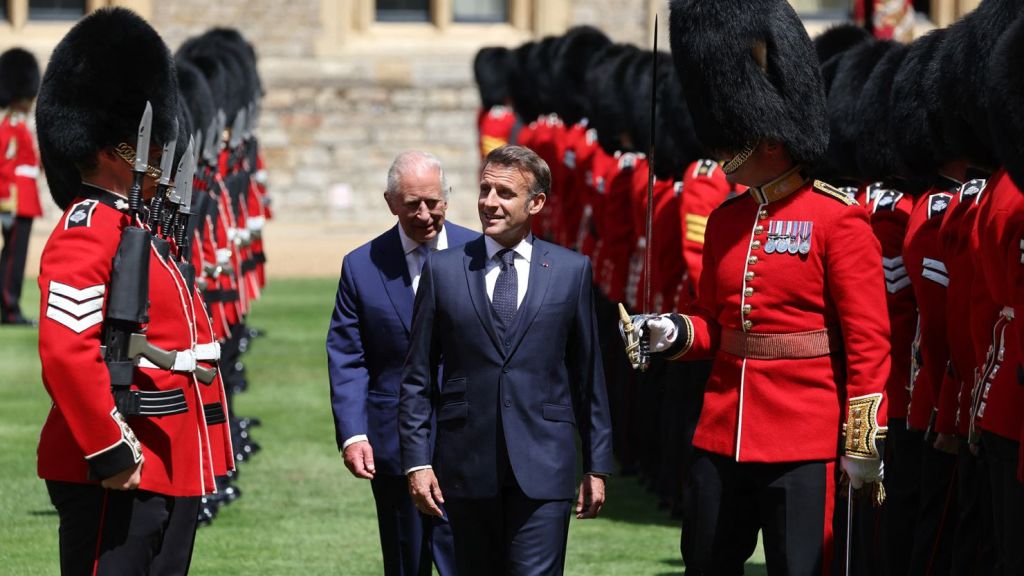
When Keir Starmer met Donald Trump at the White House earlier this year, the British prime minister handed over an invitation from King Charles for a state visit to the United Kingdom. Yet, the first foreign leader to arrive at Windsor Castle won’t be the U.S. president —it will be French President Emmanuel Macron. In a three-day affair rich with pageantry and political symbolism, Macron becomes the first to receive the full state welcome from the British monarch in 2025.
His visit marks a significant milestone in post-Brexit diplomacy: a formal chilling in cross-Channel relations that had, until recently, grown cold with mutual distrust, geopolitical shocks, and public squabbles.
In the aftermath of the Brexit vote in 2016, relations between London and Paris hit modern historic lows. British officials viewed Macron as a punitive Europhile eager to make an example of the UK, while France seethed over Britain’s perceived betrayal in the AUKUS submarine pact, which torpedoed a French-Australian deal in favor of Anglo-American defense cooperation.
Yet by 2023, the tide began to shift. Diplomatic meetings resumed after a five-year hiatus, culminating in a glittering state dinner in Versailles. Macron touted proclamations of their “convergence of destinies,” and King Charles delivered a bilingual speech, signaling goodwill and renewal. This week’s reciprocal gesture—the king hosting Macron at Windsor Castle and Macron addressing Parliament—cements that progress.
A Strategic Realignment
At the core of the renewed alliance is a shared strategic agenda. As Europe’s only two nuclear powers and permanent UN Security Council members, France and Britain are reigniting military cooperation. The 15-year-old Lancaster House Treaties, which bind the two countries on mutual defense commitments, will be updated to include a broader European security dimension. Both sides are exploring tighter nuclear coordination—even though France’s deterrent is independent and Britain’s is tied to NATO.
Macron is also advocating for a stronger joint European posture on Arctic and Baltic security, wary of instability near Russia’s borders. As part of NATO’s forward presence, the UK and France already collaborate in Estonia. Macron and Starmer now want to build on that with increased coordination on Ukraine.
Macron’s Message to Westminster
On the ceremonial first day of his visit, Macron became the first European leader since Brexit to address both Houses of the British Parliament. Speaking from the historic Westminster Hall, he called for a new era of Anglo-French leadership in Europe’s defense. “Our two countries have a special responsibility for the security of the continent,” Macron declared, invoking the legacy of Winston Churchill as he appealed for unity in the face of “destabilizing powers” that defy international norms.
He made an impassioned case for greater European self-reliance, warning against the dangers of overdependence on both the United States and China. Though careful to distinguish between the two, Macron’s comments on “derisking” Europe’s strategic dependencies were unmistakably aimed at recalibrating the continent’s balance of power. His call for “strategic autonomy”— a longtime pillar of his foreign policy—was made not from Brussels or Berlin, but from London, symbolically inviting Britain to reclaim a role in shaping continental security despite its departure from the EU.
Macron also used the platform to reiterate his support for the UK-French-led “coalition of the willing” to guarantee any potential ceasefire in Ukraine. Labeling it a “signal that Europeans will never abandon Ukraine,” he underscored the urgency of unity in the face of an increasingly fragile international order.
On the Middle East, he urged European leaders to support an unconditional ceasefire in Gaza and openly backed the recognition of a Palestinian state as “the only path to peace”—a stance that places him ahead of the cautious UK position.
Addressing one of Britain’s most politically charged issues, Macron pledged increased cooperation to crack down on illegal migration across the Channel, condemning human-smuggling networks as exploitative and inhumane.
Cracks in the Bromance
Despite the warmth of official statements and royal ceremony, points of contention remain. One such issue is migration. British officials are increasingly exasperated by France’s handling of migrants departing from its northern coast. Despite new bilateral rules permitting French police to intervene in shallow waters, migrant crossings reached record levels in the first half of 2025. Photos of French officers observing from shore as dinghies depart continue to inflame British public opinion.
Another point of irritation is Brexit-related trade. During recent UK-EU talks aimed at stabilizing post-Brexit economic ties, France secured extended fishing rights, sparking grumbles in Westminster. France, meanwhile, is displeased that Starmer reached a side deal with Trump to mitigate U.S. tariffs on British goods—an agreement that excludes the EU and leaves Paris exposed.
“France feels like the UK is freelancing,” said a French official from Macron’s Renew party, accusing Britain of “selling its soul” for favorable treatment from Washington. British diplomats rolled their eyes at the suggestion, but it reflects deeper tensions over Europe’s strategic cohesion and London’s role in it.
While Starmer and Macron find common ground on Ukraine and European defense, Trump’s looming return to power casts a long shadow over transatlantic diplomacy. Macron reportedly feels that London has bent too far to accommodate Trump’s demands, while UK officials insist its strategy is pragmatic. Behind the scenes, frustrations simmer. French insiders suggest Macron’s approach is more performative, aimed at shaping his legacy as a global statesman in the final stretch of his presidency.
The friction isn’t merely stylistic, but rather tactical. British officials prioritize firm security guarantees from the U.S., while the French are skeptical those commitments will ever materialize. Paris wants Europe to be more self-reliant. A recent poll by the European Council on Foreign Relations shows 65% of Britons and 62% of French citizens now support a European nuclear deterrent independent of the U.S.
Despite contrasting personal styles, Starmer and Macron share similar political pressures. Both are facing domestic fatigue, fragile parliamentary control, and growing scrutiny over leadership effectiveness. Their collaboration reflects not just diplomacy, but necessity. They need one another to bolster Europe’s standing and steady the ship in a tide of turbulent geopolitical waters.
Analysis:
Macron’s state visit represents a meaningful step forward in Franco-British relations. After nearly a decade of mutual suspicion, policy clashes, and personal slights, the symbolism is meant to be powerful, evoke cross-channel unity, and hopefully lead to substantive policy agreements.
Joint efforts on Ukraine, nuclear coordination, and European security show a genuine alignment of priorities. Yet underneath the smiles and state dinners lies a fragile partnership still healing from Brexit, still navigating Trump, and still learning how to work together in a fractured world order.
The deepening Franco-British axis may not signal a wholesale transformation of European power, but it shows that Europe’s two leading military powers are moving closer together at a moment of continental flux. Whether this partnership can withstand the geopolitical tremors of Trump’s foreign policy, ongoing EU tensions, and rising defense costs remains to be seen.
 IRinFive
Leave a comment