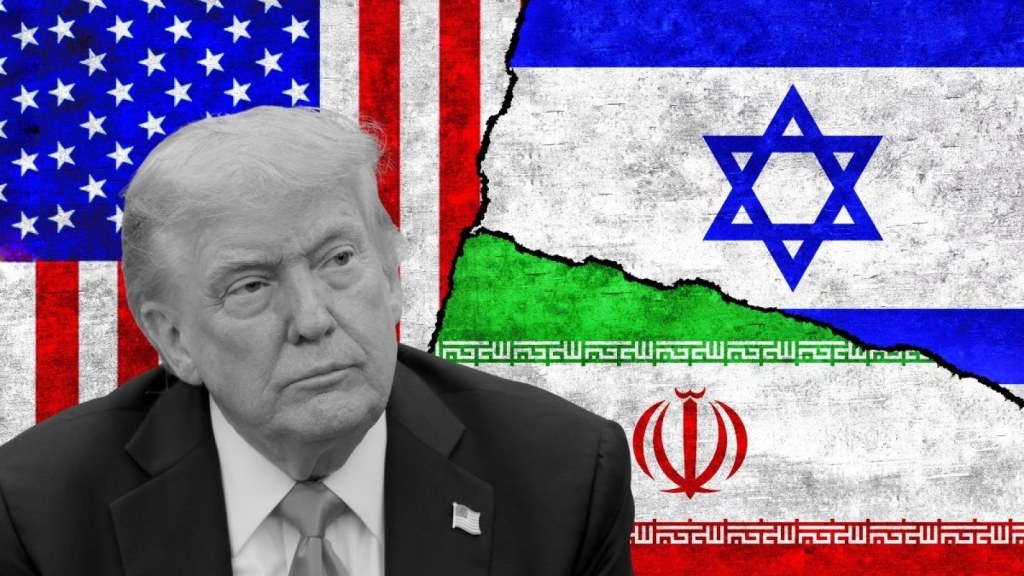
6/27 – Geopolitical Analysis Piece
In a wild two-week sequence of military maneuvers, diplomatic messaging, and social media declarations, President Donald Trump has ushered in one of the most volatile and consequential geopolitical moments of the decade. The United States and Israel launched devastating attacks on Iran’s nuclear infrastructure over the weekend in a surprise escalation dubbed “Operation Midnight Hammer.” Then within 72 hours, the world watched as the war pivoted from aerial devastation to a tenuous ceasefire—allegedly brokered through personal calls and online posts by the U.S. president.
The pace and unpredictability of the events—U.S. stealth bombings, Israeli covert operations, Iranian missile retaliation, and Trump’s all-caps diplomacy—have reshaped the contours of Middle East politics and laid bare the contradictions and unpredictability of a new era in American foreign policy.
Operation Midnight Hammer
It began late last Friday with a shock assault: a fleet of American B-2 stealth bombers departed on a secret 18-hour flight, armed with 30,000-pound Massive Ordnance Penetrators, struck key Iranian nuclear sites at Fordow, Natanz, and Isfahan. The precision strike was coordinated independently by the Trump administration, bypassing many traditional interagency processes and involving only a tight circle of advisors. Israel, which had already gained air superiority over Iran in the preceding days, failed to penetrate these heavily fortified targets and was banking on U.S. intervention.
Trump boasted that the facilities were “totally destroyed,” a claim met with cautious skepticism. While initial damage assessments from the International Atomic Energy Agency confirmed substantial destruction at surface-level facilities, contradictory claims and early intelligence reports have suggested Iran’s program may only have been set back by several months, not eliminated.
Still, the psychological and strategic impact was immense. Tehran’s underground facilities, once thought impervious and heavily fortified by the regime, had been reached.
Diplomacy in the Shadows
Even before the strikes, the U.S. had warned key Arab intermediaries of the impending operation. Middle East envoy Steve Witkoff, acting under Trump’s direct orders, delivered back-channel messages to Iran’s Foreign Minister Abbas Araghchi after the bombing. His message was blunt: negotiate or face further destruction.
Iran’s immediate response was both measured and calculated. Rather than escalate directly, Tehran launched a missile salvo at Al Udeid Air Base in Qatar, a site with U.S. military presence. Crucially, Iranian officials gave Qatar advance warning, which was then relayed to the United States. American and Qatari forces had time to relocate personnel, and most of the missiles were intercepted. No casualties occurred.
The limited nature of Iran’s response suggested it was signaling restraint—a willingness to save face while avoiding full-scale war.
The Ceasefire Gamble
Just hours after the missile attack, Trump called Emir Tamim bin Hamad al-Thani of Qatar and asked him to contact Tehran. Minutes later, the Iranians agreed to a ceasefire. Trump, known for his brash style, declared victory and an end to the 12-Day War on social media.
Vice President J.D. Vance described the episode as a new American foreign-policy doctrine: clearly defined interests, aggressive negotiation, and overwhelming force. Trump’s supporters hailed the operation as a bold and effective flex of U.S. power. Critics saw chaos disguised as strategy.
For the Trump administration and its supporters, they finally had foreign policy episode in which they could hail their mantra of “peace through strength”.
Yet the truce was tested almost immediately. Four hours before it was scheduled to take effect, Israel bombed central Tehran, killing hundreds, including researchers at the Iranian Ministry of Defense. Minutes before the ceasefire deadline, an Iranian missile struck a residential building in Be’er Sheva, killing four civilians. Despite further Iranian missiles launched just after 7 a.m., Israel held off from further strikes—reportedly after Trump personally called Netanyahu and issued a stern warning: “DO NOT DROP THOSE BOMBS.”
Netanyahu complied. The Israeli military claimed it had “achieved all of its objectives,” and stood down.
A Fragile Calm
As the guns fell silent, Iran declared that it had “shattered the enemy’s strategic goal,” while Trump turned his attention to Europe and the NATO summit. Yet behind the triumphant messaging, uneasiness and doubts remain.
A leaked Defense Intelligence Agency report raised serious concerns about the effectiveness of Operation Midnight Hammer. It suggested that while visible infrastructure was destroyed, Iran’s enriched uranium may have been preserved or relocated, and key components of its program could survive underground.
The Trump administration and Israeli officials rejected the report, calling it speculative and “low confidence.” Still, the episode highlights a recurring dilemma in American foreign policy: the allure of quick victories and displaying a spectacle of victory in the face of long-term uncertainties and settling core roots of conflict.
Analysis:
President Trump’s approach to foreign affairs has long been characterized by improvisation, personal diplomacy, and an instinct for showmanship. The Iran operation is its most vivid expression.
The airstrike, ceasefire, and diplomatic pivot illustrate Trump’s belief in “peace through strength.” But it also reveals a government where key institutions—such as the National Security Council and State Department—are sidelined. Major decisions are executed in tight inner circles, with global ramifications decided through presidential phone calls and tweets.
Supporters point to the ceasefire as proof of effectiveness. After all, Trump neutralized key nuclear sites, avoided U.S. casualties, and forced Iran to de-escalate. But critics argue the success is superficial. Iran’s nuclear ambitions are unlikely to disappear, and its leadership, rattled but not broken, may double down on secrecy and asymmetric tactics. If anything, the displays of this 12-day war and Israel’s open desire for regime change might give the Islamic Republic the justification it needs to make a sprint towards building a nuclear weapon for their own existential deterrence.
The administration now finds itself in a strategic bind: either support Israel’s regional campaign against Iran’s military infrastructure— which is likely to resume— or assume direct responsibility for preventing Iran’s nuclear resurgence. Either path risks a long-term commitment—military, financial, and political—that contradicts Trump’s “America First” ethos.
There’s also the question of what happens if Iran retaliates in ways the U.S. cannot easily preempt: cyberattacks, proxy warfare, or missile strikes on Gulf allies. The comparison to America’s containment of Saddam Hussein in the 1990s is unavoidable and troubling for many Americans.
While Trump has insisted this conflict is over, the truth is murkier. The ceasefire may hold today, but the underlying tensions—nuclear, ideological, and regional—remain unresolved.
Operation Midnight Hammer may represent the most aggressive U.S. action against Iran in decades, but whether it delivers long-term peace or opens a new era of conflict remains uncertain. For now, Trump has achieved his political objective: he struck hard, imposed terms, and walked away with a ceasefire.
But history has shown that such moments rarely endure when heated underlying tensions remain. Whether the current quiet is the beginning of a new regional order or just a pause in a longer war will depend not just on missile barrages and shows of force—but on diplomacy, restraint, and sustained bilateral engagement.
The Middle East, once again, is holding its breath.
 IRinFive
Leave a comment