6/22 – Breaking News & War Updates
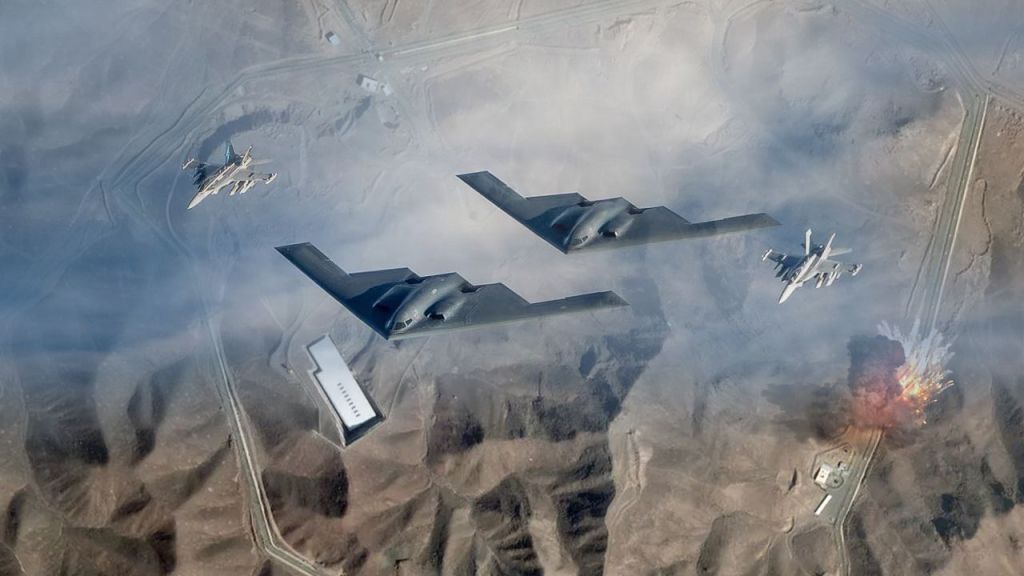
In the early hours of June 22nd, the United States launched one of the most extensive aerial operations in recent military history, striking Iran’s core nuclear facilities in Fordow, Natanz, and Isfahan. This action—codenamed Operation Midnight Hammer—was spearheaded by seven U.S. B-2 stealth bombers departing from Whiteman Air Force Base in Missouri. The bombers embarked on a 37-hour round trip, crossing the Atlantic undetected with minimal radio transmission, supported by mid-air refueling tankers and U.S. fighter jets operating as advance decoys. As the bombers approached Iranian airspace, American submarines launched over two dozen Tomahawk cruise missiles, adding to the operation’s massive firepower.
According to U.S. President Donald Trump, the aim was clear: dismantle Iran’s nuclear capabilities. “Iran’s key nuclear enrichment facilities have been completely and totally obliterated,” Trump declared in a televised address, flanked by Vice President JD Vance, Secretary of State Marco Rubio, and Defense Secretary Pete Hegseth. Despite the dramatic tone, U.S. officials maintained the operation was a “precision strike” and emphasized that it did not target Iran’s leadership or civilian infrastructure. The intention, they said, was to neutralize the nuclear threat—not to instigate regime change.
The strikes began as a decoy squadron of bombers headed west over the Pacific, misleading observers into thinking the U.S. was positioning forces in Guam. Meanwhile, the real attack force headed east. Upon nearing Iran, the bombers dropped 14 GBU-57 Massive Ordnance Penetrators (MOPs)—each weighing 30,000 pounds—on Fordow and Natanz, targeting deep underground enrichment facilities. Cruise missiles struck Isfahan, where Iran’s uranium processing and centrifuge production takes place. The operation involved over 125 aircraft and is considered the largest combat deployment of B-2 bombers in history.
Initial Results and Intelligence Assessments
The Pentagon described the operation as a tactical success. General Dan Caine, Chairman of the Joint Chiefs of Staff, noted that Iran’s air defense systems were completely blindsided. “Iran’s fighters did not fly, and their surface-to-air missiles didn’t engage,” Caine said during a Sunday press conference.
Post-strike satellite imagery released by Maxar Technologies revealed multiple craters and collapsed tunnel entrances at Fordow. Analysts believe the strikes may have hit vital points such as the ventilation shafts—key to the operation of Fordow’s centrifuges buried nearly 500 meters into a mountainside.
Experts have long debated whether the MOPs could truly penetrate a facility as fortified as Fordow without nuclear ordnance. However, some like David Albright, former IAEA inspector, had previously suggested that the site’s vulnerability lay in its ventilation systems and tunnel layout. He emphasized that while Iran’s newer IR-6 centrifuges were designed to be more robust than older IR-1s, they remain vulnerable to the shockwaves and vibrations caused by such massive ordnance.
Despite official optimism, definitive assessments of damage remain cautious. The International Atomic Energy Agency (IAEA) stated that while initial evidence suggests significant surface damage, a full evaluation of subterranean destruction is not yet possible due to a lack of on-site access. Iranian media, meanwhile, downplayed the scale of destruction, although they refrained from offering concrete data about the facilities’ current state.
Strategic Context and Escalation Risks
The American intervention came on the heels of Israel’s own strikes on Natanz and Isfahan, which had already degraded much of Iran’s air-defense capabilities. However, Fordow remained untouched until the U.S. joined the effort. Trump’s decision marked a major departure from his previous hints at diplomatic resolution and instead underscored a more aggressive “escalate-to-de-escalate” doctrine.
Within hours of the strike, Iran responded by firing a wave of missiles at Israel. Although most were intercepted, the attack caused significant damage in Tel Aviv and wounded dozens. Iran’s foreign ministry vowed severe retaliation against both the U.S. and its allies, declaring that “Americans in the region—civilian or military—are now legitimate targets.”
Iran’s parliament subsequently endorsed a move to close the Strait of Hormuz, the vital maritime corridor through which a third of the world’s seaborne oil supply passes. The final decision lies with Supreme Leader Ayatollah Ali Khamenei. A closure could send global oil markets into turmoil and would likely trigger further military confrontation.
President Trump’s abrupt decision—carried out without consulting Congress—sparked sharp criticism from Democratic lawmakers who questioned the constitutionality of unilateral military action. Meanwhile, most Republicans expressed support or remained silent, aligning behind the president. Vice President JD Vance, a previously vocal isolationist, publicly defended the strike, stating that it was not a declaration of war but a targeted operation against a nuclear threat.
“This is a reset,” Vance remarked on NBC’s Meet the Press, suggesting the strike could push Iran back to the negotiating table. However, analysts remain divided on whether this will compel diplomacy or entrench hostility.
Global Response and Future Scenarios
The United Nations Security Council convened an emergency session at Iran’s request, but concrete international consensus on the legality or future direction of U.S. action remains elusive. While Israel celebrated the operation as a necessary measure for regional security, European leaders and Chinese officials expressed concern over rising instability.
Experts now weigh several potential outcomes:
De-escalation and Diplomacy: The strike could pressure Iran into renewed talks, especially if it believes its enrichment capacity has been critically degraded. Some Iranian officials have already signaled a preference for restraint, possibly to avoid total confrontation with the U.S.
Retaliation and Regional War: Iran could retaliate through direct or proxy means, targeting U.S. bases or allies like Saudi Arabia or the UAE. Groups like the Houthis and Hezbollah may already be preparing coordinated attacks.
Nuclear Breakout Attempt: If Iran possesses a hidden stash of highly enriched uranium and functioning centrifuges, it may abandon the Nuclear Non-Proliferation Treaty and accelerate a sprint toward a nuclear weapon.
Containment and Stalemate: The conflict may evolve into a long-term standoff where the U.S. and its allies attempt to monitor and restrict Iran’s activities while avoiding direct engagement.
Tehran’s lawmakers have already moved to weaponize one of the world’s most important energy chokepoints. On June 22 the Majles (Iranian parliament) overwhelmingly backed a resolution instructing the Supreme National Security Council to close the Strait of Hormuz—a 21-mile-wide corridor that handles roughly a third of global seaborne oil—until “external aggression” ceases. Although Supreme Leader Ayatollah Ali Khamenei must still give final approval, the parliamentary vote signaled Iran’s readiness to escalate the crisis far beyond missile exchanges.
Washington reacted swiftly— Secretary of State Marco Rubio publicly urged Beijing, whose economy is heavily dependent on Gulf crude, to press Tehran to keep the channel open, warning that an attempted shutdown would be “economic suicide” for Iran and invite an international—potentially U.S-led—response. Energy analysts estimate that even a temporary disruption could spike oil prices by 30–50 percent and rattle global markets, underscoring how Operation Midnight Hammer has pushed the conflict from a clandestine nuclear shadow-war into a confrontation with immediate worldwide economic stakes.
At home, U.S. intelligence has quietly shifted to what officials describe as a “red-alert counter-terror posture.” FBI Director Kash Patel has ordered expanded surveillance of suspected Hezbollah-linked sleeper cells—dormant operatives who live inconspicuously in Western cities until Tehran signals them to act—after intelligence suggested Iran might activate assets in response to Operation Midnight Hammer.
The bureau’s Joint Terrorism Task Forces are re-reviewing travel histories, financial transfers and encrypted social-media chatter tied to known or suspected proxies, while DHS has refreshed threat bulletins warning that Iran remains the “primary foreign-sponsored terror risk” on U-S soil. The stepped-up monitoring builds on measures first tightened when Israel’s Operation Rising Lion began earlier this month and recalls the nationwide dragnet that followed the 2020 strike on General Qasem Soleimani.
Senior officials stress that no specific plot has been confirmed, but Vice-President JD Vance publicly cautioned that “unknown numbers” of individuals who entered the country in recent years remain unaccounted for, underscoring the administration’s concern that any Iranian retaliation could come through covert cells rather than overt military action.
Analysis:
Operation Midnight Hammer delivered an unprecedented blow to Iran’s nuclear infrastructure, but whether it represents a turning point or merely a dramatic act in a longer conflict remains to be seen. From a military perspective, the operation was a showcase of stealth, coordination, and overwhelming force. It demonstrated America’s continued dominance in long-range precision strike capabilities and its ability to bypass even the most fortified defenses.
From a strategic standpoint, the underlying hope behind the U.S. strike is that Iran now recognizes the futility of engaging in a full-scale war against two military powerhouses—America and Israel. The overwhelming force of Operation Midnight Hammer was likely designed to send a clear message: escalation will not end in Tehran’s favor. Given the disparity in conventional firepower, it would be irrational for Iran to launch direct missile attacks on the U.S. mainland—both in terms of capability and consequence. Such a move would provoke an overwhelming retaliatory response, potentially pushing the conflict into existential territory for the Iranian regime.
Yet, the broader picture is more ambiguous. The Iranian regime has endured decades of sanctions, sabotage, and assassination campaigns and has repeatedly shown resilience. Its ability to rebuild, redirect, and retaliate—either openly or through proxies—remains considerable.
Instead, if Iran chooses to respond, it is more likely to do so asymmetrically. U.S. military bases across the Middle East present more accessible targets, and Tehran may resort to leveraging its influence over proxy militias or disrupting global commerce. Iran’s network of regional proxies remains potent, its leadership defiant, and its history steeped in retaliation. If Iran chooses to counter with asymmetric warfare or attempts to weaponize global oil chokepoints like the Strait of Hormuz, Trump’s move may unravel into a broader crisis. Strategic assets like oil tankers, commercial ships, and shipping lanes—especially through the Strait of Hormuz—are vulnerable and hold the potential to inflict global economic shockwaves, pressuring the international community.
What’s arguably more concerning in the near term, however, is the heightened risk of covert retaliation through terrorism in Western cities. Iran has a history of using sleeper cells and proxy groups to carry out deniable operations far from its borders. With tensions at a boiling point, intelligence agencies are now on high alert for possible attacks on soft targets, particularly in urban centers. The threat landscape has shifted—not just on the battlefield, but in the everyday lives of civilians far removed from the Middle East.
For a president who once promised to keep America out of “stupid wars,” the irony is stark: his quest to project strength may have opened a door he long vowed to keep shut. Donald Trump’s decision to greenlight the largest U.S. military action against Iran since the 1979 revolution has jolted the core narrative of his foreign policy brand.
Once proudly cast as the anti-war president who vowed to end America’s entanglements in the Middle East, Trump’s pivot from restraint to escalation raises profound questions about whether Operation Midnight Hammer marks his own “Iraq moment.” Just as the 2003 invasion was justified by the perceived threat of weapons of mass destruction, Trump’s strike is framed around Iran’s estimated week-long “breakout time” to a nuclear weapon. The parallels are hard to ignore: both involved preemptive force against opaque nuclear ambitions, with no clear sense of what follows.
In launching the strikes, Trump stepped into the very terrain he once condemned—choosing bold military action over diplomacy, with ripple effects that could entangle U.S. forces in a prolonged regional conflict. His advisers describe the operation as a “limited and decisive” response, betting that Iran, weakened by internal dissent and economic hardship, will choose containment over escalation. But that assumption rests on a knife’s edge.
Iran’s network of regional proxies remains potent, its leadership defiant, and its history steeped in retaliation. If Iran chooses to counter with asymmetric warfare or attempts to weaponize global oil chokepoints like the Strait of Hormuz, Trump’s move may unravel into a broader crisis. For a president who once promised to keep America out of “stupid wars,” the irony is stark: his quest to project strength may have opened a door he long vowed to keep shut.
 IRinFive
Leave a comment