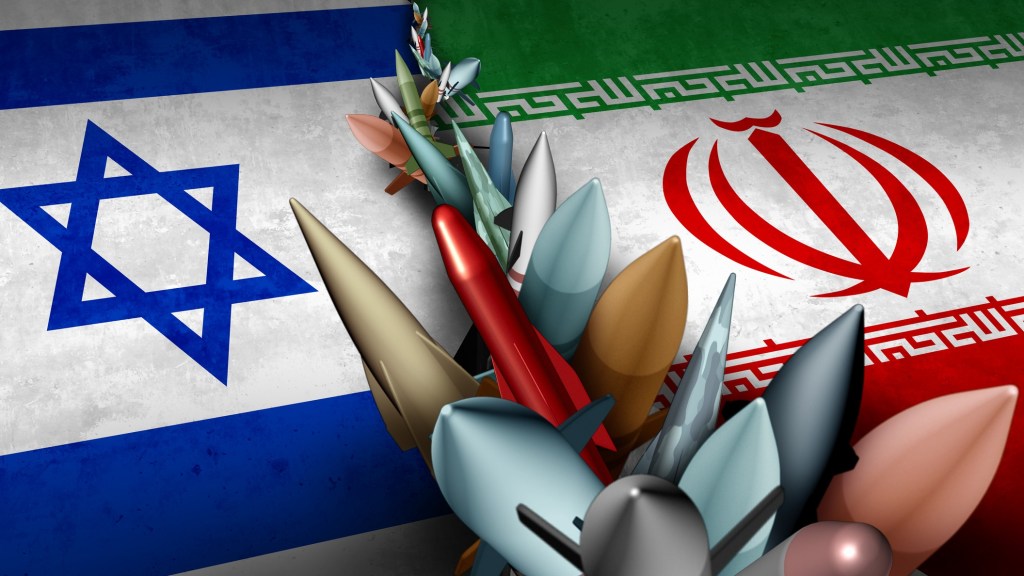
June 12, 2025 – International Update & Geopolitical Analysis
Breaking: Israel Launches Airstrikes on Iran, Marking Start of Open Conflict
9:30 PM ET — Middle East Crisis Deepens as Diplomacy Collapses
In a development that marks a dramatic turning point in the Iran nuclear standoff, Israel has officially launched military strikes against Iranian territory. The offensive began roughly 30 minutes ago, confirmed by Israeli defense authorities, and appears to target key strategic installations believed to be connected to Iran’s nuclear program.
The attack, which comes just hours before a planned round of U.S.-Iran nuclear negotiations in Muscat, Oman, effectively obliterates the last viable track for a diplomatic resolution. Multiple videos circulating from Iranian sources show smoke plumes rising from suspected military zones. Though the exact targets have yet to be confirmed, early indicators suggest that the strikes were precise, possibly focused on enrichment sites and military logistics hubs.
Israeli officials are now bracing for what their own defense minister has described as “days of battle.” Heightened alert has been issued across major Israeli cities and critical infrastructure. Defense readiness protocols have been activated nationwide.
Washington Blindsided Amid Peace Push
The timing of the strikes is particularly jarring given recent statements from President Donald Trump, who just hours ago reiterated his desire for a diplomatic resolution with Tehran. Trump, addressing reporters in Washington, emphasized his administration’s preference for a peaceful settlement, even warning Israel against unilateral action that could jeopardize negotiations.
His words—“I would rather that they [the Israelis] don’t go in”—were seen by some as a direct signal of restraint to Tel Aviv. Nevertheless, the Israeli government appears to have disregarded this message entirely, moving forward with a military option that may now irrevocably commit the region, and the United States, to a broader conflict.
A senior Trump administration official confirmed that U.S. personnel had been partially evacuated from multiple Middle Eastern outposts in the preceding 24 hours, suggesting Washington may have anticipated the strike but failed to deter it. Intelligence sources now believe that Israel’s action was designed not just to halt Iran’s nuclear ambitions, but also to preempt any potential U.S.-Iran rapprochement.
Geopolitical Fallout: A Crisis Unleashed
Iranian leaders have yet to issue a formal statement, but senior Revolutionary Guard commanders had long vowed retaliation for any strike on their soil. U.S. intelligence assessments, relayed in a briefing to the Senate earlier today by White House envoy Steve Witkoff, warned that any Israeli attack would almost certainly prompt Iranian retaliation against both Israeli and American assets.
Witkoff specifically highlighted Iran’s ballistic missile capability, citing over 2,000 projectiles capable of delivering 2,000-pound warheads. Israel, according to the same intelligence, may not have the air defense capacity to fully repel such a barrage, raising fears of mass casualties and regional escalation.
Iran has consistently stated that any strike on its nuclear facilities would be interpreted as a declaration of war, triggering immediate and overwhelming retaliation. Israeli cities and U.S. military installations across the region are believed to be potential targets. Analysts now fear the possibility of multiple fronts opening in Lebanon, Syria, Iraq, and potentially the Gulf.
Diplomacy Crushed, War Inevitable?
Until this evening, there was guarded optimism that upcoming talks in Muscat might provide a pathway to de-escalation. Steve Witkoff had emphasized a narrowing but real opportunity to reach a new agreement—one that would limit uranium enrichment and restore inspection access to the International Atomic Energy Agency (IAEA). That optimism has now been eclipsed by the reality of Israeli bombs falling on Iranian territory.
Critics argue that Israel’s decision reflects a broader loss of faith in multilateral diplomacy. With the IAEA’s recent censure of Iran and growing evidence of clandestine weapons activity, Tel Aviv viewed the moment as a point of no return. Yet the costs of this choice are already mounting, as markets react and military assets mobilize on all sides.
Analysis: A Precipice of Global Conflict
This is the most dangerous escalation in the Middle East since the 2003 U.S. invasion of Iraq—and potentially even more destabilizing. It arrives at a moment when the global system is already strained by conflict in Ukraine, geopolitical tensions in East Asia, and fractured trust in international institutions.
Israel’s move to strike Iran, just hours after U.S. diplomatic overtures, is more than a military operation—it is a geopolitical rupture. It challenges Washington’s authority, undercuts ongoing negotiations, and potentially drags NATO allies into a widening regional war.
While some U.S. officials believe the Trump administration may have offered tacit intelligence support, others insist this was a rogue move by a close but defiant ally. Either way, the fallout is now Washington’s to manage. American troops in the region are at elevated risk. Energy markets are on edge. And the broader world faces the very real threat of a drawn-out and devastating conflict.
If retaliation unfolds as expected, the United States may find itself pulled further into another Middle Eastern war—despite repeated public avowals to the contrary. The coming days will determine whether this conflict can be contained or whether it marks the start of a new, and possibly generational, regional war.
 IRinFive
Leave a comment