2/25 – International News Update & Election Analysis
Germany’s political landscape has undergone a seismic shift following the snap election triggered by the collapse of Chancellor Olaf Scholz’s left-leaning coalition. The outcome, which saw a sharp rightward tilt, has set the stage for Friedrich Merz and his conservative Christian Democratic Union (CDU) to take the helm of Europe’s largest economy. Merz’s road to forming a stable government remains fraught with challenges, as deep political divisions, policy disputes, and shifting geopolitical dynamics loom large.
Voter participation surged to 83 percent, the highest since Germany’s reunification, signaling the electorate’s strong engagement in what was widely regarded as the most consequential German election in years. The CDU, along with its Bavarian sister party, the Christian Social Union (CSU), secured a clear, albeit underwhelming, victory with about 29 percent of the vote. This result cements Friedrich Merz as the next likely chancellor but falls short of a decisive mandate, making coalition-building a necessary and strenuous task.
The far-right Alternative for Germany (AfD) emerged as one of the biggest winners, securing 21 percent of the vote, and doubling its 2021 election result. The party’s platform, focused on immigration restrictions, economic grievances, and a Russia-friendly stance, resonated particularly in the eastern regions, solidifying its position as the dominant force there. The Left (Die Linke), after years of decline, staged a surprise revival, gaining traction among young voters likely disillusioned with the rise of the far right.
Meanwhile, the Social Democratic Party (SPD) suffered a historic defeat, plummeting to 16 percent, its worst performance in over a century. Chancellor Olaf Scholz announced that he would not seek a role in the new government, leaving the party in a period of self-reflection and restructuring. The Free Democratic Party (FDP) fared even worse, failing to cross the parliamentary threshold, leading its leader, Christian Lindner, to announce his retirement from politics.
The once-dominant Greens also took a hit, losing three percentage points from the last national election, with high energy prices and economic policies under Economy Minister Robert Habeck pushing voters elsewhere. Though their losses were not as severe as those of their coalition partners, the SPD and FDP, the Greens are now set to be relegated to the opposition.
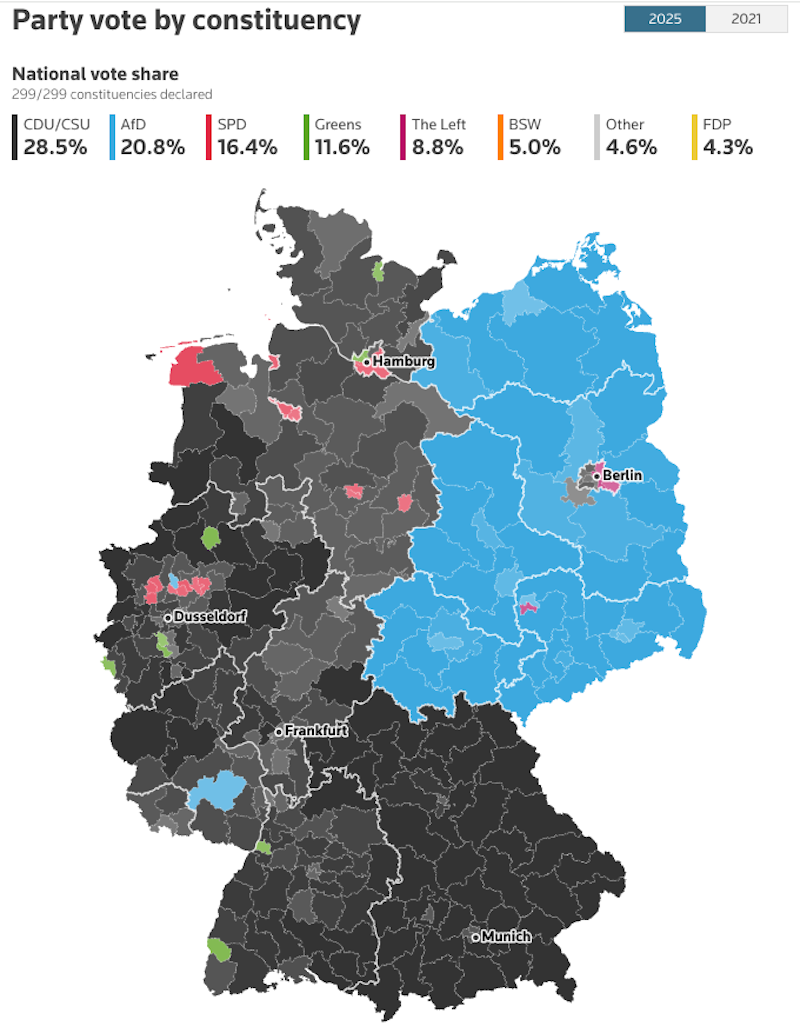
Following the results of February 23rd’s historic election, the Bundestag stands at 208 seats for the CDU/CSU, a notable 152 seats for the far-right AfD, 120 seats for the underperforming SPD, 85 seats for the Greens, and 64 seats for the Left.
Despite Merz’s victory, coalition-building remains a daunting challenge. The CDU/CSU and SPD together hold a narrow majority, but forming a grand coalition—a model that once symbolized stability—is now fraught with distrust. Some SPD members have openly resisted the idea, while Merz’s pre-election rhetoric, particularly his criticisms of left-wing and Green policies, has strained relations.
Beyond political divisions, policy disagreements pose additional hurdles. One of the most contentious issues is immigration, with Merz advocating for stricter border controls and asylum policies that the SPD and Greens argue violate domestic and European law. Another key issue is Germany’s constitutional debt brake, which restricts deficit spending. While Merz has signaled some openness to reform, his party remains largely opposed, despite Germany’s growing investment needs in infrastructure, defense, and economic revitalization.
The failure of BSW to reach the 5 percent threshold means the CDU/CSU and SPD can govern without needing the Greens. This effectively sidelines climate policies, with the next government expected to focus less on ambitious environmental reforms. For businesses, this shift could mean a relaxation of EU green regulations, a point of contention that has divided Europe’s economic and environmental policies.
Geopolitical Implications
Germany’s election results also carry significant geopolitical weight. Merz has emphasized the need for Europe to prepare for a future where U.S. support is uncertain, particularly under this second Trump administration. He has proposed discussions with Britain and France on nuclear cooperation, signaling a possible shift away from reliance on American security guarantees.
Merz has also pledged to strengthen Germany’s defense commitments, potentially reversing Scholz’s cautious approach to military aid for Ukraine. He has hinted at lifting the restrictions on sending Taurus cruise missiles to Kyiv and increasing military spending beyond NATO’s 2 percent target. These shifts indicate that Germany may take a more assertive role in European security.
In economic policy, Merz has signaled a harder stance on China, breaking from Scholz’s business-friendly approach. German carmakers, deeply reliant on the Chinese market, may face tougher scrutiny under his leadership. Trade relations within the EU could also see a shift, with Merz advocating for strengthening Franco-German ties to push forward stalled agreements like Mercosur.
Domestic Reforms
Merz’s economic vision revolves around deregulation, reducing bureaucracy, and revitalizing Germany’s struggling industries. His administration is expected to push for tax cuts and business-friendly policies while maintaining strict fiscal discipline. However, this approach may clash with Germany’s need for increased public investment, particularly in infrastructure and defense.
One of the most controversial aspects of Merz’s agenda is his opposition to Germany’s recent cannabis decriminalization law. He has vowed to repeal it, citing concerns over rising drug-related crime. Additionally, his stance on migration suggests that Germany’s asylum policies will become significantly stricter under his leadership. He is also expected to implement corporate reforms, particularly in the automotive sector, as he seeks to address Germany’s declining economic competitiveness.
Analysis
Germany’s election results reflect deep societal divisions and widespread dissatisfaction with the previous government. While the CDU/CSU’s victory represents a rejection of Scholz’s leadership, it does not necessarily indicate overwhelming support for Merz. His lower-than-expected vote share suggests lingering doubts within his own party and the electorate at large.
The rise of the AfD underscores growing frustration with mainstream politics, particularly in eastern Germany, where economic disparity remains a key issue. Meanwhile, the resilience of leftist parties, particularly among younger voters, signals a counter-reaction to the rightward shift. This polarization will likely define German politics in the coming years.
Merz’s success will depend on his ability to navigate these divisions while implementing decisive policies. His handling of coalition negotiations, economic challenges, and Germany’s role in European security will be crucial. If he fails to deliver tangible results, disillusionment could grow, paving the way for further political upheaval in the next election cycle.
For now, Germany stands at a crossroads. With a new chancellor poised to take office, the country must decide whether it will embrace a more assertive, conservative path or struggle with the same political inertia that plagued its previous government. One thing is certain: the challenges ahead will test both Merz’s leadership and Germany’s resilience in an increasingly uncertain world that needs the European Union’s heavyweight to step up when it needs it most.
 IRinFive
Leave a comment