07/21 – International News Story & Analysis
As China’s economic slowdown continues, the governing Communist Party held its third plenum from July 15 to 18 to lay out future economic developments while Europe braces itself with uncertainty.
In the years following the COVID-19 pandemic, China’s economy has faltered with a shaky property market and decreased consumer spending, impacting European foreign investments.
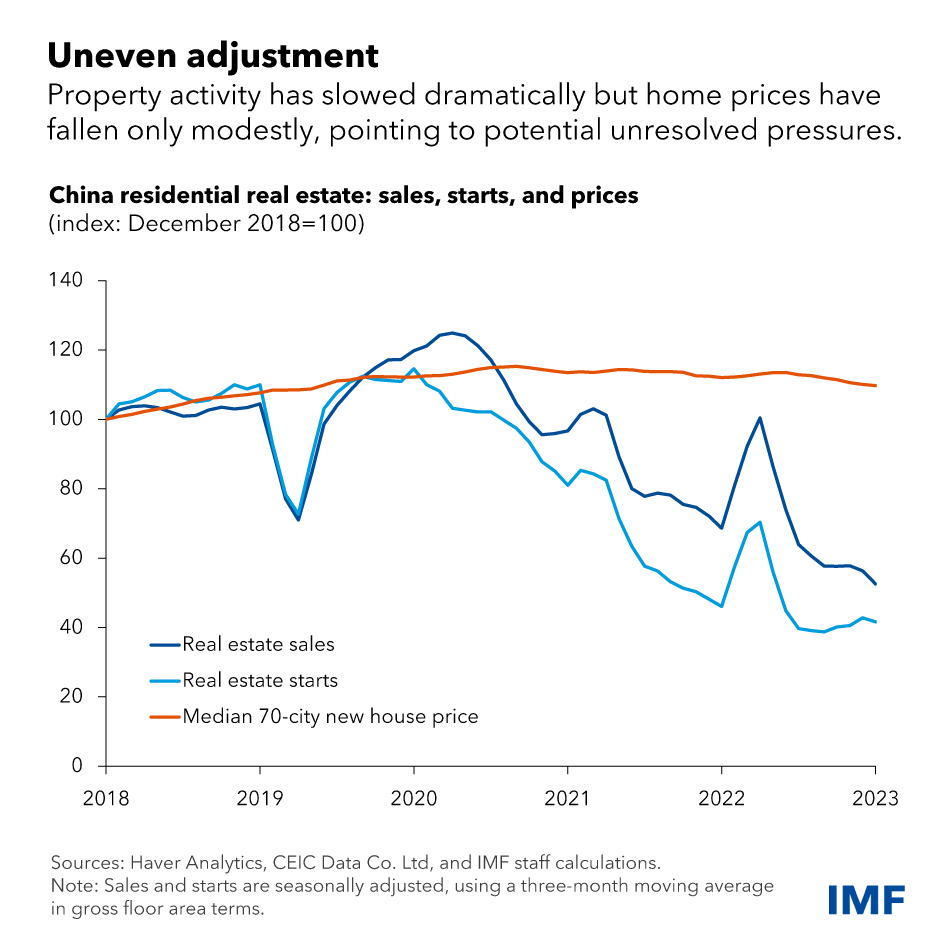
At the height of the COVID-19 pandemic in 2020, the Chinese government attempted to crack down on indebted real estate developers to reduce risk to the financial system. This effort pushed housing prices down and weaker companies defaulted.
With a slowdown in the development of pre-paid homes, some homeowners stopped paying mortgages increasing the perceived uncertainty of property investments.
As of mid-2023, housing prices had fallen every month for more than a year and the declining value of homes seemed to negatively impact spending tendencies in China as people adopted a “save-over-spend” mentality.
In the first half of 2024, property investment fell 10.1% from a year earlier. Home sales by floor area declined by 19%. [Reuters]
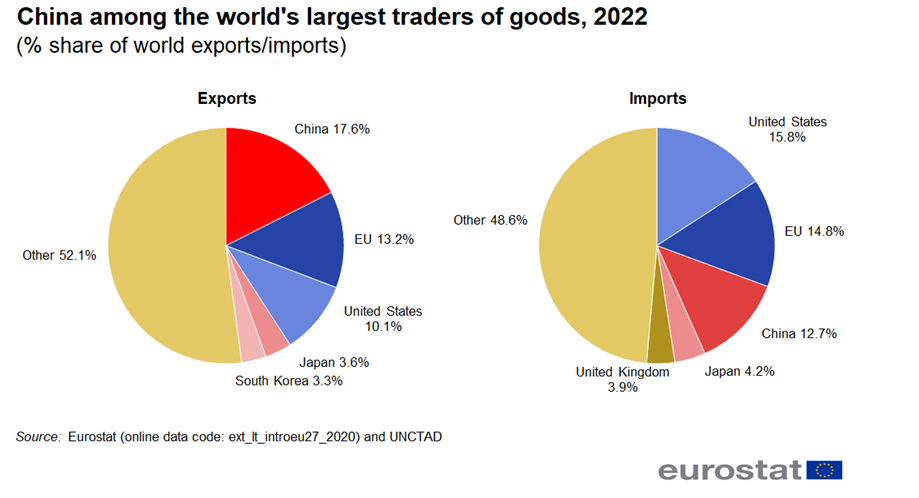
At the end of 2021, China’s exports peaked at a record $340 billion and the country took over as the world’s largest exporter of goods.
All of this led to optimism at the start of 2023 that China would see a rapid recovery in consumer spending after the loosening of both global COVID-19 restrictions and China’s strict Zero Covid policy.
China’s growing tensions with the United States has also played a role in negative economic impact with increasing doubts about future access to technology, markets, and capital. Concerns over the potential for reduced feasibility of regular travel and engagement with the West have also been raised.
The structural slowdown of China’s economy has also been linked to China’s Deleveraging Campaign from 2013 to 2021 which aimed to expand credit and investment to reduce debt within the Chinese economy, particularly in the corporate and local government sectors. [CSIS]
One such tactic under this campaign involved developers replacing one form of borrowing from shadow banks with revenues from sales of homes before their construction.
When housing sales began declining, developers cut back on new land purchases and construction
THIRD PLENUM
Amid these economic challenges, China held its third plenum meeting from July 15-18 presided over by Chinese President Xi Jinping, head of the party’s Central Committee.
In all, there are 7 plenums with the first, second, and seventh focusing on power transitions between Central Committees. The fourth and sixth generally center around party ideology leaving the fifth for five-year development plans and the third to focus on long-term economic reforms. [Reuters]
Following the closure of the third plenum meeting on July 18, the government reiterated China’s commitment to a “new development philosophy,” focused on “high-quality economic development” driven by “all-around innovation” as well as reaching its 5% annual growth target.
The CCP has also shown signs of shifting away from its previous emphasis on raw growth driven by infrastructure investments. [The Diplomat]
The official Chinese Xinhua News Agency reported after the meeting, “High-quality development is the top mission of building a modern socialist country.” [Bloomberg]
IMPACT ON EUROPE
In 2024 so far, China’s economy has continued its slowing trend which has only furthered uncertainty in Europe.
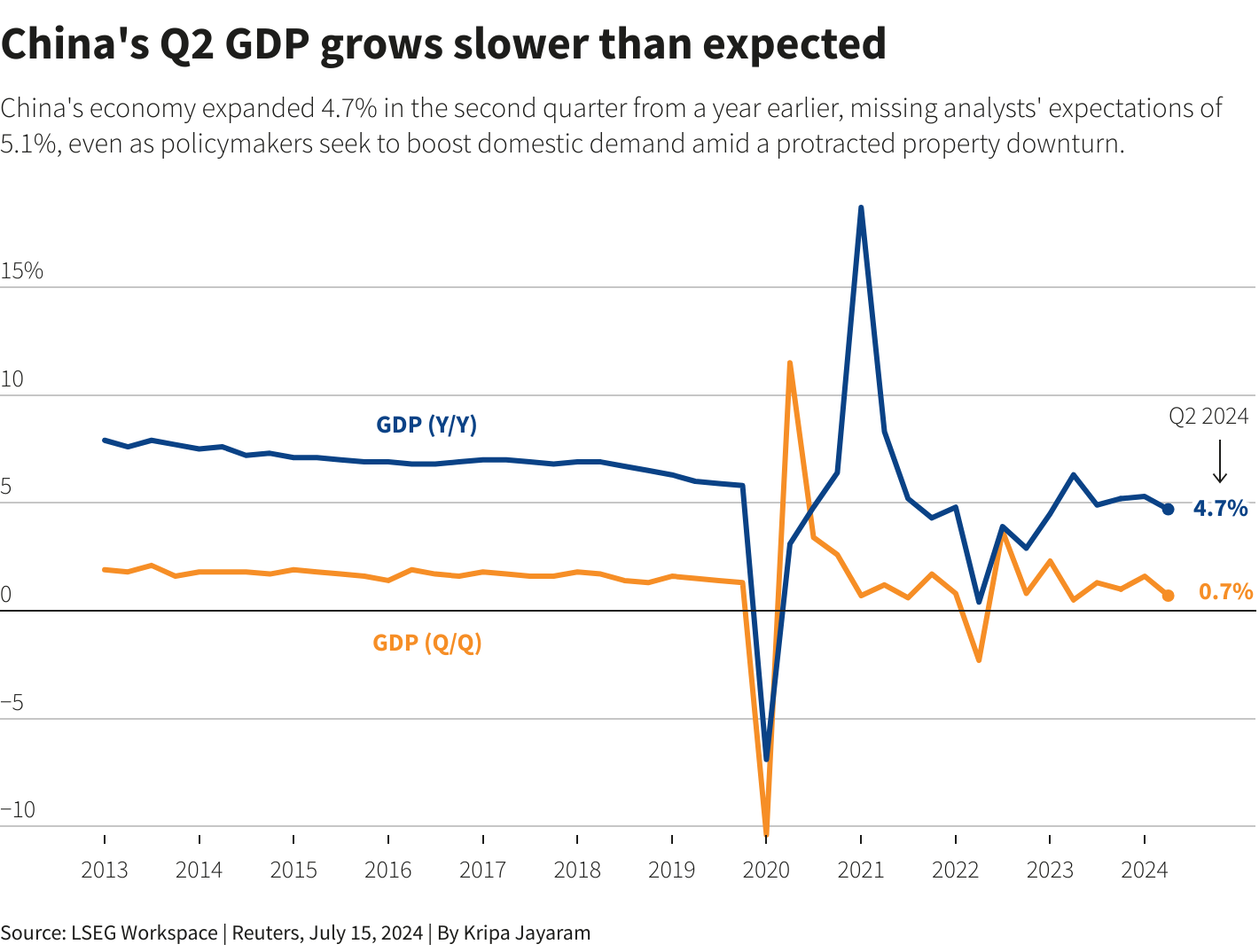
China’s economy, the second-largest in the world, grew much slower than expected in the second quarter of 2024, growing by 4.7% from April to June, its slowest since the first quarter of 2023. [Reuters]
By the end of 2024, the Chinese government is aiming for an economic growth target of around 5.0%, an ambitious target according to some analysts.
This second-quarter growth slowdown prompted investment banking company Goldman Sachs to lower its forecast for China’s 2024 growth to 4.9% from 5.0%.
The consumer sector has remained a major concern during the slowdown as retail sales hit an 18-month low, forcing businesses to cut prices on various products.
In particular, luxury markets in Europe have been hit by China’s slowing economy and decreasing consumer demand.
The Stoxx luxury index, a stock market index that tracks the performance of the top European luxury goods companies was down 1.5% on July 15. [Market Watch]
British fashion brand Burberry reported a quarterly sales decrease of 21% in China with Swiss watchmaker Swatch also reporting a decrease in sales due to weaker demand in China.
Lynn Song, chief economist for Greater China at ING said: “A negative wealth effect from falling property and stock prices, as well as low wage growth amid various industries’ cost cutting, is dragging consumption and causing a pivot from big-ticket purchases toward the basic ‘eat, drink and play’ theme consumption,”
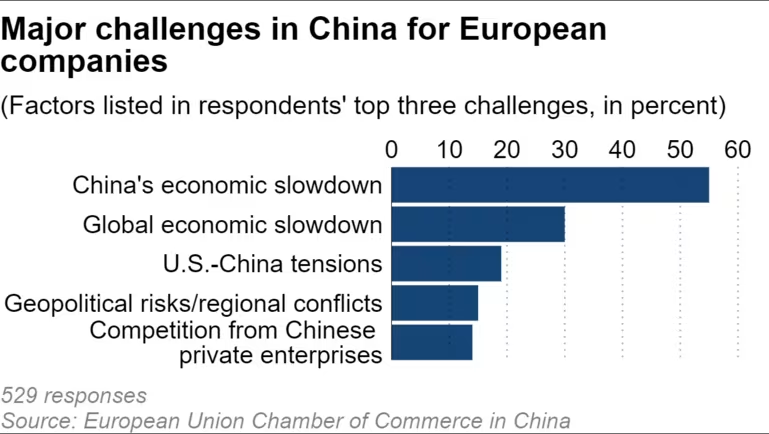
In May the European Union Chamber of Commerce in China said that European companies operating in China are concerned that the slowdown will hurt their profitability.
It also reported in its Business Confidence Survey that the outlook for doing business in China hit its lowest in the report’s 20-year history.
In recent months the US and EU have also accused China of flooding global markets with cheap products to cope with industrial overcapacity. [Nikkei]
Data on China’s inbound foreign direct investment showed a 26.1% decline for the January to March quarter, dampening prospects for a turnaround. [Nikkei 2]
EU Commission chief Ursula von der Leyen and French President Emmanuel Macron urged President Xi Jinping in May to ensure more balanced trade with Europe.
Von der Leyen said at the talks in Paris that the European Union “cannot absorb massive over-production of Chinese industrial goods flooding its market,” [Reuters]
Denis Depoux, global managing director of management consultancy Roland Berger said: “European companies are confronted by growing uncertainties in China, in large part due to economic volatility and less predictable policy direction,”
Opinion:
It is becoming clear that popular Western fears of China overtaking the United States as the world’s top economy have proven exaggerated, with the U.S. still firmly in the lead for the foreseeable future.
China’s decades of growth largely resulted from the historic opening of their socialist economy, which spurred modernization and financial boom. However, as with all nations that experience significant economic runs, a slowdown and structural issues eventually emerge.
The ruling Communist Party remains committed to its authoritarian model, and necessary reforms to reignite economic development may lead them to double down on national security, limiting free-market development and foreign investment.
This could heighten tensions with the West, setting the stage for another global power rivalry between democracy and autocracy, where historically, democracy has often emerged victorious on the economic front. [The Diplomat]
Despite its slowing economy, China’s dominant role in the global economy is undeniable. They lead economically in their region, and a declining Chinese economy will impact the development of its Asian neighbors.
The European Union faces its own challenges, particularly with China as its second-largest trading partner and the EU being China’s largest trading partner. [EEAS]
The European Union will have to deal with its own reliability issues amidst an economically stagnating Chinese— and not to mention the looming potential of an increasingly protectionist United States on the horizon.
This EU-China relationship is becoming more antagonist as of late, as a stagnating China has led to more economic malpractices from the Xi regime which has invited condemnation from the European commission. Top EU and NATO leaders have also recently publicly condemned China’s foreign policy actions and economic enabling of Putin’s war of aggression in Ukraine.
As China’s economy slows, European companies with operations or production bases in China are increasingly worried and may begin exiting the country. This stagnation, coupled with a potential trade war with the West, could create uncertainty in European economies heavily reliant on trade with China.
Germany will be particularly important to monitor, as the EU’s largest economy grapples with recent financial turmoil. For the past eight years, China was Germany’s largest trading partner, until being overtaken by the United States this year. [Reuters]
European governments, including Germany, will need to engage in serious discussions about their economic ties and dependence on the People’s Republic of China. As the economic prowess of the Chinese begins to show signs of decline, these discussions will be crucial in addressing the ripple effects on international trade.
– K.M./P.T.
 IRinFive
Leave a comment