7/27 – International Trade News & Diplomacy Analysis
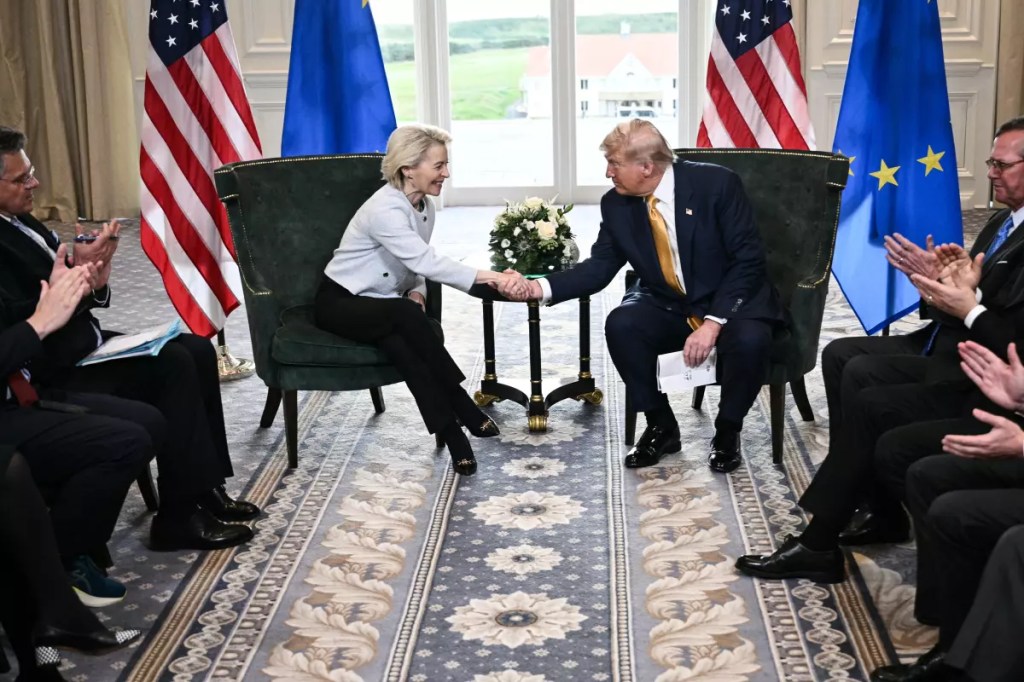
After months of building tensions and simmering negotiations, the United States and the European Union have secured a sweeping trade agreement that averts what could have become a damaging economic rift between the two largest trading blocs in the world. The accord, announced Sunday by President Donald Trump and European Commission President Ursula von der Leyen following last-minute talks in Scotland, sets a baseline 15% tariff on EU goods entering the U.S. and commits the EU to massive American energy and military purchases, totaling more than $1.3 trillion over the coming years.
This deal comes just days before the Trump administration’s hard deadline to impose 30% tariffs on all European imports—an ultimatum that had galvanized negotiations and sent shockwaves through both political and corporate circles in Europe. With the EU’s transatlantic exports valued at over €530 billion annually, and the U.S. trade deficit with Europe hitting $235 billion in 2024, the stakes could hardly have been higher.
Terms of the Agreement
Under the new deal, EU goods will face a 15% import tariff—a compromise figure well above Europe’s desired “zero-for-zero” model, yet notably lower than Trump’s threatened 30%. The agreement also includes a commitment from the EU to purchase $750 billion worth of U.S. energy exports, including LNG and oil, as well as a $600 billion pledge toward military procurement and U.S.-based investment. Notably, steel and aluminum products will remain under a 50% tariff, while pharmaceuticals are excluded from the framework.
Automobiles, a politically sensitive export for Germany and other EU nations, will also be taxed at 15%, the same level applied to other goods under the agreement. In contrast to the EU’s earlier negotiating position, which called for tariff reductions or eliminations in strategic sectors, the deal essentially locks in a new minimum tariff structure for future U.S. trade relationships.
Diplomatic Context
The agreement followed a tense standoff. Just two weeks prior, EU trade negotiators had activated a €93 billion retaliatory tariff package targeting a wide swath of U.S. exports—from Kentucky bourbon and soybeans to Boeing aircraft. Those countermeasures, due to take effect on August 7, are now ultimately suspended following the breakthrough in Scotland.
Von der Leyen, who flew to Scotland at short notice to meet Trump at his Turnberry resort, described the process as “heavy lifting.” She was accompanied by EU Trade Commissioner Maroš Šefčovič and top Brussels negotiators. Trump was joined by Commerce Secretary Howard Lutnick, who made clear that the U.S. would move ahead with tariffs unless an agreement was finalized. Their one-hour meeting marked the first high-level trade engagement between the U.S. and EU since Trump imposed global steel tariffs in April.
The deal represents a rare moment of convergence between the Trump administration’s “America First” trade strategy and the EU’s desire to preserve economic stability and avoid an all-out trade war. Yet European officials were quick to temper any celebration, pointing out that the agreement had only narrowly avoided a more severe rupture.
European industry groups, particularly in the auto, luxury, and cosmetics sectors, expressed relief but also frustration at what many see as an asymmetric outcome. German carmakers like BMW and Mercedes, which manufacture vehicles in the U.S. for re-export to Europe, feared they would be penalized on both sides of the Atlantic. Meanwhile, executives in sectors such as French beauty products and aerospace warned that further tariffs could devastate transatlantic supply chains.
France had pushed for a tougher stance, with President Emmanuel Macron publicly supporting the EU’s readiness to impose countermeasures. Germany, meanwhile, favored a more conciliatory approach to protect its export-heavy economy. In the end, the EU managed to present a relatively united front, but not without internal friction.
No joint statement or finalized deal text has yet been published. A formal briefing of EU ambassadors was scheduled for Monday in Brussels. Some negotiators emphasized the need to codify the verbal commitments swiftly, particularly given Trump’s past record of abrupt reversals.
Analysis:
While the deal brings temporary relief to rattled markets and companies on both sides of the Atlantic, analysts warn that it falls short of solving the deeper trade imbalances that have fueled tensions. For Trump, the agreement represents another notch in a growing portfolio of 15%-based trade pacts—similar frameworks were recently announced with Japan, Vietnam, Indonesia, and the Philippines. The UK, still finalizing its own agreement, has negotiated a more favorable 10% tariff baseline.
Yet the transatlantic deal is by far the largest and most symbolically significant. It underscores Trump’s willingness to use hard deadlines and tariff threats to force concessions, and it signals the emergence of a new global trade architecture shaped not by multilateral norms but by bilateral brinkmanship.
From the European side, the deal may have averted economic catastrophe, but at the cost of conceding to a more protectionist global order. The EU’s once-lofty ambitions of championing rules-based trade now face the harsh reality of adapting to a world led by transactional geopolitics.
Ultimately as of now, the Trump-von der Leyen agreement is more of a detente than a diplomatic triumph. It stabilizes their immediate diplomatic and economic relationship, but with trust frayed and tariff structures now codified, the era of transatlantic trade friction is far from over.
 IRinFive