1/3 – International Breaking News & Geopolitical Updates
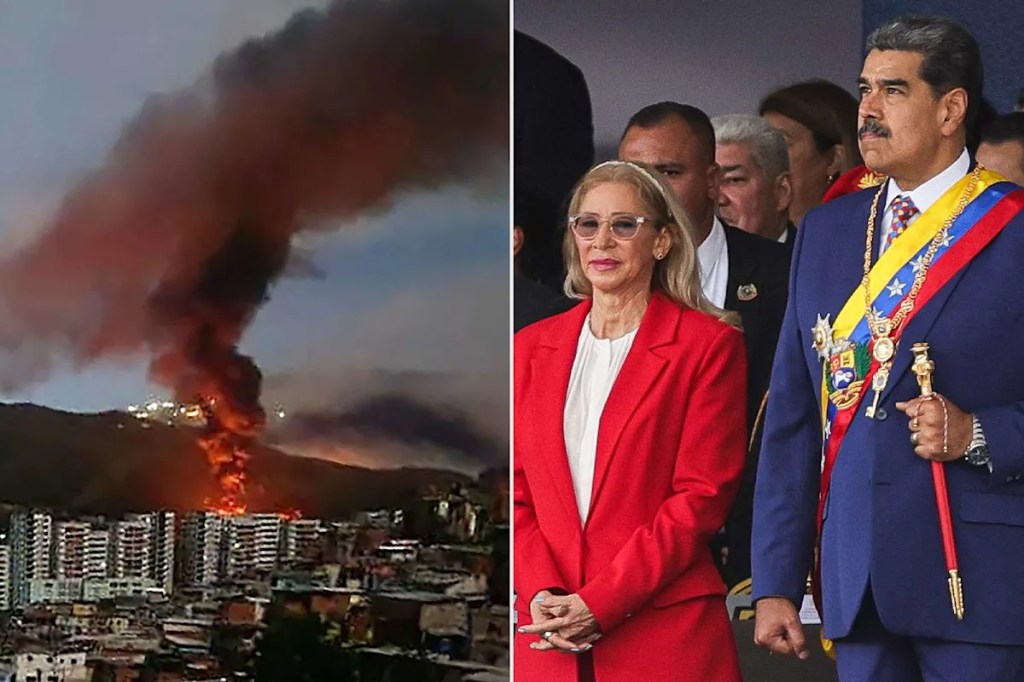
In the early hours of January 3, the United States carried out a dramatic and unprecedented military operation in Venezuela that culminated in the capture and removal of President Nicolás Maduro and his wife, Cilia Flores. By sunrise, the Venezuelan leader had been flown out of the country aboard a U.S. Navy vessel, marking one of the most sweeping acts of forced regime change in modern American history.
President Donald Trump announced the operation publicly just hours after explosions were reported across Caracas and surrounding strategic locations. The announcement confirmed weeks of speculation that Washington’s escalating pressure campaign against Venezuela had moved beyond maritime interdictions and covert pressure into direct military action on Venezuelan soil.
Months of Escalation Lead to Direct Intervention
The operation capped a five-month buildup of U.S. military assets across the Caribbean, the largest such naval concentration in the region since the Cuban missile crisis of 1962. Beginning in September, the Trump administration authorized dozens of strikes against vessels accused of transporting narcotics toward the United States. By December, those actions expanded to include a blockade of tankers carrying Venezuelan oil and a CIA-directed drone strike on a coastal port facility.
Although administration officials repeatedly insisted during the fall that regime change was not the objective, President Trump publicly escalated his rhetoric in late December, warning that the campaign would soon move “on land.” Days later, Maduro attempted to reopen negotiations, offering concessions related to drug trafficking and security cooperation. Those efforts were rejected.
Behind the scenes, U.S. intelligence agencies had already been preparing for a far more ambitious operation.
The Night of the Operation
Shortly after midnight on January 3, explosions rocked multiple military and infrastructure sites in and around Caracas. Targets included the Tiuna military base, headquarters of Venezuela’s defense ministry and a residential compound for senior officers, the port of La Guaira, the La Carlota airfield, and the communications hub at El Volcán, a heavily fortified antenna site overlooking the capital. Additional strikes were reported in Higuerote, a port and airfield east of Caracas, where secondary explosions lit up the night sky.
American aerial refueling tankers were observed taking off from Puerto Rico as part of the operation, while more than 150 aircraft launched from 20 bases across the Western Hemisphere. These included advanced fighter jets and strategic bombers designed to overwhelm air defenses and disable command and control systems. Large portions of Caracas experienced power outages during the raid, which U.S. officials later attributed to cyber and electronic warfare tactics.
The strikes themselves were brief, lasting less than half an hour, and notably left several major military installations untouched. U.S. officials later suggested that the bombardment served as cover for a more focused objective.
The Capture of Maduro
As air defenses were suppressed, U.S. special operations forces moved in. Helicopters from an elite night operations unit flew low over Caracas, firing on ground targets and landing near a fortified residence on a military base where Maduro was believed to be staying. Intelligence officials had spent months tracking his movements, eating habits, and sleeping locations. A small CIA team had been operating inside the country since August, supported by at least one human source close to Maduro who was able to relay his precise location in real time.
Elite troops, including Delta Force operators, had rehearsed the mission using a full-scale replica of the residence. With those preparations complete and weather conditions deemed optimal, the operation proceeded. Maduro and his wife were seized without prolonged resistance and transported to the USS Iwo Jima before being flown toward New York.
Whether elements within Maduro’s inner circle assisted the operation remains unclear.
Venezuelan state television condemned what it called a grave act of military aggression and urged citizens to prepare for armed resistance. However, initial official statements conspicuously avoided confirming Maduro’s fate. Vice President Delcy Rodríguez later demanded proof that Maduro was alive and is now widely regarded as the acting authority, though the command structure of the Venezuelan state remains intact.
Despite the operation, U.S. forces do not control Venezuelan territory, and domestic security forces, militias, and armed groups remain active across the country.
Legal Justification and Criminal Charges
Within hours of Trump’s announcement, U.S. federal prosecutors unsealed a revised indictment charging Maduro, his wife, and their adult son with narco-terrorism conspiracy, cocaine importation conspiracy, and weapons offenses. The indictment alleges that Maduro presided over a criminal network that used state power to facilitate drug trafficking, enriching his family and collaborating with armed groups operating across the region.
Administration officials cited these indictments as legal justification for the operation. Vice President JD Vance argued that Maduro’s criminal status eliminated any protection associated with his position. Secretary of State Marco Rubio reiterated that the U.S. does not recognize Maduro as Venezuela’s legitimate president.
Maduro and Flores are expected to stand trial in New York. It remains unclear whether their son has also been captured.
Trump Declares Temporary U.S. Control
Speaking from Mar-a-Lago later that day, President Trump declared that the United States would effectively run Venezuela until a leadership transition could be arranged. He suggested that a small group of senior U.S. officials would oversee the process and did not rule out deploying American troops on the ground if necessary.
Trump also announced plans to open Venezuela’s oil sector to major U.S. energy companies, promising large-scale investment to restore production and infrastructure. While American firms expressed interest, analysts warned that years of neglect and sanctions would require tens of billions of dollars and at least a decade of sustained investment to reverse the industry’s decline. A full U.S. embargo on Venezuelan oil remains in place.
Congressional Backlash and Domestic Criticism
The operation triggered immediate outrage among Democratic lawmakers, who accused the president of bypassing Congress and launching an unauthorized war. Several lawmakers warned that Venezuela posed no imminent threat to the United States and likened the operation to the early stages of the Iraq war.
Veterans of previous conflicts questioned the lack of planning for the aftermath and asked who now governs Venezuela. Polling shows that a strong majority of Americans oppose military intervention in Venezuela, including opposition among Venezuelan diaspora communities in Florida.
While some Democrats welcomed Maduro’s removal in principle, they criticized the unilateral nature of the decision. Republicans were more divided, with several hawks praising the operation and others warning against deeper entanglement. Even some long-time opponents of U.S. intervention described the raid as tactically impressive while remaining skeptical of its long-term wisdom.
The administration defended its secrecy by arguing that congressional notification could have compromised operational security.
Governments across Latin America largely condemned the intervention, warning of violations of sovereignty and regional instability. Other global leaders expressed alarm, while a handful of U.S. allies praised the decisiveness of the operation.
Trump framed the action as part of a revived Western Hemisphere doctrine, warning that foreign powers such as China and Russia would no longer be tolerated in what he described as America’s strategic backyard. He singled out Cuba and Colombia as future areas of concern, further raising fears of regional escalation.
Analysis:
Even if the removal of Maduro is initially successful, history suggests that the most dangerous phase of regime change begins after the leader is gone. Venezuela is not a small, centralized state like Grenada or Panama during past U.S. interventions. It is a vast country with rugged terrain, porous borders, and a dense ecosystem of armed actors, including pro-regime militias, criminal organizations, and transnational guerrilla groups. Many of these actors have little incentive to disarm and every incentive to exploit chaos.
Research on foreign-imposed regime change consistently shows a heightened risk of civil war, insurgency, and prolonged instability. Armed forces that do not formally surrender often reemerge as insurgent networks, as seen in Iraq. Venezuela’s security apparatus, which still controls weapons and territory, may fragment rather than dissolve.
Any successor government installed with U.S. backing would face acute legitimacy problems. Leaders elevated by external force are significantly more likely to be removed violently, especially when they are perceived as dependent on foreign power. While Venezuela’s democratic opposition commands genuine popular support, aligning that movement with a foreign military risks undermining its credibility and provoking nationalist backlash.
The operation also exposes deep contradictions in President Trump’s foreign policy narrative. For years, he criticized the Bush administration for launching open-ended wars and campaigned as a leader opposed to foreign entanglements. A unilateral regime change operation, conducted without congressional authorization and with unclear exit plans, directly conflicts with those commitments.
Strategically, the benefits are uncertain. Venezuela is not a major source of narcotics entering the United States, and intelligence assessments have downplayed the threat posed by Venezuelan-based criminal groups to U.S. homeland security. Further destabilization may accelerate refugee flows rather than reduce them.
Perhaps most striking is that diplomacy was not exhausted. Maduro had reportedly offered sweeping economic and geopolitical concessions, including preferential access for U.S. companies and a realignment away from rival powers. Walking away from those talks in favor of military action raises questions about whether force was necessary to secure U.S. interests.
By focusing intensely on how to remove Maduro while leaving the aftermath largely undefined, the administration risks repeating a familiar pattern. History offers repeated warnings that toppling a regime is often far easier than building a stable order in its place. Without a credible plan for governance, security, and legitimacy, the United States may find itself drawn into exactly the kind of prolonged conflict it once vowed to avoid.

 IRinFive