1/23 – International Relations & Diplomacy News
President Donald Trump used his appearance at the World Economic Forum in Davos to defend his increasingly assertive foreign policy, centering on Greenland, trade, and global security, amid mounting criticism from European and other Western leaders. His speech and accompanying meetings unfolded against a backdrop of market volatility, diplomatic unease, and warnings that the dispute risks reshaping the transatlantic relationship.
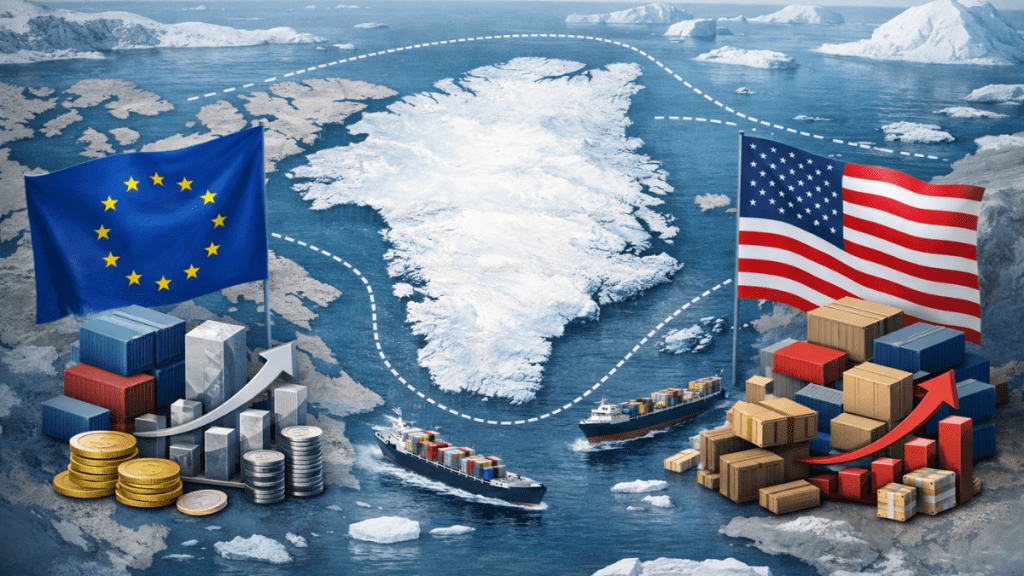
Trump’s remarks came one day after sharp declines in major U.S. stock indexes, which followed his threat to escalate tariffs against several European countries if they do not support U.S. control over Greenland. While equities later staged a partial recovery, Trump himself linked the earlier selloff to investor reactions to his Greenland comments, underscoring how closely markets are tracking the dispute.
Rather than focusing primarily on economic themes previewed by his advisers, Trump delivered a wide-ranging address lasting more than an hour that mixed foreign policy demands, trade threats, and criticism of allied governments. He reiterated that Greenland is central to U.S. and global security interests, particularly in the context of missile defense and Arctic surveillance, while insisting he would not resort to military force to secure control of the territory.
For the first time, Trump explicitly ruled out armed intervention, stating that negotiations should begin immediately and that force would not be used. At the same time, he warned that refusal by Denmark and its European partners would carry consequences, framing the issue as a strategic necessity rather than a discretionary geopolitical ambition.
European Responses and Rising Friction
European officials listening closely to the speech said that, despite the pledge to avoid force, Trump’s broader message offered little reassurance. Diplomats in Brussels and Davos described confusion over his ultimate objectives, noting that the tone suggested his determination to acquire Greenland remained unchanged.
Canadian Prime Minister Mark Carney delivered one of the sharpest rebukes of Trump’s approach during the forum, warning that the world is entering a period of rupture in the global order. He argued that economic integration loses legitimacy when it results in subordination rather than shared benefit, and called for closer cooperation among middle powers to avoid being marginalized by larger states. His remarks drew a standing ovation from attendees.
French President Emmanuel Macron echoed calls for greater European autonomy, criticizing what he described as coercive behavior by powerful states. In contrast, NATO Secretary General NATO Mark Rutte adopted a more measured tone, acknowledging that Trump is correct to emphasize Arctic defense while stopping short of endorsing the U.S. position on Greenland.
Germany’s former foreign minister Annalena Baerbock warned publicly that questioning borders through pressure or coercion risks returning the international system to darker historical precedents. Meanwhile, several European policymakers declined to comment directly, reflecting both caution and uncertainty over how to respond.
Tariffs, Trade, and Institutional Pushback
The dispute intensified after Trump reiterated threats to impose escalating tariffs on a group of European countries, including Denmark, Germany, France, and several Nordic states, unless they back his Greenland proposal. Under the plan outlined earlier in the week, a baseline tariff would take effect in February and rise substantially by mid-year.
European leaders warned that such measures could trigger a trade war and strain NATO cohesion. The European Union’s trade chief met with U.S. Trade Representative Jamieson Greer on the sidelines of Davos, emphasizing that Brussels prefers dialogue and negotiated solutions. Nonetheless, the European Parliament moved to suspend work on the EU U.S. trade agreement in protest at Washington’s demands.
Greenland at the Center of Strategic Competition
Greenland, an autonomous territory within the Kingdom of Denmark, has become a focal point of great power competition due to its geography, resources, and role in Arctic security. The world’s largest island sits largely within the Arctic Circle between the Atlantic and Arctic oceans and is covered by ice across most of its interior. Its population of roughly 56,000 people is concentrated along the coast, with the capital Nuuk home to about one third of residents.
The island already hosts a major U.S. military installation, the Pituffik Space Base, which plays a key role in missile warning and space surveillance. Denmark oversees Greenland’s defense through the Joint Arctic Command, responsible for sovereignty enforcement, monitoring, and search and rescue operations.
Trump argued that only the United States is capable of fully securing Greenland, linking the territory to the planned Golden Dome missile defense system. Danish Foreign Minister Lars Lokke Rasmussen responded that while it is positive Trump ruled out military action, his underlying ambition remains intact and the dispute itself is unresolved.
The Arctic’s Expanding Strategic Role
The Greenland controversy is unfolding as the Arctic rapidly gains importance due to climate change and increased maritime activity. Melting ice has contributed to a sharp rise in Arctic shipping over the past decade, opening new routes that could significantly shorten travel times between Asia, Europe, and North America.
Three major corridors are drawing attention. The Northern Sea Route along Russia’s coast could reduce transit times between East Asia and Western Europe by up to two weeks compared with the Suez Canal. The Northwest Passage through Canada’s Arctic could cut journeys via the Panama Canal by about ten days. A future Transpolar Sea Route across the central Arctic may eventually become viable by mid-century as ice conditions continue to change.
According to the Center for Strategic and International Studies, Russia views control of Arctic routes as central to its security posture. The Northern Sea Route is overseen by Rosatom, giving Moscow leverage over access. Russia has expanded radar coverage, airfields, and missile systems across the Arctic, reinforcing its military footprint from the Barents Sea to the Bering Strait.
China has also emerged as a major Arctic stakeholder, promoting a Polar Silk Road linked to its Belt and Road Initiative. Chinese state owned firms hold stakes in Russian LNG projects, including those operated by Novatek, and have supplied key equipment following Western sanctions. Chinese companies are also involved in mining projects in Greenland, targeting iron ore, rare earth elements, and uranium.
Beyond its strategic location, Greenland possesses significant natural resources. The island hosts large deposits of rare earth elements critical to high tech manufacturing, renewable energy, and defense industries. It also contains zinc, lead, gold, iron ore, copper, nickel, graphite, tungsten, titanium, vanadium, and potential hydrocarbon reserves.
Many of these resources remain underexplored, particularly in Greenland’s eastern and northeastern regions. Their potential has drawn international interest, reinforcing perceptions in Washington that Greenland is both a security asset and a long term economic prize.
Reactions from Davos
Trump’s speech produced a subdued and at times uncomfortable atmosphere in the Davos hall. While some remarks drew scattered laughter, much of the audience remained silent. Many delegates eventually drifted away to follow the address on screens in nearby halls or resumed private conversations.
The president also used the platform to criticize allies on a range of unrelated issues, from European environmental policies to immigration and energy production, and to revisit grievances with the United Kingdom, Switzerland, France, Canada, and NATO. Domestic economic concerns, including cost of living pressures, featured only briefly and late in the speech.
Recent Frameworks Reached
Momentum around Greenland shifted again as President Donald Trump announced that he had secured what he described as total and open-ended U.S. access to Greenland through a new framework arrangement with NATO. The announcement marked a clear tactical retreat from earlier threats of tariffs and force, and immediately eased financial market pressure in Europe and the United States. Equity markets rebounded sharply after days of volatility that had been driven by fears of a deep transatlantic rupture.
NATO Secretary General Mark Rutte confirmed that allied military planners would now begin working through the operational implications of enhanced Arctic security, with the aim of moving quickly toward implementation, potentially as early as 2026. The emerging understanding centers on expanded access, coordination, and presence rather than a formal transfer of sovereignty. Denmark stressed that no negotiations had taken place regarding ownership or territorial control, reiterating that Greenland’s constitutional status within the Danish kingdom is not subject to discussion.
Greenland’s Prime Minister Jens Frederik Nielsen cautiously welcomed the easing of rhetoric but underscored that significant uncertainty remains. Greenlandic authorities indicated openness to deeper cooperation and an upgraded partnership with the United States and NATO, particularly on security and infrastructure, while drawing a firm line at any arrangement that would infringe on sovereignty or violate international law. Reports that Washington had sought control over areas surrounding U.S. military facilities were met with clear resistance from Nuuk.
Denmark, Europe, and the Question of Trust
In Copenhagen, Prime Minister Mette Frederiksen described the situation as stabilizing but still serious. She framed recent developments as progress toward structured discussions on collective Arctic security rather than a resolution of political tensions. Frederiksen and several European leaders emphasized the need for a more permanent NATO presence in the Arctic, including around Greenland, as a way to address Russian and Chinese activity without redrawing borders or undermining alliance norms.
European Union officials took a more sober view. EU foreign policy chief Kaja Kallas said the episode had inflicted lasting damage on trust between Washington and Brussels, even if immediate economic and military risks had receded. Diplomats across Europe signaled concern that the abrupt policy shifts and intense pressure tactics had exposed vulnerabilities in the transatlantic relationship that could not be repaired solely through technical agreements.
While Trump’s reversal triggered relief in markets and among some allies, it also reinforced a growing perception in Europe that U.S. commitments have become unpredictable. Officials privately questioned how durable the new framework would be, given how rapidly the administration’s position had evolved over the previous two weeks.
Existing Legal Foundations and Strategic Reality
Analysts noted that much of what Washington is now seeking is already permissible under long standing agreements. A 1951 defense accord between the United States and Denmark grants U.S. forces wide latitude to build facilities and operate freely in Greenland, provided Danish and Greenlandic authorities are informed. During the Cold War, the United States maintained a far larger footprint on the island than it does today, with multiple bases and extensive activity.
From this perspective, the current negotiations appear less about legal access and more about formalizing an expanded NATO role in response to intensifying Arctic competition. Russia’s military buildup along northern sea routes and China’s growing economic and scientific presence have sharpened allied concerns. The Greenland framework is increasingly being interpreted as part of a broader effort to lock in Western strategic advantage in the Arctic rather than a genuine bid for territorial acquisition.
Analysis: A Test for the Transatlantic Order
Trump’s renewed push for Greenland marks one of the most direct challenges to postwar transatlantic norms in decades. While he has now ruled out military force, the combination of territorial demands, trade threats, and public pressure on allies has unsettled European capitals and raised questions about the durability of existing alliances.
Supporters of Trump’s approach argue that Arctic security realities have changed and that U.S. leadership is necessary to counter Russian and Chinese expansion. From this perspective, Greenland is framed as a strategic necessity rather than an act of territorial revisionism.
Critics counter that leveraging tariffs and coercive diplomacy against allies risks undermining NATO cohesion and accelerating a fragmentation of the global order. They warn that normalizing pressure over sovereignty, even without force, could set precedents with far reaching consequences.
In the narrow sense, Trump’s decision to rule out military force and step back from tariff escalation can be read as a successful application of pressure followed by negotiation, producing a framework that advances U.S. security objectives while avoiding outright confrontation.
Yet the broader political consequences are harder to contain. Even as tensions cooled, the episode reinforced the belief among European leaders that the postwar assumptions underpinning the alliance are eroding. The willingness of a U.S. president to openly challenge the sovereignty of a fellow NATO member, even temporarily, crossed a psychological threshold that cannot be easily reversed by technical agreements or market recoveries.
For Europe, the Greenland dispute has accelerated an already ongoing reassessment of strategic dependence on the United States. Calls for greater European autonomy, stronger internal defense capacity, diversified trade relationships, and a more reciprocal posture toward Washington have gained momentum. Recent moves to deepen trade ties beyond the transatlantic space and to strengthen independent defense planning reflect this shift.
For the United States, the episode illustrates the limits of coercive diplomacy among allies. While pressure tactics may yield short term concessions or frameworks, they risk weakening the very alliance structures that have historically amplified American power. A NATO centered solution on Arctic security may ultimately stabilize the immediate situation, but it does not fully repair the erosion of trust exposed over the past weeks.
The Greenland affair is therefore less a resolved dispute than a turning point. It underscores a transition toward a more transactional, power centered Western order in which even close allies hedge against uncertainty. Whether the new framework becomes a foundation for renewed cooperation or merely a pause before future confrontations will depend on whether Washington can translate strategic urgency in the Arctic into alliance management grounded in predictability rather than pressure.
 IRinFive